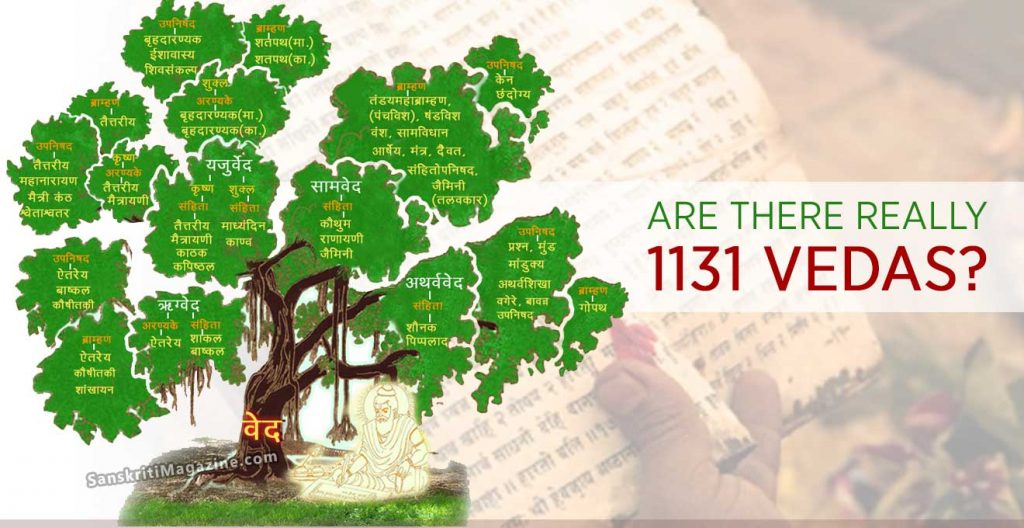
“According to the Mahabhasya of Patanjali, there were 21 Shakhas of Rigveda, 9 of Atharvaveda, 101 of Yajurveda (86 of Krishna Yajurveda and 15 of Shukla Yajurveda, according to later authorities) and a 1000 shakhas of Samaveda. All these add to give the figure 1131.
By Akhila Padhi
However, out of these 1131 Shakhas, only 11 Shakhas remain available. As far as Rigved is concerned, only one Shakha, Shaakal Shakha alone remains available out of the 21 that existed at one time. Another shakha that may have survived is the Bāṣhkala, although this is uncertain. Out of the 101 Shakhas of Yajurveda, only 6 are available. In fact, Yajurveda is classified broadly into Shukla Yajurveda (White) and Krishna Yajurveda (Black). Shukla Yajurveda is also known as Vajasaneyi. The Vajasaneyi Samhita has forty chapters or adhyayas and there are two extant Shakhas of Shukla Yajurveda viz. Kanva and Madhyandina.
Krishna Yajurveda has 4 extant Shakhas viz.
- Taittirīya
- Maitrayani
- Kaṭhak
- Kapiṣṭhala
There are three surviving Shakhas out of 1000 of the text of the Samaveda Samhita:
- Kauthuma Shakha is current in Gujarat, Uttar Pradesh, Orissa and since a few decades in Darbhanga, Bihar,
- Jaiminiya in the Carnatic, Tamilnadu and Kerala,
- Rāṇāyanīya in the Maharastra.
Out of the nine Shakhas of Atharvaveda, only two have survived
- Paippalāda, in regions south to Narmada river
- Shaunakīya, in regions north to Narmada river”
Reading the above for the first time with out any back ground knowledge of Vedas, one will reach at the conclusion that a vast portions of vedas are lost some where. Some even think in this line. They believe there were 1131 vedas of which only 21 are available.
But everywhere we learned that there are only four vedas. How there can be 21 vedas then ?
In the previous blog “What is the total number of Vedas (http://akhilapadhiblogs.blogspot.com/2011/11/what-is-total-number-of-vedas.html), we read how the Vedas originated. There it is clearly mentioned that the Vedas are four in number.
Later we came to know that these four vedas were taught to four Rishis who spread the knowledge generation after generations through oral tradition. So the number of vedas being 3 or 21 or 1131 is nothing but a myth.
To understand better, we need to know the Vedangas. There are six vedangas –
1. Sikhshya : Siksha deals with phonetics, the pronunciation and accent. It explains how each syllable should be pronounced in which context and the psychic effects of those. There are two variations to plain pronunciation, called Udatta and Anudatta. Altering the pronunciation alters the meaning of what is being chanted and the results of chanting. Important to preserve each and every syllable of Vedas.
2. Chhanda : Chandas is the science of metres. Syllables are classified into two categories, Guru and Laghu. A string of Guru-Laghu sequence of a particular length is called a metre. There are various metres in which the Vedic mantras are composed, such as Gayatri, Anusthup, Trishtup and Jagati. The chandas of a mantra determines its usage, such as its purpose and context. But it acts more as an error-correcting mechanism. Since the Veda is an oral tradition, any aberration in the chandas because of error in text or the swara, can be easily identified and corrected. Important to check the errors in reciting the Veda mantras.
3. Vyakarana : Vyakarana is Grammar. Panini’s Astadhyayi is the authority on Sanskrit Grammar. It was not written in Sanskrit but Panini used a meta-language called Upadesa to define the grammar of Sanskrit in about 8000 sutras/rules. Text: Panini’s Astadhyayi. Important to understand the literature of Vedas
4. Nirukta : Nirukta is the science of etymologies. It explains the word-roots and derivation of meanings of words in different contexts. Text: Yaska’s Nirukta. Important understand the meaning of veda mantras
5. Jyotisha : yotisha is the science of shining objects – astronomy. Text: Lagadha’s Vedanga Jyotisha. Important to mark the period and dating of events.
6. Kalpa : Kalpa speaks of the ritual portion, how and when sacrifice is to be conducted. Texts: Kalpa Sutras, consisting of Sulba Sutras and Srauta Sutras. Sulba Sutras contain the geometry of altars along with mathematical deductions for the geometry. Srauta Sutras contain guidelines for conducting sacrifices. Important to follow the vedic principles so as to get maximum benefit.
We saw above, the Shikhya and Chhanda Vedangas are important to preserve the vedas. Pratishakhya is a school of Shikhya Vedang, those are concerned about preserving the sancity of Samhitas by way of neutralizing the specifics or pronounciations based on dialects. Pratishakhya was not about laying down grammatical rules but about conjugation and declension and principles of formation of words.
Lets start from the Pratishakhya of Rig Veda, prepared by Shaunak. The “Anukramani” (Indices) of Shaunaka shows 1017 hymns of Shakala Samhita and 1025 hymns in Bhaskal Samhita.
When the Shakal Samhita was codified and Samhita section was completed, the final was 1028 hymns (Additional 11 hymns).
Again, the hymns of Shakal and Bhaskal Samhita match to each other hymn by hymn.
So, in reality, Shakal and Bhaskal Samhitas are not two different branches of Rig Veda, rather two different set of collection of hymns of Rig Veda. This may be understand better as the same text published by two Publishers.
Here we reached at a conclusion that, the Shakas of Vedas are not different pages of Vedas, rather different modes of presenting the same Veda.