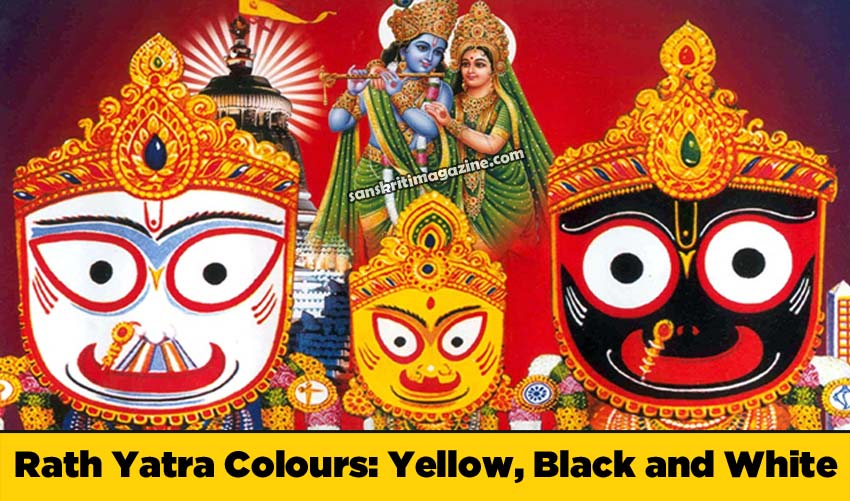
In the Puri Shree Jagannath Temple, the presiding deities are three siblings: Lord Jagannath, Devi Subhadra and Lord Balabhadra.
On Rath Yatra day, the three siblings come out of the Shreemandir, to embark on a journey to visit their parents at the Gundicha temple, about three kilometers away. The rationale behind this is yet unclear. The temple of the two brothers and the sister is named after the consort of Lord Jagannatha, Lakshmi, who is also referred to as Shree.
One often sees a picture of Vishnu, sleeping on the Shesha Naga and served by Lakshmi in the mythical Vaikuntha Dham. Jagannath represents Vishnu and Balabhadra the Shesha Naga. In the Ramayana, the three went to the forest together as Rama, Lakshmana and Sita. In the mythical Dwapara yuga, however, there is no such account of the three embarking on a journey together. In that age, Krishna represented Vishnu, except that the former married several women and loved a multitude of damsels (the gopikas). Krishna perhaps did not want to invoke the wrath of his wives by going on a journey with brother Balarama and Rukmani, considered as the incarnate of Devi Lakshmi. In Dwapara, Krishna and Balarama together undertook a journey to Mathura to kill their tyrant uncle, Kamsa. In order to justify his romance with many, Krishna revealed to Arjuna, husband of Devi Subhadra, that He represented many in One.
The deities in Puri are painted in three different colurs: Jagannath is black, Balabhadra white and Subhadra, yellow. From science we know that white light is dispersed into seven colours and yellow is one of them. However, black is not a part of this. Hence it is distinct. It is unfathomed. In other words, Lord Jagannath is beyond all understanding and probes. All colours have finite wave lengths, implying that these are in the limits of measurement. Black does not have a wavelength, and hence beyond all measure.
Black is dark, implying absence of knowledge. Lord Jagannath is beyond all knowledge. Dark is ferocious. Thus Jagannath represents the all devouring annihilator, the Kala. In the Bhagwad Gita, Arjuna sees that the entire universe rushes into the darkness of the mouth of that all pervading entity and vanishes there. Dark is mysterious. Jagannath is more mysterious than mystery itself. Hence He is called Mayadhara, the mysterious among the mysteries.
Ram means the full moon, the bright light in the dark sky. Balabhadra is strong but gentle. He is as clear as the full moon which is bright and white. While Krishna is the mysterious incarnation of Vishnu, Balabhadra or Balarama is the non-mysterious manifest of Vishnu and transparent-absence of mystery. He is knowledge and thus either precedes the mystery or follows it. In Treta yuga he followed Vishnu as Lakshmana and in the Dwapara, he preceded Vishnu as Balarama. In Rath Yatra he precedes Jagannath in all respects.
Subhadra is yellow. Yellow means joy and happiness. Indeed Subhadra was much younger to Balarama and Krishna and was born after the wicked Kamsa’s demise. Yellow is a particularly important colour for physicists. Yellow light coming out of a sodium lamp can show bright and dark fringes in an interference experiment. Yellow represents a single colour, while white light is a combination of several colours and thus unable to show bright and dark fringes. Thus Subhadra represents the essence of both Jagannath and Balabhadra and hence is well protected by them.
~ by G S Tripathi