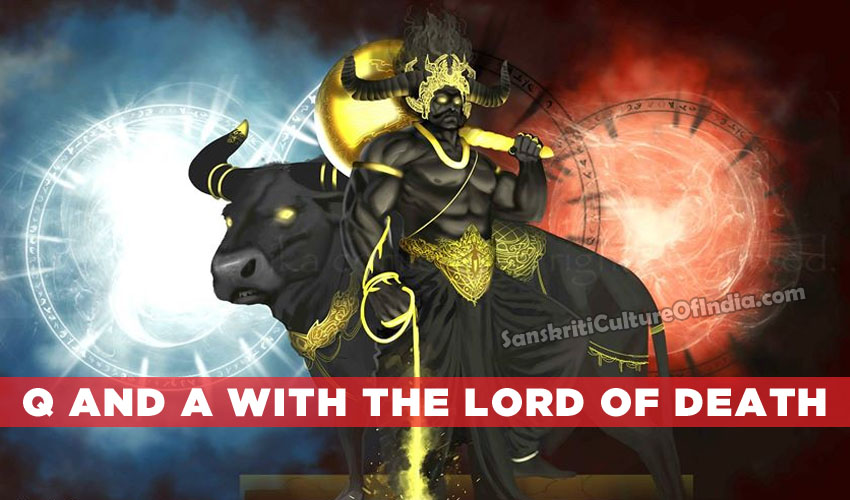
The Indian spiritual traditions are replete with dialogues, Q&As and rhetoric on truth. Even in the great epic Mahabharata we find many accounts of reasoning and inquiry where application of dharma is discussed. The Yaksha Prashna in the Mahabharata is one such section where we find a famous Q&A (question and answer) session between Yama the Lord of death and the wise King Yudhistir. In this Q&A we find 123 pointed questions by Lord Yama in a rapid-fire style to which the righteous Yudhistir answers in a crisp and insightful way covering many aspects of applied DHARMA.
The story is set up at the end of twelve years of exile of the five brothers Pandavas in the forest in the great Mahabharata. The episode is in the book of the forest (Aranyaka parva) where Yama the Lord of Death and Justice comes in disguise as a Yaksha (a nature spirit) to test the mettle of the dharmic King-in-exile Yudhistir. The test is quite rigorous and the situation is deadly. The episode brings out the core teachings of dharma which is the ‘Summum Bonum’ of all existence. This dialogue called the ‘Yaksha Prashna’ (questions by a Yaksha) is quite popular and oft quoted to validate righteous actions.
Why is Yaksha Prashna popular?
The Q&A covers a wide range of aphorisms on rightful conduct, relationships, piety, duties, religiosity etc. The account is more like a Chief Justice of Supreme Court interviewing a brilliant practicing lawyer who has a reputation for righteous conduct and cause for justice. The Chief Justice here is Yama who presides as the God of Death who rules according to the principles of dharma. The dharma practitioner is King Yudhistir who has established himself as an embodiment of dharma with an unsullied reputation of being righteous to the core. This episode gives us insight into what dharma means and how it can be applied today. While the context story for this dialogue is quite interesting, the wisdom that comes out of the Q&A is the real reason for the story.
To make the long story short…
When the five brothers (Pandavas) were living in the forest, a stag took away the fire making sticks from the sage’s home in the forest in its antlers. The saint requested the Pandavas to recover it. The Pandavas followed the hoof marks of the deer throughout the day and reached deep in the forest. Yudhistir the eldest of the Pandavas becomes tired and thirsty and wants some water. Sahadev the youngest brother spots a lake nearby. The lake was bare of any living beings except a crane.
When Sahadev is about to drink water from the lake, the crane speaks, “Oh Sahadev, the water of this lake is poisonous, if you drink it without answering my questions.” Sahadev ignores, drinks the water and dies instantly. The three other brothers of Yudhistir do the same and die. Seeing his four brothers missing, Yudhistir comes in search and seeing his brothers dead by the lake he too tries to fetch the water for their last rites. The crane warns Yudhistir and so he agrees to answer the questions of the crane. Before asking the questions, the crane reveals itself as a Yaksha. All the questions asked by the Yaksha get satisfactorily answered by Yudhistir and the brothers get revived. Then the Yaksha reveals his true being as Yama the Lord of death. (So the Lord of death and justice starts with a crane (baka) form, then changes to a Nature Spirit-Yaksha and then returns to the original form of Yama).
A sample of the rapid-fire Q&As…
In the Yaksha Prashna, Yama asks Yudhishtir 120 odd questions and here is a selection of these Q&As. Some of the answers are not that straightforward and needs a Guru to explain the import of it all.
- Who makes the sun to rise and ascend in the skies? Who moves around the Sun? Who makes the sun set in the horizons? What is the true nature of the Sun and where is the sun established?
Yudhishtir answers: Brahma makes the sun rise and ascend. The Gods perambulate about the Sun. The dharma sets the Sun. Truth is the actual Sun and the Sun is established in truth only.
- What instils ‘divinity’ in Brahmanas? What is the quality of virtuosity in a Brahmana? What is the humanlike quality of a Brahmana? What is the conduct akin to a non-virtuous person in a Brahmana?
Yudhishtir replied: The self-study of the Vedas is divinity in a Brahmana. Penance is the quality like a virtuous person in a Brahmana. Death is human-like quality in a Brahmana. Criticising others is conduct in a Brahmana like a non-virtuous person.
- What is heavier than earth, higher than heavens, faster than the wind and more numerous than straws?
Yudhishtir: One’s mother is heavier than the earth; one’s father is higher than the mountains. The mind is faster than wind and our worries are more numerous than straws.
- Who is the friend of a traveller? Who is the friend of the householder? Who is the friend of one who is ill and one who is dying?
Yudhishtir: The friend of a traveller is his companion. The friend of the householder is the wife. The physician is the friend of one who is sick and a dying man’s friend is charity.
- What is that which, when renounced, makes one lovable? What is that which is renounced makes happy and wealthy?
Yudhishtir: Pride, if renounced makes one lovable; by renouncing desire one becomes wealthy; and to renounce avarice is to obtain happiness.
- What enemy is invincible? What constitutes an incurable disease? What sort of man is noble and what sort is ignoble?
Yudhishtir: Anger is the invincible enemy. Covetousness constitutes a disease that is incurable. He is noble who desires the well-being of all creatures, and he is ignoble who is without mercy.
- Who is truly happy? What is the greatest wonder?
Yudhishtir: He who has no debts is truly happy. Day after day countless people die. Yet the livings wish to live forever. O Lord, what can be a greater wonder?
~ Ram Lingam blogs his insights on India and Indian culture at India Sutra