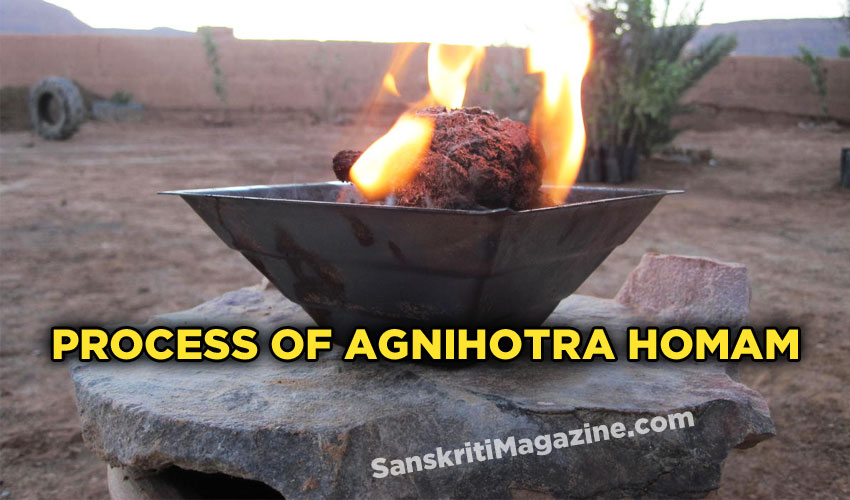
The process of Agnihotra consists of making two offerings to the fire exactly at the time of sunrise & sunset along with the chanting of two small Sanskrit mantras.
The offerings consist of two pinchfuls of uncooked rice grains smeared with a few drops of cow’s pure ghee. The fire is prepared out of dried cowdung cakes in a small copper pot of a semi-pyramid shape. The positive effects of Agnihotra are an outcome of simultaneous functioning of many subtle scientific principles such as, effect of chanting of specific sounds on the atmosphere and mind, energies emanating from the pyramid- shape, nutritional effect of burning of medicinal ingredients and the effects of bio-rhythms etc .
Agnihotra balances the cycle of nature and nourishes the human life. It creates pure, clean and medicinal atmosphere. It cleanses the negative effects of pollution.
Agnihotra is for purification and healing of the atmosphere. The atmosphere in which we live today is polluted in all respects. Many complex problems which the world witnesses today have their origin in pollution.
In today’s polluted atmosphere, we witness Mass Destruction of forests, Disappearance of many species of plants, animals, insects, birds, Disturbance in Ecocycles, Ozone Depletion, Golobal Warming, Acid rain and Decreasing Agricultural Production. Human health is at stake. Many killing diseases like Cancer and AIDS are on the rise. Increased alcoholism and drug abuse is a great challenge. Human mind is under great stress giving rise to more violence and many complex family and social problems. The list is unending.
For the practice of Agnihotra a few disciplines are observed:
- Agnihotra is performed exactly at local sunrise/sunset timings.
- A semi-pyramid shaped copper pot has to be used.
- A small fire prepared using dried cow dung cakes.
- Two pinchfuls of uncooked rice grains smeared with few drops of cow’s ghee are offered in fire.
- Two simple Sanskrit mantras are chanted while offering.
The Sunrise and Sunset Mantras:
In the morning exactly at sunrise the offerings are made with the Mantras: (While meditating on the divinity viz Soorya)
1. ‘Sooryaya Svaha Sooryay idam na mama’
2. ‘Prajapatye swaha. Prajapataye idam na mama’ (God or divinity of creation)
And in the evening exactly at the sunset the offerings are made with the mantras:
(While meditating on divinity fire-god.)
1. ‘Agnaye swaha. Agnaye, idam na mama’
2. ‘Prajapataye Swaha. Prajapataye, idam na mama’ (God or divinity of creation)
Effects of Agnihotra:
The positive effects of Agnihotra are an outcome of simultaneous functioning of many subtle scientific principles, such as, effect of chanting of specific sounds on the atmosphere and mind, energies emanating from the pyramid- shape, nutritional effects of burning the medicinal ingredients, effects of the bio-rhythms etc. Agnihotra balances the cycle of nature and nourishes the human life. It creates pure, clean and medicinal atmosphere. It cleanses the negative effects of pollution.
Published with the kind permission of Prof. H.G. Ranade
Prof. H.G. Ranade, Ex-Editor and Coordinator of the “Sanskrit-English Encyclopaedic Dictionary of Historical Principles” at the Deccan College, Pune, had the honour of completing his education with first class throughout at the Benaras Hindu University (1955-61) and did his Ph.D. on A Study of the Satapatha Brahmana as a Commentary on the Vajasaneya Samhita from the University of Bombay in 1970. Being in the profession of teaching and research, he has developed a special liking for Vedic ritual, the tradition of which is dwindling day by day.
After completing his first English translations of the Katyayana- and Asvalayana- srautasutras (published in 1978, 1983-86), he prepared a critical edition of the Latyayana-srautasutra with its first English translation under the auspices of the IGNCA (published in 1998). He also regularly attended the performances of important Soma-sacrifices in India and later delivered lectures on Vedic rituals abroad discussing problems therein with noted scholars.
Enriching thus his knowledge of the Vedic ritualistic terminology through participating in the Vedic sacrifices, he purposefully devoted himself to the compilation of this Illustrated Dictionary of Vedic Rituals, his magnum opus, which is going to be a landmark in the history of the Vedic scholarship. For his outstanding contributions towards facilitating the understanding of the Srautasutras, he was honoured as a “Vedanga-Vidvan” by the Rashtriya Vedavidya Pratishthan. At present, he is engaged in preparing a critical edition of the Jaiminiya-brahmana with its English translation as a project of the IGNCA.