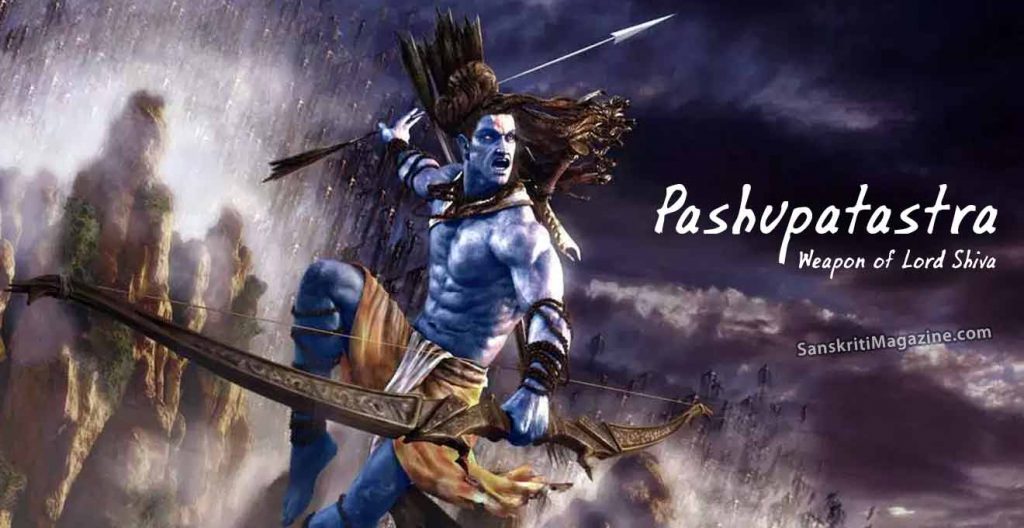
Lord Shiva and his close association with the mighty weapon – Pashupatastra.
Throughout history lord Shiva is reckoned for his temper. This is one of the reasons that he is considered to be the destroyer in the holy Hindu Trinity. The usually calm and composed Lord Shiva is also known for his rage. Once in that frame of mind he doesn’t bother about the world and the result is complete devastation. The Pashupatastra, a powerful weapon is also quite similar. And how is it similar?
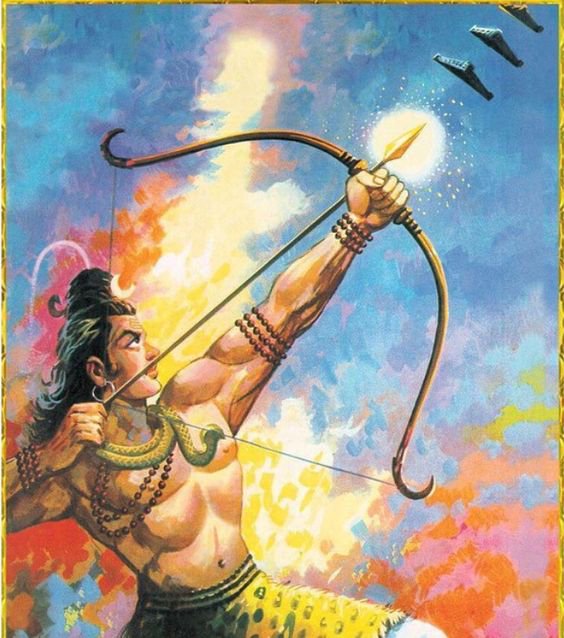
The pashupatastra is believed to be one of the most powerful and fierce weapons throughout Hindu history. It was a weapon of Lord Shiva and goddess Kali and was discharged by the mind, the eyes, the words or a bow. The power of the pashupatastra was such that it was forbidden to be used against lesser enemies or lesser warriors. This weapon is capable of immense carnage and overpowering all beings. Therefore it is advised that the pashupatastra should not be used. This dominant weapon is an important aspect of the Pashupatinath temple which is located in Kathmandu, Nepal. The Pashupatinath temple is believed to be one of the most popular Shiva temples of the world.
No known warrior has ever used this mighty weapon, but there is a story on how Arjuna got the possession of this weapon. The epic Hindu text – Mahabharata mentions that Arjuna took this the pashupatastra from Lord Shiva, but never used it. Arjuna was in exile for 12 years because of his interference in the privacy of his elder brother. During this time Vyasa advised Arjuna to obtain the Divyastras (the celestial weapons) for the coming up war. That’s when Arjuna decided that he would pray to Lord Shiva and seek this weapon. An asura (demon) – Mukasura disguised as a pig tried to kill Arjuna. Since Arjuna was praying he didn’t have any weapons handy, so to prevent himself he fired arrows onto the pig.
The pig takes him deep into the forest and the tussle continues. Frustrated of all the efforts, Arjuna finally takes an arrow and shoots the pig. At the same instant another arrow hits the pig. This arrow was supposedly shot by a tribal called Kiraata. Realizing that the tribal is way stronger than him, Arjuna decides to ask Lord Shiva for help. He decorates a Shiv Lingam with sandalwood tilak and a garland. The Kiraata comes from the bushes. Arjuna sees a sandalwood tilak on his forehead and a garland around his neck. He realizes his mistake and asks for forgiveness. Lord Shiva is impressed with Arjuna’s devotion and gives him the pashupatastra that he can use for the war against Vishwathama.
It was said that the pashupatastra was reusable ‘n’ number of times and if it is used against a mortal enemy the entire world would be destroyed. Thus, Arjuna refrained from using it.
But there is a version of Ramayana which states the use of the pashupatastra by Lakshmana against Meghanada.
According to the Kurma Purana, in the battle between the Purusha and the demonic forces, the Narsimha (half man – half lion) avatar of Lord Vishnu escapes the powerful pashupatastra. The Kurma Purana is one of the 18 Mahapuranas which is narrated by Lord Vishnu. The weapon didn’t cause any harm to anyone because its primary aim is to uphold Dharma or faith. As mentioned earlier it can be used ‘n’ number of times, provided it is not being used against a lesser enemy.
The mantra to obtain the weapon is sealed by Lord Shiva so that it cannot be misused under any circumstances, especially in the Kali Yuga. The pashupatastra can be neutralized only through another pashupatasra or any other astra (weapon) whose presiding deity is Lord Vishnu.
The pashupatastra teaches a lesson of life – if damage is done, it cannot be reversed. Thus, we should think about our words and actions before, rather than being sorry later. Words are one of the strongest weapons and give wounds that even time cannot heal. Whether it is our life or the pasupatastra, stability and patience are the key attributes that would enable us overcome enmity and annoyance!