Every yajna is special. Somehow this one seemed extra special. There was a particular peace in the ashram from the moment of arrival.
After days of travelling in planes and trains, the movement was over and a stillness began within. Perhaps the contrast with the outside world was more stark than ever. I had left an Australia beset with worry and fear amidst its plenty. Its government, media and people can no longer deny the reality of global warming as a seemingly endless drought leaves communities without water and farmers with failed crops and animals they cannot feed. A sense of sadness and confusion is spreading as we wake up to this most ‘inconvenient truth’. The ‘war against terror’ dims in the light of this overdue realization of what we ourselves have done. I stepped out of that hard world with its desperate edge, and into Rikhia. Here the feeling was of an eternal and indestructible stability and quiet. The presence of the gurus was tangible, as if it could be held in one’s open hands.
The days before the yajna are days of arrival. Into this remote, faraway place come people from everywhere. They come from countries you have never heard of and countries you had forgotten about. They come from all the continents, in groups and alone. Each night under my window the Bulgarians gathered, equipped with voices and a drum. Their kirtan filled the darkness with a bright, joyful energy. “The Bulgarians are in demand,” I was told. “Their reputation as workers has outstripped the Australians.” And indeed they seemed to function as one, their spirit strong with yajna. During this time, I spent just one day in the accommodation team, surrounded by loaded phrases like, “The Greeks are here. The Italians are here.” With the coming of these large groups the numbers swelled and the yajna was very close.
My new job was photography. Through the lens and through my body I experienced the event. My mind was left to follow as best as it could.
On the first morning Swami Satyananda was there. And also on the second, third, fourth and fifth. He was there the whole time, laughing, dancing, singing, chanting, giving satsang, mixing with the children, having a word with old friends, relaxed and happy, wise and seeing. As the prasad distribution went on day after day, the feeling of his great sankalpa, for peace, prosperity and plenty for all, was shown to us in all its dynamism. His example was before our eyes as thousands received the prasad of Devi: practical things, especially clothing, to ease our lives.
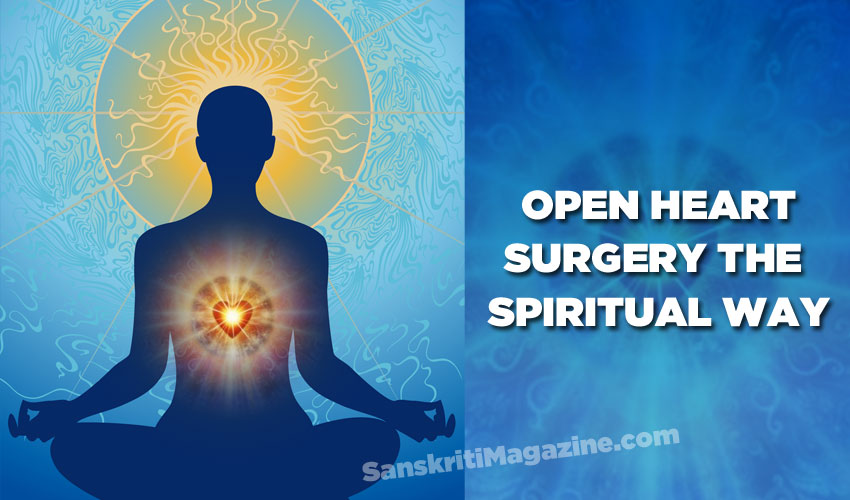
In his ‘open heart surgery’ satsang he put the message very clearly. Clean out your arteries, we were told. You all need open heart surgery. The arteries are blocked. Your hearts are blocked. I am the heart surgeon, I will open your hearts and then your cheque books will also open. Only when you give freely will you want for nothing.
The scalpel was wielded with skill and precision. The vision of the kanyas and batuks was that scalpel. They were everywhere, managing the whole event with discipline and care. Children who live in simple huts of mud and straw coordinated this massive event efficiently and smoothly, from the chanting to the tilak. They were even Swami Niranjan’s minders. Gone were the giant bodyguards of past years. In their place were small boys, linking arms around him if the crowds swelled too close. It was a circle of thin arms that could not be broken.
On the kirtan stage the girls sang and chanted hour after hour. And as the kirtan built, other children jumped up to dance. Soon the whole stage would be filled with their quick, rhythmic movement. Paramahamsaji would stand up on his chair and dance along with them. Swami Satsangi became one of them as she joined them on stage, her face beaming, arms waving, body swaying. Meanwhile, Swami Niranjan kept the crowds involved, moving amongst them, clapping them into life and pumping up the energy. These were magic moments.
From the vedi the chanting of the pandits struck the air, and the heart surgery continued with the scalpel of mantra. Around them the one thousand pathis sat, heads down, fingers following the mantras line by line, concentrating on the chant, the rhythm, the flow. Each day the pandits made a new form of Devi, and each day the children were given new clothes to wear also. They were the channel for that energy – dynamic, alive and right there amongst us.
Sometimes I felt I was among rivers of people. Many different things were often happening at once. Moving lines of prasad distribution; moving lines of pathis or Indian nationals or kanyas or batuks circling the vedi; lines, lines, lines, moving simultaneously, curving around each other, ceaselessly flowing, rivers of people, all guided and kept in order by the children. Movement and colour and sound blended into one form.
The final day of yajna is many hued. During kanya pooja the kanyas are worshipped with food and blessings. Swami Satyananda explained that they are only kanyas up to the age of twelve. The older girls are not included in the pooja, though they are otherwise fully involved. And the boys, he said, are not for worshipping. Following this pooja was havan, with Swami Niranjan and the pandits making fire using friction. This havan continues for several hours, culminating with the sacrifice of a pumpkin dramatically cut with a sword. Finally there is Sita Kalyanam, the marriage of Sita and Rama, symbolizing the uniting of energy and consciousness, reminding us of that essential, timeless merging.
Five days of energy, brilliance and activity are over. The masses move out and the dismantling is swift. At the completion I searched for some words to help hold on to the experience. The words that came were simple ones. Joy. Happiness. Fulfilment. Love. Words, I hope, that indicate some success in Paramahamsaji’s operating theatre.
~ Swami Ahimsadhara Saraswati