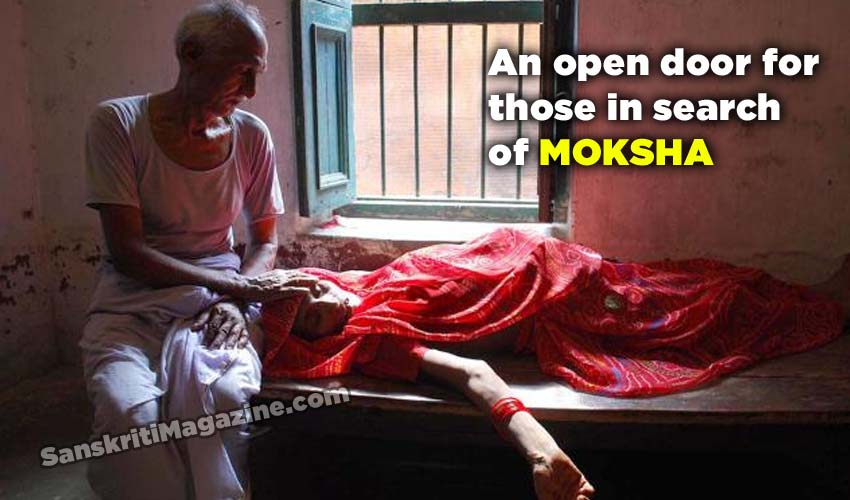
In one of the many narrow bylanes of the historic city of Varanasi is a special home where people come to die so that they can attain ‘moksha’ or salvation. “For over six decades now, thousands of people from across the country have come to this city of Lord Shiva where the entry of Yamraj or the God of death is not allowed … As per Hindu mythology, those who die here go to heaven. We at this ashram ensure that they die in peace,” says Mahant Bhairav Nath Shukla, priest and caretaker of ‘Moksha Sadan’.
Started by the industrialist Dalmia’s family in 1958 as a trust, ‘Moksha Sadan’ near the Goudoliya crossing in the heart of the city is now being run through a Delhi office, while Mahant Shukla takes care of the two-storey building comprising over a dozen rooms and also the needs of those who come to live here before leaving for their final journey.
Mostly it is the poor people of eastern Uttar Pradesh, Bihar, Jharkhand and West Bengal and even neighbouring Nepal who come here to spend last days of their lives. “People have come to know about this place through word-of-mouth publicity. They call us at 0542-2410984 to inform us before moving in,” Shukla adds.
On an average, the ashram records 10 deaths every month. “We have simple rules. We give people free space to live but they have to share electricity charges. A person should be above 60 years to live here and accompanied by his family members to take care of his/her daily chores. Generally we do not allow a person to stay after 15 days, but sometimes we have to make exemptions. We take care of all their needs, including medical care, if required. And after death, we also arrange for last rites, if so desired by the family of the deceased,” says Mahant Shukla, who has been serving at the ‘Moksha Sadan’ for almost 45 years now.
“Over the years I have seen many changes taking place in the ashram … Earlier, music cassettes used to play devotional songs, which were later replaced by CDs and now we have pen drives. But we still go to a dying person three times a day and sing bhajans in front of him/her, or read the Ramayana or other religious texts…We follow strict religious decorum at the place,” he adds.
All the Moksha Sadan’s activities are funded by a corpus set up by the Dalmia family.
~ Sandeep Joshi