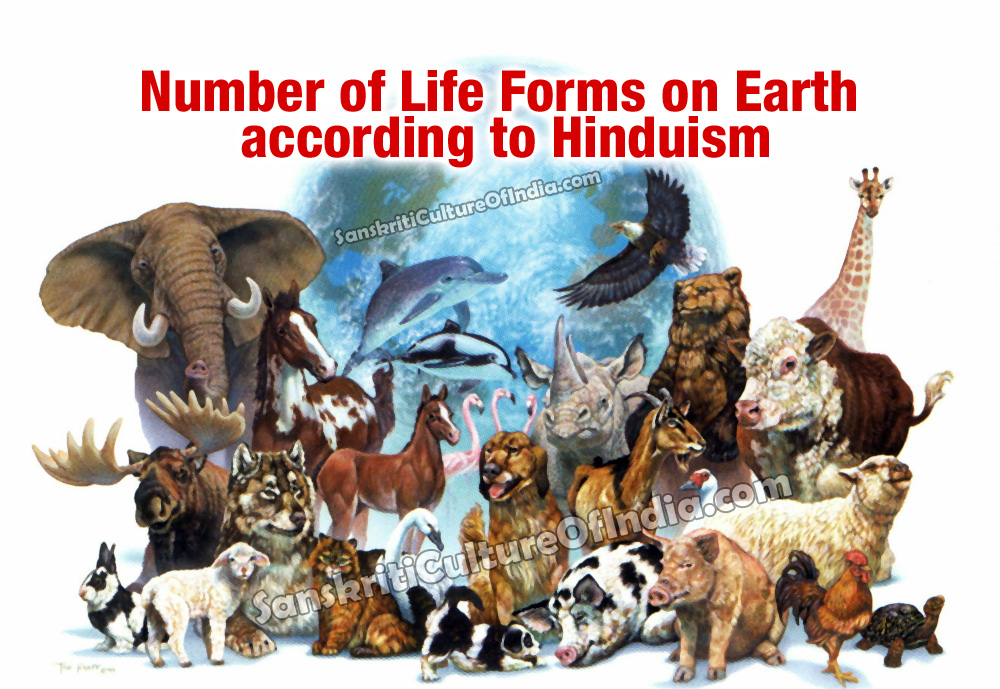
Modern biologists today can list and name around 1.3 million species of life forms on planet earth. But modern biologists also agree that this number is a significant underestimate of the actual total number of species on this planet, so millions of species and life forms are yet to be identified, named, listed and studied. Even today every year around 15,000 new species and life forms are discovered which keeps adding to the number of known species mentioned above. For centuries Taxonomists around the world have been trying to get an approximate definitive figure about the total number of species on Earth and to list them all. Now let us see what the ancient Hindu scriptures have to say about the total number of species on planet Earth.
Ancient Hindu Texts on Total Number of Life Forms
Bhagavad Gita
The ancient Hindu text Bhagavad Gita which dates back to the times of Mahabharatha says in (2.22) that just as one gives up an old shirt to put on a new one, the soul gives up an old body to acquire a new kind of a body (vasāmsi jirnāni yathā vihāya). And that a soul can be born as any of the 8.4 million species on this planet one of which is humans, the greatest of all life forms. Since being born as a human is such a rare opportunity, one should make complete use of this human life, and devout one’s lifetime to do good things, earn knowledge, help others, serve the society and try to attain moksha (salvation).
What is quite obviously hidden in this message is a statement which says that there are 8.4 million different life forms on this planet!
Padma Purana
Another ancient Hindu text Padma Purana which is also a contemporary of Bhagavad Gita not only says that there are 8.4 million different species on Earth, but also goes a step ahead and categorizes or classifies them as follows.
Jalaja (Water based life forms) – 0.9 million
Sthavara (Immobile implying plants and trees) – 2.0 million
Krimayo (Reptiles) – 1.1 million
Pakshinam (Birds) – 1.0 million
Pashavah (terrestrial animals) – 3.0 million
Manavah (human-like animals) – 0.4 million
8.4 million life forms in all! The actual Sanskrit verse from the Padma Purana explaining the above numbers is as follows:
jalaja nava lakshani, sthavara laksha-vimshati, krimayo rudra-sankhyakah, pakshinam dasha-lakshanam, trinshal-lakshani pashavah, chatur lakshani manavah
In other words these 5000 year old texts are not only suggesting that there are 8.4 million species or 8.4 million different life forms on earth, but have also categorized them!
Total Number of Life Forms estimated by Modern Science
As late as Aug 2011, a detailed study “estimated” (not discovered them all, but only calculated using a detailed mathematical analysis) the total number of species on planet earth to be around 8.7 million, plus or minus 1.3 million. Read this article on The New York Times, How Many Species? A Study Says 8.7 Million, but It’s Tricky. What this means is that around 7 million species or life forms are yet to be discovered and cataloged! Also please note that it doesn’t have to be exactly 8.4 million species even today, because biodiversity on earth has changed in the past few thousand years with climate change, mass extinction, etc. Irrespective of whether the final number ends up near 8.4 million or not, this gives us a lot of insight into the scientific and analytic capabilities of our ancestors and proves that the ancients were as equally scientific tempered as the scientists of our age. Please note that the numbers quoted above are from texts which are atleast 5000 years old, a period which modern science says belongs to “Stone Age” !?
Look at the striking resemblance of the number 8.4 million life forms mentioned in the ancient Hindu scriptures, and the new number “8.7 million, plus or minus 1.3 million” arrived at using modern scientific analysis and decide for yourself. Be careful the next time you chose to ignore a number or a statement in an ancient text as myth or irrelevant.
Remember these lines from the 500 year old kannada dasara pada?
“ಎಂಭತ್ತ್ನಾಲ್ಕು ಲಕ್ಷ ಜೀವ ರಾಶಿಯನ್ನು ದಾಟಿ ಬಂದ ಈ ಶರೀರ…” which means that our human body evolved out of 8.4 million species.
Who said there is no science in spirituality, and who said that the ancients knew no science. They knew better than us, ain’t it?
~ Gurudev