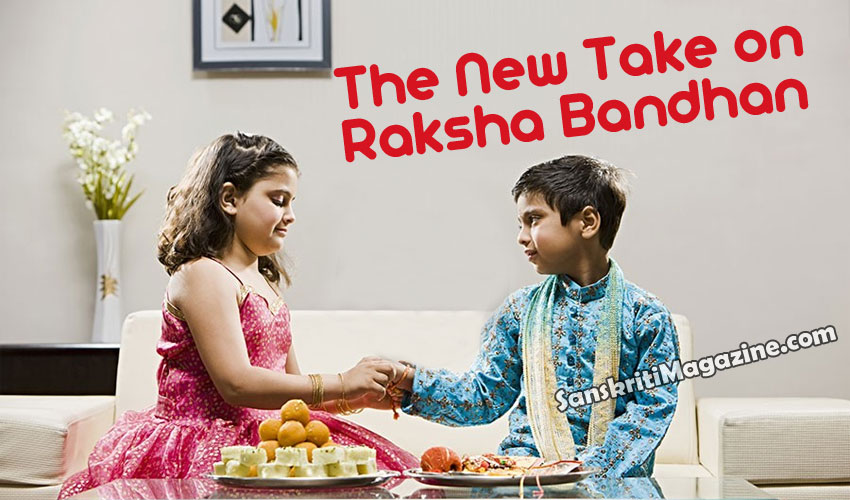
A young boy of a middle class family, all of 5yrs, is sitting on a chair in the drawing room of his parents’ modest apartment. He’s wearing a crisp and well fitting pyjama-kurta brought specially for the occasion of Raksha Bandhan. In the pocket of his kurta he safeguards an envelope with some content of cash. Proudly sporting a ‘tilak’ on his forehead, just under the Anna cap, he waits impatiently for his mother and elder sister, aged 12yrs, to get the pooja thali ready. After all today is the day his sister and he had been waiting for.
This perhaps is quite a familiar situation that we can visualize in millions of households across socio-economic sections of India. Perhaps among NRI’s too. Chances are that we may have even gone through these situations in our growing years, whether or not we had a sibling; the neighbours ‘bhaiyya’ or ‘didi’ happily filling in.
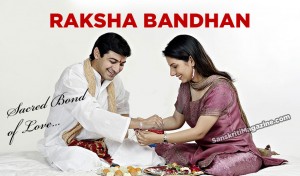
The pooja thali arrives. The older sister goes through the rituals of lighting the lamp, moving it clockwise around the innocent face of her brother and showering him with coloured rice. The boy places the envelope on the pooja thali, which the sister eyes expectantly. The ritual ends with the sister tying a rakhi or sacred thread of protection around her brother’s right wrist, signifying the assurance of protection the brother heaps upon his sister in commitment.
Wait a minute. It’s not over yet.
The boy innocently asks his sister “Didi, every morning when we walk to the bus-stop to go to school, it is you who holds my hand while crossing the road.”
“Yes, so?” enquires the sister with a tinge of irritation.
“It is you who takes care to ensure whether i’ve eaten my dabba or not, right?”
“Yes, baba! So what?” the girl looks at her mother with a quiz on her face.
“And it is you, who ensures that i have got everything back from school”. “And continues sheepishly “it is also you who speaks to the supervisor in my defence when i’m pulled up for mischief!”
“Yes, yes…now you better tell me what you’re getting at else I’m going. I don’t have time for such kid stuff”, the sister sounds an ultimatum.
“If all the time it is you who are protecting me, then why should i also not tie a rakhi to you?”
The household is stunned into silence. Each looks at the other with no real answers. The parents’ eyes turn moist. The sister laughs it off as some childish gibberish and chides him “Stupid, it is meant to be so. Now go.”
In walks grandma. “Wait a minute, Akka. Putta has raised a question for all of us to reflect upon.”
And her wisdom tumbles out. And everybody listens in rapt attention.
She continues: “It was okay in yesteryears when it was just men who had to earn and provide for the family, it was they who had to fight wars and battles and so it was their duty to protect the family. Women largely stayed at home, seldom ventured out and engaged mostly in household chores. Even i did it. So by that logic it was fine that sisters tied the thread of protection and took a vow from the brother to protect her from all harm. But now, times have changed and so should traditions that have outlived their time. The ‘wars’ to be fought are those of self and social responsibility, of economic and emotional challenges, those of equality and self-respect. Gone are the days of physical wars and masculine domination and male one-upmanship. Today, as parents you are educating your daughter as passionately so that she grows up to be self-sufficient and independent. You are empowering her into emancipation so that she will look after herself and her family where she gets married into with compassion, self-dignity and as much responsibility as her husband. While the brother is certainly expected to come to his sister’s aid, it could well be that in times of difficulty for Putta, it would be Akka who will come to his rescue. It would be a situation of mutual protection. Then what is wrong in what Putta has asked? He should be certainly allowed to tie the rakhi – the thread of everlasting protection – on Akka’s wrist too!”
Friends, give this a good and honest thought.
~Girish Deshpande
You may also Like: