Maa Skandamata
The Divine Mother Who Holds Kartikeya and the Cosmos
There is an image in the Hindu tradition that is at once completely familiar and endlessly mysterious. A mother holding her child. It is the most universal scene in human experience — found in every culture, every century, every corner of the world. And yet when we contemplate it in its divine form — when the mother is the goddess herself and the child in her arms is the commander of the celestial armies — it becomes something far greater than the familiar. It becomes a window into the nature of the cosmos itself.
On Day 5 of Chaitra Navratri, we bow to Maa Skandamata — the mother of Skanda (Kartikeya), the divine commander and son of Shiva and Parvati. In her, we do not merely worship a goddess. We worship the principle of divine motherhood itself — the force that nurtures the warrior, enables the hero, and holds the universe in the steadiest, most fearless, most unconditional embrace that creation has ever known.
The Story of Skandamata: How Parvati Became the Warrior's Mother
To understand Skandamata, we must understand the story of her son — for in many ways, she is defined by him, just as every great mother is partly defined by the extraordinary being she brings into the world and sends forward into it.
The birth of Kartikeya — also known as Skanda, Murugan, Subramanya, or Kumara — is one of the most dramatic stories in Hindu mythology, and it begins with a crisis that threatened the entire cosmos.
The demon Tarakasura had received a powerful boon from Brahma: he could be killed only by the son of Shiva. Since Shiva had been immersed in deep meditation since Sati's death, the gods calculated this was effectively immortality — for who could rouse the great ascetic from his tapas? Into this situation stepped the gods, who sent Kamadeva (the god of love) to awaken desire in Shiva. The plan partially worked — Shiva was disturbed from his meditation, and in his anger, burned Kama to ash with the fire of his third eye — but not before a seed of divine energy was released.
This seed — too powerful to be held even by Agni (fire) or Ganga (the sacred river) — was eventually received by the six Kritikas (the Pleiades star cluster). From these six mothers, Kartikeya was born with six heads, one for each mother who nursed him. Parvati, recognising her son, embraced him — and as she held him, his six heads merged into one. The warrior-god was complete.
Kartikeya went on to lead the celestial armies against Tarakasura and defeated him. And Parvati, in her role as his mother, became Skandamata — the mother of Skanda.
The Sacred Iconography of Maa Skandamata
The Lotus Throne
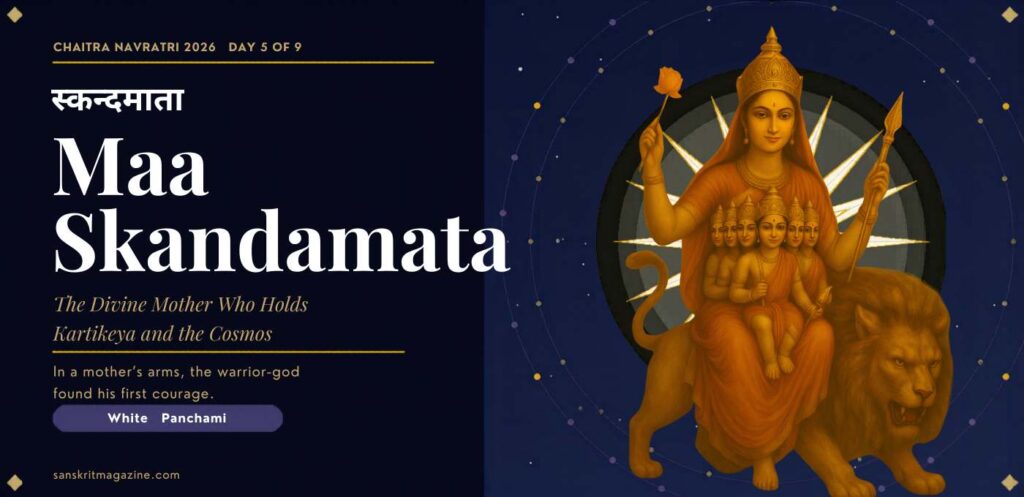
Maa Skandamata is seated on a lotus flower — the Padmasana — which is why she is also known as Padmasana Devi. The lotus throne is the seat of enlightenment, of the bodhisattva and the awakened being. That the divine mother sits on the lotus tells us that motherhood at its highest is not a limitation but a flowering — the full, open-petalled expression of the soul's capacity for love.
Four Arms
She has four arms: two holding lotus flowers, one holding the infant Kartikeya (who sits in her lap), and one in Abhaya mudra — the gesture of protection and fearlessness. The Abhaya mudra raised toward the devotee is one of the most reassuring gestures in all of Hindu iconography: it says, simply and absolutely, "Do not be afraid. I am here."
White Complexion
Skandamata is described as having a pure white complexion — the white of snow, of moonlight, of milk. White in the Hindu tradition is the colour of Sattva — the quality of purity, clarity, and spiritual luminosity. The white goddess holding her golden-bright son is a study in contrasts that reveals a deeper unity: purity as the ground from which all brilliance arises.
The Lion
She rides a lion, just as the other warrior forms of the Goddess. Even in her most tender, maternal expression, Skandamata is not passive. She is the fierce protector. Any mother who has ever felt her child threatened knows this energy: the instant, absolute, all-consuming readiness to fight that arises when what you love most is in danger.
- Form: Parvati as the divine mother of Kartikeya (Skanda)
- Also known as: Padmasana Devi (the lotus-seated goddess)
- Vehicle: Lion — fierce protection; maternal courage
- Complexion: Pure white — Sattvic purity and luminosity
- Colour worn today: White — purity, peace, divine motherhood
- Planet governed: Mercury (Budh) — intellect, communication, agility of mind
- Bhog (offering): Banana — blesses children with intelligence and health
- Chakra: Vishuddha (Throat Chakra) — expression, truth, communication
Skandamata and Mercury: The Governance of Budh
Among the Navdurga, Maa Skandamata governs Mercury (Budh) — the planet of intellect, communication, learning, agility, and commercial acumen. Mercury is the planet of the student, the writer, the trader, the scientist — anyone whose work requires clarity of thought and grace of expression.
The connection between the divine mother and Mercury is profound when understood through the lens of early childhood development. It is the mother's voice — her stories, her songs, her explanations of the world — that first activates the child's Mercury, the child's capacity for language and thought. Before any school, before any teacher, it is the mother who teaches the child the most fundamental cognitive skills: how to name things, how to ask questions, how to string words into sentences that carry meaning.
Worshipping Skandamata is said to bless devotees with enhanced intellect, improved communication skills, and success in studies and learning. Students preparing for examinations, writers working through difficult projects, and professionals who depend on clear communication are all encouraged to pray to her with particular devotion during these nine days.
सिंहासनगता नित्यं पद्माञ्चित करद्वया ।
शुभदास्तु सदा देवी स्कन्दमाता यशस्विनी ॥
Sinhaasanagata Nityam Padmaanchita Karadvaya
Shubhadaastu Sadaa Devi Skandamaataa Yashasvinee
"Always seated on the lion throne, with lotus-adorned hands — may Skandamata, the illustrious goddess, always be auspicious to me."
The Spiritual Significance of Kanya Puja: Worshipping the Goddess in the Child
Day 5's theme of divine motherhood is a fitting moment to reflect on one of the most beautiful practices of Navratri: Kanya Puja, the worship of young girls as living embodiments of the nine forms of Devi. While Kanya Puja is formally performed on Ashtami (Day 8) or Navami (Day 9), the spirit of it permeates the entire festival — and finds its most direct expression in the worship of Skandamata.
In the Kanya Puja tradition, nine young girls (ideally between two and ten years of age) are invited to the home, their feet are washed by the host family, they are seated on the altar, offered food (the traditional Halwa-Puri-Chana), gifted with new clothes or a small amount of money, and worshipped with flowers, kumkum, and prayer. Each girl represents one of the nine forms of the Goddess.
This practice carries a teaching that is as radical today as it was when it was first instituted: that every girl child is not merely human, but divine. That the divine feminine is not something confined to idols on an altar — it lives and breathes in the daughters, sisters, nieces, and students of the world. Skandamata, the goddess who holds a child in her lap, invites us to look at the children in our lives and see the divine staring back at us.
Bhog: Sacred Offering for Maa Skandamata
The traditional bhog for Maa Skandamata is the banana. Offering bananas to Skandamata is said to grant the devotee's children with intelligence, longevity, and freedom from illness. Bananas also represent fertility, abundance, and the sweetness of life's simplest gifts. They are one of the most ancient and universally beloved fruits on earth — humble, nourishing, and complete in themselves.
- Kela halwa: Mash ripe bananas, cook in ghee with sugar and cardamom until thick and fragrant — a simple, sattvic sweet.
- Banana milk: Blend a ripe banana with warm milk, a pinch of cardamom, and a drizzle of honey. Offer and serve as a wholesome Navratri drink.
- Fresh offering: Simply place five or seven ripe bananas on the altar, offer them with prayer, and distribute as prasad. Sometimes the most direct offering is the most powerful.
Why White? The Significance of Today's Navratri Colour
White is the colour of Day 5 — and in the context of Skandamata, it is perfect. White is the colour of Sattva — the quality in Vedic philosophy that represents purity, clarity, and the highest form of consciousness. It is the colour of milk, of the full moon, of the clean page before the first word is written. It is the colour of potential — not empty potential, but the rich, full, ready-to-flower potential of a mother in the moment before she holds her child for the first time.
Wearing white today is an act of opening — of clearing space within yourself for something new to be born. Skandamata's white complexion is not the white of emptiness but the white of pure receptivity — the deepest, most complete form of love, which holds without grasping and nurtures without controlling.
💕 A practice for Day 5: Today, reach out to the mother figures in your life — your own mother, a grandmother, an aunt, a teacher who mothered you — and tell them what their love has meant to you. And if you are a mother yourself, take a moment today to sit quietly and feel the magnitude of the love you carry. That love is Skandamata. It lives in you.
The Deeper Teaching: The Warrior Is Always the Child of a Mother
There is a detail in the Skandamata iconography that is easy to overlook but carries immense significance: even as she sits on the lion, even as she holds lotus flowers and raises the Abhaya mudra, she holds in her lap the infant Kartikeya — the baby who will grow up to be the most fearsome warrior-commander the cosmos has ever seen.
The warrior begins in the mother's lap. The courage that will eventually face down demons was first kindled by a mother's love. The strength that will command armies was first drawn from a mother's milk. The fearlessness that will stand between the cosmos and destruction was first learned from a mother who said, with her whole body and her whole heart: "You are safe. You are loved. You can do this."
Skandamata tells us that behind every great act of strength and courage, there is a mother's love. And that love — quiet, white, lotus-seated, unarmed and unarmoured and more powerful than any weapon — is the most fundamental force in the universe.
🙏 Jai Maa Skandamata! Wear white today. Offer bananas at your altar. Chant ॐ देवी स्कन्दमातायै नमः 108 times. Tag a mother today who is your greatest strength. And may the divine mother's love fill every corner of your life with the fearless peace of the lotus. 🪷
Published by Sanskriti Magazine — India's largest digital platform for Hindu heritage, culture, and spirituality.
Read more at sanskritimagazine.com · Follow us on Instagram & Facebook: @indian_sanskriti
Continue the journey tomorrow: Day 6 — Maa Katyayani, the fierce warrior born to destroy Mahishasura.