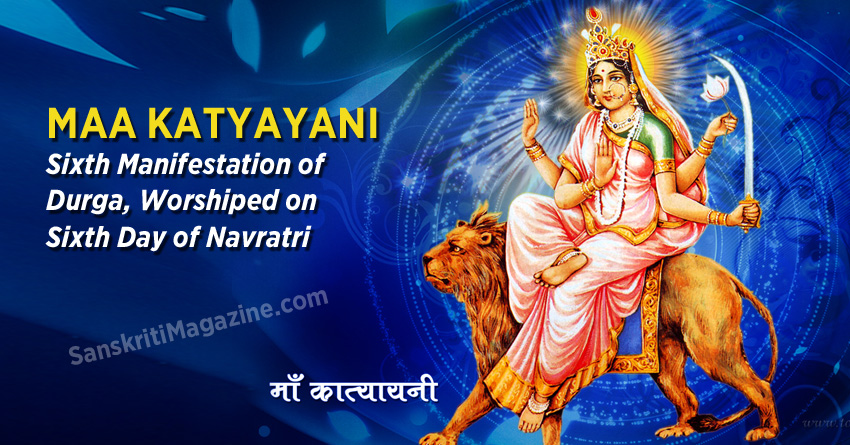
Katyayani Devi is worshipped as sixth form of Goddess Parvathi on the sixth day of the Navaratri. As per Hinduism, the form of Katyayani was adorned by Goddess Parvathi to destroy Mahishasura who was a ferocious demon. Katyayani is known to be the fiercest face of the Goddess and she is termed as the Warrior Goddess who fought against the evil and destroyed it completely. She is felicitated with various names such as Bhadrakali, Durga and Chandrika that speaks about her fearless form.
Depiction in scriptures
The Goddess appears in various Holy Scriptures as a symbol of Shakti (strength), knowledge, victory of good over evil and courage. She holds a prominent place in Hinduism and inspires devotees, especially female worshippers to face challenges and perceives the inherent strength within. One of the earliest references to Her have also been found in the Taittiriya Aranyaka part of the Krishna Yajurveda.
She is also depicted in holy texts like Devi-Bhagavata Purana, Devi Mahatmyam, a section of the Markandeya Purana. Texts attributed to Buddhism and Jainism, Kalika Purana also mention Her vividly.
Chapter 22 in the 10th Canto of the Bhagavata Purana speaks of Katyayani Vrata, where young marriageable gopis of Vrindavan would take bath in the river Yamuna and worship Katyayani. They observed a vrata throughout the month of Margashirsha to get Lord Krishna as their husband. Katyayani-vrata, a fast for a whole month is also observed and offerings like sandal, flowers and incense are made by girls to marry the person they want.
Legends associated with Katyayani
A great legend is associated with the creation of the great Goddess Katyayani. The atrocities of the demon Mahishasura were assuming gigantic proportions. So powerful and evil was he that he aimed at destruction of the earth as well as the gods. Goddess Durga (Katyayani), equipped with powers and weapons from Gods, confronted the demon to fight him. He began changing his forms, one of which was that of a buffalo. Goddess Durga sprang on the back of Mahishasura from Her lion and struck his head and killed him.
This legend has also been narrated in different ways, but the end result and the moral remain the same. The world and the gods were saved from annihilation in the hands of Mahishasura and a great divine female personality came to be worshipped devotedly.
Spiritual Beliefs:
Goddess Katyayani Devi is been paid respect in many Holy Scriptures symbolized as Goddess of Strength, knowledge and courage as she is gained victory of good over evil. She has always been worshipped by the Hindus and has a respectful place in the Hinduism. It is said that her followers always inherit inner strength while facing the society. Her presence is found in many Holy Scriptures, puranas and vedas. There are her glimpses found in the texts attributed by the Jainism and Buddhism. It is said that the worshippers specifically marriageable girls follow Katyayani Vratha for one month in order to get a husband as good as Lord Krishna. During this, the goddess is worshipped every day and sandal, incense and flowers are offered by the devotees.
It is said that the Goddess Katyayani has special place for women and girls. Thus, during Pongal in the part of Tamil Nadu, young girls pray for the prosperity of the place throughout the month. The idol of Goddess Katyayani is carved from wet sand and worshipped during these period. The Goddess said to be possessing three eyes and eight hands and is a removal of all the negative forces from the place where it is worshipped. She is also worshipped on various form in the Northern Part of India and specifically as Durga. Goddess Katyayani is remembered even in chants that are for the victory of good over evil, while starting a new business, possession of a new house and start of a new life.
कात्यायनि महामाये महायोगिन्यधीश्वरि ।
नन्द गोपसुतं देविपतिं मे कुरु ते नमः ॥
Kātyāyani mahāmāyē mahāyōgin’yadhīśvari |
Nanda gōpasutaṁ dēvipatiṁ mē kuru tē namaḥ ||
and rides a magnificent lion and destroys the demons, bestow welfare on me.
Benefits of worshipping Maa Katyayani
Devi Kanya Kumari (associated with Kanya Kumari, the southernmost tip of India, is believed to be an incarnation of Katyayani. During Pongal, the harvest festival observed in Tamil Nadu, young girls pray for abundance, rain and prosperity throughout the month. The idol of Goddess Katyayani, carved out of wet sand is worshipped, which is believed to shower upon girls whatever they ask for.
The word Katyayani also specifies the power to remove severity, pride and negative forces that befall an individual. Katyayani also implies destruction of ego that results in great struggles and sufferings of the weak. She has three eyes and eight hands, which are an inherent part of fight against evil put up by Her. Worship of Katyayani is not restricted to women alone; males too can offer obeisance to Her to win love and marriage.
Taking recourse to mantras and yantras dedicated to the Goddess are a sure way to attain love and Her blessings. Rudra Centre offers auspicious Katyayani yantras. You can place the Yantras at home, offices or on altars facing North, East or North East.Wearing the auspicious 17 Mukhi Gauri Shankar Rudraksha also invokes Katyayani.