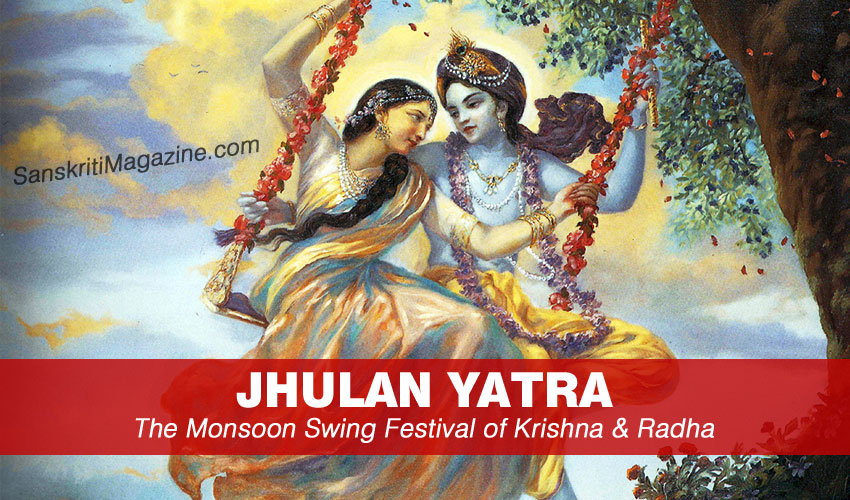
Jhulan Yatra (Aug 7th, 2014) is one of the most important festivals for the followers of Lord Krishna celebrated in the monsoon month of Shravan. AfterHoli and Janmashthami, it is the biggest and most popular religious occasion of the Vaishnavas. Known for its spectacular display of decorated swings, song and dance, Jhulan is a joyful festival celebrating the Radha-Krishna amour coupled with the romantic fervor of the rainy season in India.
Origin of the Jhulan Yatra Festival
Jhulan Yatra has been inspired from the swing pastimes of Krishna and his consort Radha during their fable romance in the idyllic pastoral groves ofVrindavan, where the divine lovers along with their cowherd friends and ‘gopis’ took part in joyful swinging in the cool monsoon season.
Jhulan Yatra has its origins in the major Krishna legends and literature such as the Bhagavata Purana, the Harivamsa, and the Gita Govinda, and the metaphor of the swing of the monsoon or ‘Sawan Ke Jhuley’ have since been used by poets and songwriters to describe the romantic feeling that permeates the rainy season in the Indian subcontinent.
The popular Krishna literature Hari Bhakti Vilasa(Performance of Devotion to Hari or Krishna) mentions Jhulan Yatra as part of the various festivals dedicated to Krishna: “…the devotees serve the Lord during the summer by placing Him on the boat, taking Him out on a procession, applying sandalwood on His body, fanning Him with chamara, decorating Him with jeweled necklaces, offering Him palatable foodstuffs, and bringing Him out to swing Him in the pleasant moonlight.”
Another work Ananda Vrindavana Champu describes the swing festival as “the perfect object of meditation for those desiring a taste of devotion.”
The Jhulan Yatra of Mathura, Vrindavan and Mayapur
Of all the sacred places in India, Mathura, Vrindavan, and Mayapur are most famous for Jhulan Yatra celebrations.
During the thirteen days of Jhulan-from the third day of the bright fortnight of the Hindu month of Shravan (July-August) until the full moon night of the month, called Shravan Purnima, which usually coincides with the Raksha Bandhan festival-thousands of Krishna devotees throng from around the world to the holy cities of Mathura and Vrindavan in Uttar Pradesh, and Mayapur in West Bengal, India.
The idols of Radha and Krishna are taken out from the altar and placed on heavily decked swings, which are sometimes made of gold and silver. Vrindavan’s Banke Bihari Temple and Radha-Ramana Temple, Mathura’s Dwarkadhish temple, and Mayapur’s ISKCON temple are some of the major places where this festival is celebrated in their greatest grandeur.
Jhulan Yatra Celebrations at ISKCON
Many Hindu organizations, especially the International Society for Krishna Consciousness (ISKCON), observe Jhulan for five days. At Mayapur, the world headquarters of the ISKCON, idols of Radha and Krishna are decorated and placed on an ornate swing in the temple courtyard for devotees to swing their favorite deities using a flowery rope while offering flower petals amid bhajans andkirtans. They dance and sing the popular hymns ‘Hare Krishna Mahamantra,’ ‘Jaya Radhe, Jaya Krishna,’ ‘Jaya Vrindavan,’ ‘Jaya Radhe, Jaya Jaya Madhava’ and other devotional songs. A special ‘aarti’ ritual is performed after the idols are placed on the swing, as devotees bring their ‘bhog’ or food offerings for the divine couple.
Srila Prabhupada, the founder of ISKCON, prescribed the following rituals to honor Krishna on Jhulan Yatra: During these five days the deities’ clothes should be changed daily, a nice prasad (food offering) be distribution, and sankirtan (group singing) should be performed. A throne may be constructed on which the deities (Radha & Krishna) can be placed, and swayed gently with accompanying music.
The Role of Art and Craft in Jhulan Yatra
Jhulan owes its popularity and enthusiasm among the young people owing to the immense possibilities it opens up for the display of one’s talent in art, craft and decoration.
My childhood memories are etched with the fun activities that surrounded Jhulan, especially the care that we would take to construct the miniature landscape that would form the backdrop of the altar and beautifully decorate the set with every little household trinket we could lay our hands on. The centerpiece of the set would be the swing on which sat a pair of dolls depicting Lord Krishna and his beloved Radha. The swing would be wreathed with colorful flowers, fresh blossoms, leaves, creepers, beads, strings, and streamers and a replica of the forest groves of Vrindavan would often be created to relive the enchantment of the setting where Krishna courted Radha.
~By Subhamoy Das