IndianSanskriti

Hinduism and Animal Worship

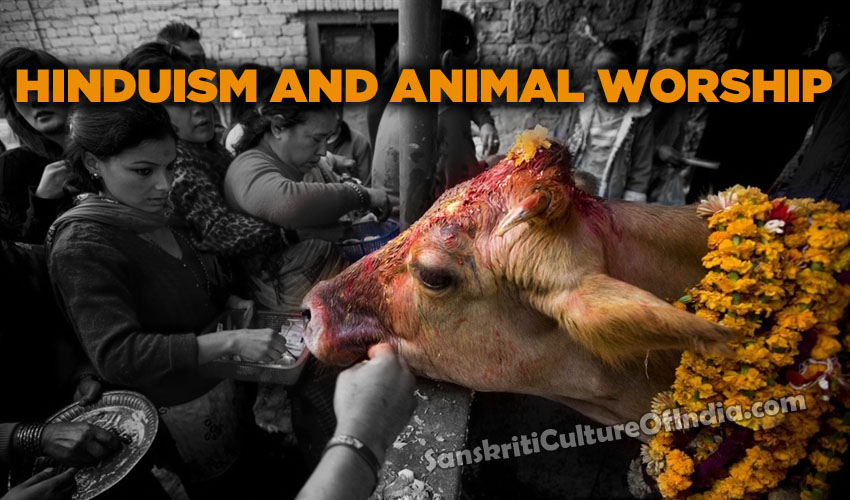
Animals have always fascinated us as humans and we all feel at least some connection to at least one type of animal.  In india, animal worship is widely practiced, animals have always been linked to the divine.  Hindus believe that most gods have an animal as a symbol of themselves and their connection to it.  For example, Shiva is always identified with snakes because he has snakes all around his body.  He is also seen with his companion bull, Nandi.  Ganesh is represented by the mouse and Krishna is always seen as the cow herder so naturally, cow.  Although these animals are not a direct extension of the god in some spiritual form or anything, they are part of that god’s personality.  When people want to pay homage to a god, not necessarily worship, they can usually do it to the animal.  The devotion is in the same mentality as praying to a statue of the god.  It’s merely symbolism, more then anything.  I mean, we all know that cows will be cows and bulls will be bulls and they can not replace the real deity.  Also, what’s more important then worshiping these animals is the behavior and the lifestyle of the individual.  This is also another reflection of the piety of the devotee.

Animal worship is not uniquely Hindu.  In fact, many of the world religions regard animals in a spiritual sense.  The ancient Egyptians were notorious for animal worship, going as far as having priests with heads of animals.   The Native Americans in particular were deeply attached to their animals, especially the buffalo, and other animals of nature.  They considered them brothers and sisters and often referred to them in that context.  Hindus do not go as far as getting possessed by animal spirits as some religions did but the feeling of affection and connection still remains.  Also, another perspective that remains very strong is that the cow is also seen as a mother to Hindus.  I say this because cows give milk and since milk is used for a variety of purposes, the animal is very sustaining.  It gives a lot so naturally Hindus feel very close to it.  It has been this way since long ago when the number of cows you had usually was an indicator of your wealth as well.

Therefore, animal worship is really not unique to Hindus but is unique in it’s symbolism and significance.   So, next time you see an Indian cow, maybe you will understand why it has such significance.

~ John Silver
You may also like

Search the website

Like us on Facebook

Get daily updates via Email

Enter your email address:

Recent Posts

Purushottam Maas — The Month No Deity Would Claim, and the Lord Who Made It Supreme

Every month of the Hindu calendar has a lord — except the rare thirteenth, the Adhika Maas, born an orphan and shunned as the “impure month.” The Puranas tell how this rejected month went in grief to Bhagavan Vishnu, who claimed it, gave it His own name — Purushottam — and made it the most fruitful month of all. The origin story, the teaching, and what it means for Purushottam Maas 2026 (May 17 – June 14).

Padmini Ekadashi 2026 — The Ekadashi Even the Devas Descend to Keep

Padmini Ekadashi 2026 — The Ekadashi Even the Devas Descend to Keep

The rarest Ekadashi of the entire Hindu calendar is three days away. The Padma Purana preserves a conversation between Bhagavan Krishna and Yudhishthira about a single Ekadashi the great Rishis spend lifetimes waiting for — Padmini. The Vrat Katha of Queen Padmini of Mahishmati, the lotus teaching, and why May 27, 2026 is the morning Vaishnavas across Bharata are preparing for.

Varada Chaturthi 2026 — The Rare Ganesha Day of Purushottam Maas

Varada Chaturthi 2026 — The Rare Ganesha Day of Purushottam Maas

Once every 2.5–3 years — when the rare 13th month of Adhika Maas opens — a thirteenth Vinayaka Chaturthi appears. The Mudgala Purana calls it Varada Chaturthi, the “boon-giving” Chaturthi, and holds it as the most fruit-bearing Ganesha day of the entire calendar. Today, Wednesday May 20, 2026, is that day.

Padmini Ekadashi 2026 — The Rare Ekadashi That Comes Only in Purushottam Maas

Padmini Ekadashi 2026 — The Rare Ekadashi That Comes Only in Purushottam Maas

Padmini Ekadashi 2026 falls on Wednesday, May 27 — the Shukla Paksha Ekadashi of Adhika Maas, the rarest Ekadashi in the entire Hindu calendar (it appears only every 2.5–3 years). The Padma Purana conversation between Bhagavan Krishna and Yudhishthira, the Vrat Katha of Queen Padmini, complete vrat vidhi with jagrana, mantras, and the lotus symbolism that gives the Ekadashi its name.

Ganga Dussehra 2026 — The Day Maa Ganga Came Down to Bhagiratha

Ganga Dussehra falls on Monday, May 25, 2026 — commemorating the day Maa Ganga descended from Vaikuntha to the earth through the millennia-long tapasya of King Bhagiratha. The full account from the Valmiki Ramayana, snan vidhi, dana traditions, mantras, and the teaching of sustained sincerity.

css.php