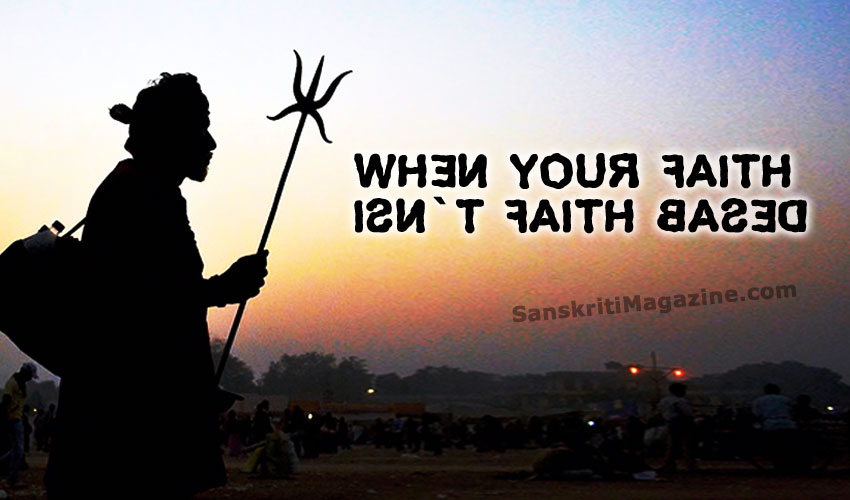
One of the most puzzling things I often say in my lectures on the Hindu Dharma to church groups and schools is that Hinduism isn’t faith based. That is, while we have plenty of doctrines to share, we have no solid dogmas that bind “the faithful” to our fold. It is in this area that we share a great deal with our Jewish friends. To Jews, what they believe, how they conceive of a deity, or even if they take the time to acknowledge a deity has nothing to do with their membership in good standing with their religion. I’ve had students question the ability to even have a viable religion without locking adherents into a communal creed. Honestly, I don’t know how to answer that. But certainly two of the oldest religions in the world have found a way to make it work.
There is no question that Christianity and Islam have gained great power in insisting upon very exact beliefs that adherents must hold. Heresy continues to be a danger zone that few care to enter. I’ll add that in the last century more liberal Christian denominations have taken a less creedal path. But in 2,000 years it is still the exception to the rule. It makes me realize that the world’s faiths use different elements of human psychology to maintain traditions and grow ranks. Sometimes those tools are the exact opposite of what another faith is using for its own purposes. So while some religions are founded on a creedal code and prosper, Hinduism maintains a fierce independence of thought that allows its adherents to think themselves…sometimes right out of the religion…with our blessings.
We get the predictable retort, “Oh, so you can just believe what you want.” No, if I believed just what I wanted to be spiritual reality I might opt for a path to moksha that included a lifestyle such as seen in a Fellini film. No, it’s not what I want to believe. It’s what I’m able to believe. There are millions of religionists all over the world who wrestle with doubts that they cannot easily reconcile. I’m sure that crowd includes a good number of Hindus; and I would offer solace in way of indicating that Self Realization can only be attained by ridding oneself of lesser beliefs. Part of my sadhana is the continued reinvestigation of long held assumptions. If any doctrine doesn’t pass the test I quickly sweep it into my spiritual dustbin with an efficiency my wife could only wish I’d exercise in cleaning our basement of more mundane artifacts that have long since abdicated any measure of usefulness.
And honestly, there is nothing wrong with admitting that on some issues, I just don’t know.
If you are Hindu I encourage you to take advantage of this wonderful aspect of our Dharma. Be at peace with the gift of questions. .However I would pray that doubt never devolves into cynicism, as it can. I believe that this is what Sri Krishna meant when He said in the counsels Arjuna about his doubts. Here is the trick: to find the Great Middle. Somewhere between mindless blind faith and that obsessive skepticism which can keep us so stagnant that we refrain from everything; from choosing pizza toppings to getting married.
That may be a subject for another day.
~ Fred Stella began his spiritual search within the Hindu Dharma at the age of 15. He was initiated into his specific tradition over 20 years ago. His training includes time spent in temples and ashrams both in US and in India. His articles have appeared in Freeman, India Link and Hinduism Today magazines, and the Grand Rapids Press. For over a decade Fred has held leadership positions in the local chapter of Self Realization Fellowship (Yogoda Satsanga Society in India) , a worldwide society deeply rooted in the Hindu/Yoga system of teaching. He is an ordained Pracharak (which translates to “Outreach Minister”) for the West Michigan Hindu Temple. Under the direction of Vivekananda Kendra in 2005 Mr. Stella completed a 30 city lecture tour in India, joining the effort to promote indigenous culture and religion in areas facing the encroachment of Western influence. In 2011 he was a guest of the Niagara Foundation to study interfaith efforts in Turkey. Here in the United States, he has given lectures, facilitated workshops and retreats at schools, churches and in the private sector. Fred is a consultant at GVSU, where he is an instructor of Hatha Yoga and meditation to MBA candidates. He is also president of Interfaith Dialogue Association, and hosts its weekly radio program on Religion and Spirituality, Common Threads on local NPR affiliate, WGVU-FM. Mr. Stella was educated at the University of Detroit, where he majored in Media Studies. Besides IDA, Fred sits on the advisory boards of Grand Dialogue (promoting conversations between Science and Religion), The Kaufman Interfaith Institute and the West Michigan chapter of the ACLU, where he often consults on freedom of religion issues. In 2012 Mayor George Heartwell presented Fred with the city’s “Champion of Diversity Award” for his work in interfaith relations