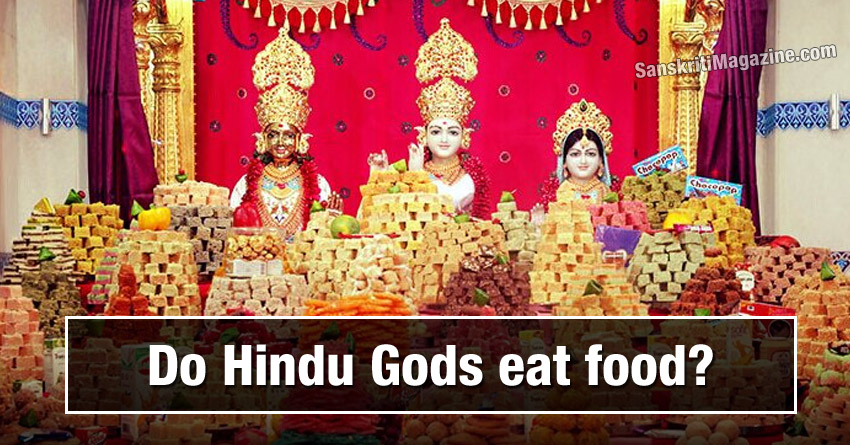
My friend, Mohamed Ashiq Naseeruddin from Birmingham, UK told me: “Your gods might be getting indigestion! Millions of people offer them food every day….”
I initially thought it was a harmless joke. Neither our gods won’t get angry or insecure on jokes on them, nor do real Hindus get hurt on innocent jokes. I laughed. “Yeah, especially with those loads of chemicals in the food now‐a‐ days”
“Seriously Uday Sir, I see Hindus offer food to idols and believe that gods can eat! I am not a religious hater. But isn’t this foolish and nonsense? ”
“Yes, Hindus do offer food to god. What we offer to God is Naivedyam. When it comes back to us, it becomes Prasadam. I also do that at home, celebrations and in temples.”
“See…even an educated journalist like you too… Don’t you know God won’t eat this food? Idol can’t open its mouth. God won’t eat or talk the way we human do. Offering food to god is very materialistic thinking. There is no spirituality in that. You people are so superstitious and Idiotic…”
 “Hmm”
“Hmm”
“In fact God doesn’t need anything from you. But you need everything from god. So, all we should do is, pray to god…That’s what 21st century’s modern, cultured, educated people do…”
“So, god will hear your prayer…”
“Yes. He can hear the prayer. Not only food – but God doesn’t want anything. He is perfect and complete. Everything in this universe happens as per God’s will and wish…”Ashiq said.
“Ashiq, you mean to say, god (or idols in question here) doesn’t eat food, it doesn’t even open its mouth. It won’t talk. You said God will hear your prayer. So, according to you, we only have to pray and worship him. Everything in this universe happens only by his wish and will. God doesn’t need anything from us. He is perfect and complete. This is what you say as modern and scientific. Am I correct?”
“Exactly” he beamed. “Yes sir. I know you are very open and you can understand fast… Crystal clear. So you will stop pre‐historic tradition of offering food to God…”
“No Ashiq.”
“Why?” he was surprised.
“I am not convinced about what you said. You said, your God doesn’t eat, he doesn’t speak or behave as humans do, right?” I paused.
“Yes…yes…” “Then how can he hear to what we humans say? The very concept of delivering prayers through words (in any language) brings God to possess hearing capability as we humans…If god doesn’t eat and talk, how can he hear?”
“That…but God can hear, right?”
“God can’t talk or eat. But he can hear what kind of logic is that? Does it mean that God has only selective few sensory organs? Who told you that? Did God tell you that?”
“No, he talks through Prophets…All religions have prophets…”
“Is it so? Then, what prevents him from eating food through his people?”
“It’s not right. Everything happens as per God’s will and wish.”
“Ashiq, will and wish are related of human thinking. You are saying that God also thinks as we humans do. And he has will and wish! God’s will or God understanding our wish is proof of material relation of God. Theoretically, how is it different from materialistic offering food to god?”
“It’s not like that. We can just pray….God will listen to us…all the Holy books say we have to pray for it…”
“But you just said he doesn’t need anything from us. Then why did your God order in Holy books to worship him and pray to him?”
“Prayer is for us…God knows everything” Ashiq said.
“You are contradicting again. If your God is powerful enough to know about everything why should you tell anything to God? God knows what is happening and what will happen. Then why ask for anything to God when God already knows what is going to happen to us? Or is he so egoistic that he wants you to plead? Does he enjoy such ego? And if God is perfect and complete, then anything offered to him (including “Namaz” or “Prayers”) which if accepted by him, would prove to fill up some void. It makes God incomplete. So as per your own arguments based on Holy books, rendering of prayers itself binds God…”
He didn’t talk for a moment. We were talking over WhatsApp. I sent him a question mark. He replied: “I am thinking for answers…”
“You won’t get. Ashiq, before ridiculing other’s beliefs, we have to check if our path is right. When it comes to irrational beliefs, no religion is better…”I told him.
Then he asked: “Seriously, why are you people offering food to God? What’s the rationale behind it?”
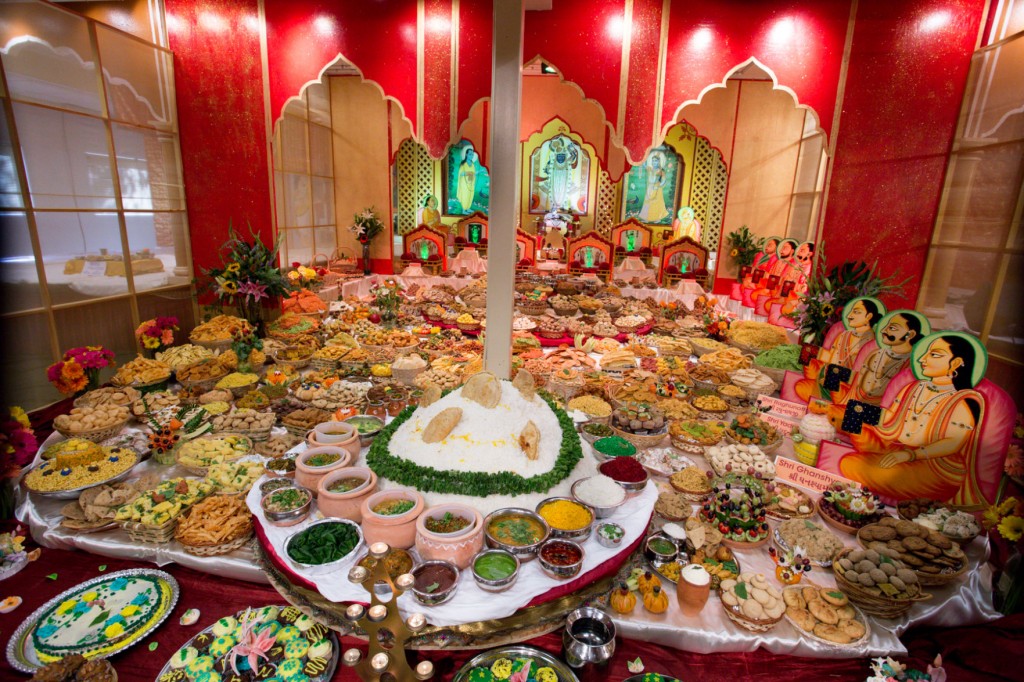
“Why do you offer flowers to your girlfriend? To express your love. Offering food is a symbolic gesture of love. It is a way of thanking God for the food provided. It’s an act of gratitude. We prepare Naivedyam with utmost devotion, dedication with purity of mind and body. Then offer the sacred food (Bhagwan Bhog) to god. We know god won’t eat directly. It’s just symbolic. After rituals we distribute the prasadam to everyone around us for blessings. The idol won’t eat. God eats through us. Because we are the integral part of god.”
-When we offer food and flowers to god, we say ‘Samarpayaamee’ means it is yours and you have the first right on it. We seek God’s blessings (Prasad), we believe god has blessed (Prasad) the food; we distribute the Prasad (blessings) of god with devotion. And we accept and eat the Prasad (blessings) of God with utmost devotion. It also believed that offering ‘Prasad’ daily to Gods showers food and prosperity on the house.
– We offer food to god at prayer room in home and in the temple. We also celebrate festivals (like Pongal, Makarasankrathi, Diwali) when we make and share the food. In every temple in India, it is customary to make a small offering of sweets or other food, as a mark of our devotion and gratefulness towards the God or Goddess.
“Is this mentioned in any of your scriptures?”
“All the scriptures talk about offerings to god. Bhagavad‐Gita says, ‘all that you do, all that you eat, all that you offer and give away, as well as all austerities that you may perform, should be done as an offering unto Me (Me=Brahmam, cosmos)’. So offering food to God before eating is an integral part of our culture to make the food blessed…”
– Our ancestors found that food is the source of human body and mind. It should be eaten for the survival and strength of the body, with a humble attitude, to practice austerities and gain awareness, and not just for pleasure.
– All disease – related to body and mind – derives from food. Prevention is always better than cure. Hence, they have scientifically developed a traditional medicinal system, Ayurveda that highlights the Viruddha Ahara (incompatible foods) and pathyam or parhes (dietary restrictions). According to Ayurveda scriptures, if you follow this concept you can live up to 120 years without any major pain and miseries. So, food is considered as divine.
– Since their economic system was based on the temple, they have charted out the list of Naivedyas in temple for each month based on seasonal and environmental relevance and its impact on human body. If a person follows the similar diet strictly, you won’t have any physical problems… They wanted us eat sattvik food with gratitude and devotion. They wished that their descendant should follow this great system. So they have mixed it up beliefs and temple, so that people would earnestly follow it. I don’t know if modern concrete business centres in the name of temples and those religious crooks that are behind this would follow this tradition. Modern priests won’t even know about this divine food system.
“I am really sorry – I didn’t know the significance of prasadam and divinity of food…” he said.
“But Ashiq, it is a lost art in India. I wouldn’t be surprised if modern temples offer you Pizzas, Chicken Biriyani and Mutton pulav as prasadams, instead of pure Sattvik food. Given the trend among fraud priests and the brain‐ washed zombie Hindu communities, instead of Milk Abhisheka (bathing a deity in milk), an alcohol Abhisheka may also be expected.”
~ Udaylal Pai, Freelance Journalist, Writer and Researcher