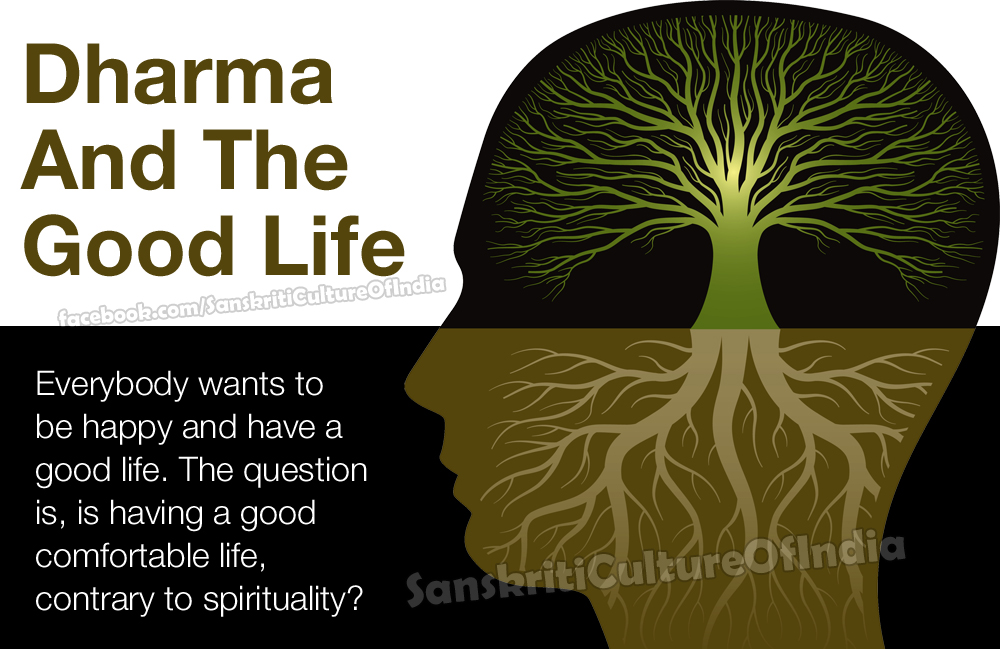
Everybody wants to be happy and have a good life. The question is, is having a good comfortable life, contrary to spirituality?
Atharva Veda verses speak clearly about the natural desire of all beings for joy and prosperity. “Earth, my mother, set me securely with bliss, in full accord with heaven…O Wise One, uphold me in grace and splendour.” And, “The earth bears all-sustaining treasure-bearing places…May she pour on us riches, in any forms, and endow us with lustre.”
Dharma, artha, kama and moksha are the four purusharthas or goals stated in ancient texts. These are exposition of the universality and practicality of Indic wisdom; the warp and woof of human existence. One would think that holy texts ought to be only about dharma and moksha- but, no, here we clearly have artha or wealth and kama, desire, too! Then, where do we go wrong?
Perhaps we tend to remember artha and kama, and forget dharma and moksha. Dharma is the foremost principle, the very foundation for the other three. Whatever it is that you are seeking in life, if you hold on to dharma, you will reap the fruit. Where there is dharma, there is no fear. Today, the lives of rich, successful and powerful people are riddled with apprehensions and fear because they live in fear and uncertainty of being caught out in some flagrant breach of ethics. Though they have luxuries, they have no peace of mind.
The foundation of dharma or righteous action clears the path for a fulfilled, happy life. Earning wealth righteously is the most productive way to real success and overall well-being. Unrighteously acquired wealth is the ultimate burden on the soul; it vitiates your karmic balance.
Kama, too, when it is based on dharma, is to be welcomed as a necessary aspect of human life. However, here again, especially in the prevalent context of our times, the most important thing is to test your desire on the touchstone of dharma — is my desire going to harm someone? Will it demean or diminish another? A desire which harms or hurts another is to be abandoned for otherwise, its fulfilment will bring ruination — to the other and to you.
It is ironical that for a few fleeting moments of pleasure, sometimes, one barters away a whole life that has been painstakingly built. Everything comes crumbling down in a matter of seconds, and is reduced to rubble. Wealth lost can be regained but character lost is lost forever.
Sri Sathya Sai Baba says, “Dharma is the foundation for the welfare of humanity; it is the truth that is stable for all time. Confronted by dharma, anyone, however powerful, will be cut to size. Therefore, the most vital thing is dharma….And, how are you to decide, in any particular case, what is dharma and what is not? I shall tell you…That which does not inflict pain on you and on others, and that which gives you joy and others too, that is right; that is dharma.”
We have a higher destiny than living only to pleasure our senses. Strive to be comfortable, but not only in body. Nourish the spirit, too.The good life is an integrated life, where body, mind and soul are in perfect harmony. It is the duty of every one of us to go beyond transient attractions, and seek out this holistic balance, to bring beauty and purpose to our lives.
~By S. Paranjape