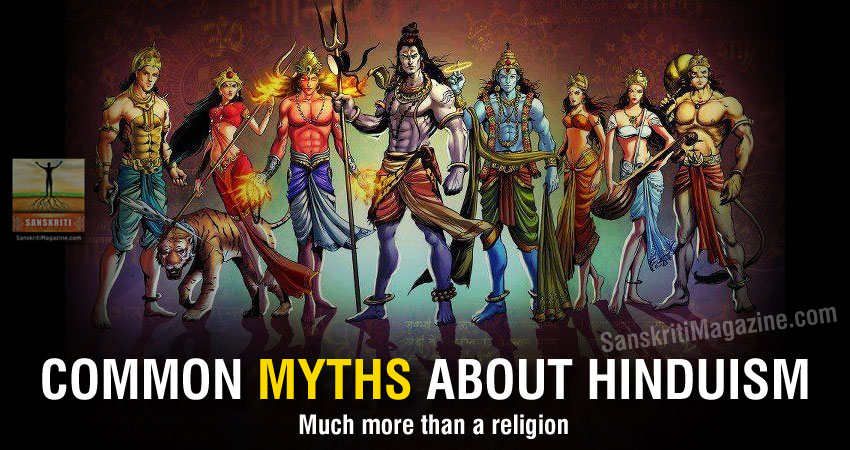
Hinduism is a unique faith! The most obvious misconception about Hinduism is that we tend to see it as just another religion. To be precise, Hinduism is a way of life, a dharma. Dharma does not mean religion. It is the law that governs all action. Thus, contrary to popular perception, Hinduism is not just a religion in the tradition sense of the term. Out of this misinterpretation, has come most of the misconceptions about Hinduism.
Hinduism – A Modern Term:
There has been a debate and a propaganda that word “Hindu” was derived from “Sindhu” due to incapability of Greeks to pronounce “H”. But in reality, Hindu word has been used throughout history in Asia and older scriptures for thousands of years. For more details, please CLICK HERE
A Culture More than a Religion:
Hinduism does not have any one founder, and it does not have a Bible or a Koran to which controversies can be referred for resolution. Consequently, it does not require its adherents to accept any one idea. It is thus cultural, not creedal, with a history contemporaneous with the peoples with which it is associated.
Much More than Spirituality:
Writings we now categorise as Hindu scriptures include not just books relating to spirituality but also secular pursuits like science, medicine and engineering. This is another reason why it defies classification as a religion per se. Further, it cannot be claimed to be essentially a school of metaphysics. Nor can it be described as ‘other worldly’. In fact, one can almost identify Hinduism with a civilization that is flourishing even now.
A Common Faith of the Indian Subcontinent:
The Aryan Invasion Theory having been completely discredited, it cannot be assumed that Hinduism was the pagan faith of invaders belonging to a race called Aryans. Rather it was the common meta faith of people of various races, including Harappans. The Sanskrit word ‘Aryan’ is a word of honorable address, not the racial reference invented by European scholars and put to perverse use by the Nazis.
A Culture Much Older than We Believe:
Evidence that Hinduism must have existed even circa 10000 B.C. is available: The importance attached to the river Saraswati and the numerous references to it in the Vedas indicates that the Rig Veda was being composed well before 6500 B.C. The first vernal equinox recorded in the Rig Veda is that of the star Ashwini, which is now known to have occurred around 10000 B.C. Subhash Kak, a Computer Engineer and a reputed Indologist, ‘decoded’ the Rig Veda and found many advanced astronomical concepts therein. The technological sophistication required to even anticipate such concepts is unlikely to have been acquired by a nomadic people, as the Invasionists would like us to believe. In his book Gods, Sages and Kings, David Frawley provides compelling evidence to substantiate this claim.
Hinduism is a Not Polytheistic!
Many believe that multiplicity of deities makes Hinduism polytheistic. Such a belief is nothing short of mistaking the wood for the tree. The bewildering diversity of Hindu belief – theistic, atheistic and agnostic – rests on a solid unity. “Ekam sath, Vipraah bahudhaa vadanti”, says the Rig Veda: The Truth (God, Brahman, etc) is one, scholars call it by various names.
What the multipicity of deities does indicate is Hinduism’s spiritual hospitality as evidenced by two characteristically Hindu doctrines: The Doctrine of Spiritual Competence (Adhikaara) and the Doctrine of The Chosen Deity (Ishhta Devata). The doctrine of spiritual competence requires that the spiritual practices prescribed to a person should correspond to his or her spiritual competence. The doctrine of the chosen deity gives a person the freedom to choose (or invent) a form of Brahman that satisfies his spiritual cravings and to make it the object of his worship. It is notable that both doctrines are consistent with Hinduism’s assertion that the unchanging reality is present in everything, even the transient.