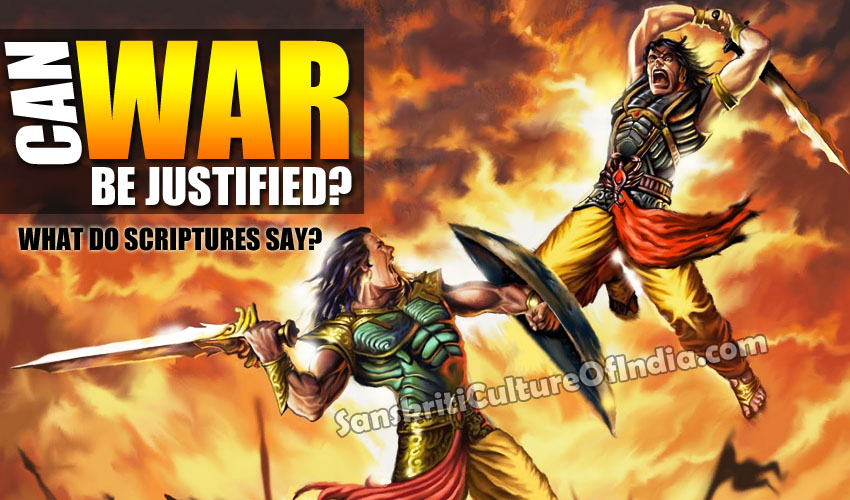
Hinduism, like most religions, believes that war is undesirable and avoidable because it involves killing fellow humans. However, it recognizes that there can be situations when waging war is a better path than tolerating evil. Does that mean Hinduism glorifies war?
The very fact that the backdrop of the Gita, which Hindus consider sacrosanct, is the battlefield, and its main protagonist a warrior, may lead many to believe that Hinduism supports the act of war. In fact, the Gita neither sanctions war nor condemns it. Why? Let’s find out.
The Bhagavad Gita & War
The story of Arjuna, the fabled bowman of the Mahabharata, brings out Lord Krishna’s view of war in the Gita. The great battle of Kurukshetra is about to begin. Krishna drives Arjuna’s chariot drawn by white horses into the centre of the battlefield between the two armies. This is when Arjuna realizes that many of his kinsmen and old friends are among the ranks of the enemy, and is appalled by the fact that he is about to kill those he loves. He is unable to stand there any longer, refuses to fight and says that he does not “desire any subsequent victory, kingdom, or happiness.” Arjuna questions, “How could we be happy by killing our own kinsmen?”
Krishna in order to persuade him to fight, reminds him that there is no such act as killing. He explains that the “atman” or soul is the only reality; the body is simply an appearance, its existence and annihilation are illusory. And for Arjuna, a member of the “Kshatriya” or the warrior caste, fighting the battle is ‘righteous’. It is a just cause and to defend it is his duty or dharma.
“…if you are killed (in the battle) you will ascend to heaven. On the contrary if you win the war you will enjoy the comforts of earthly kingdom. Therefore, get up and fight with determination… With equanimity towards happiness and sorrow, gain and loss, victory and defeat, fight. This way you will not incur any sin.” (The Bhagavad Gita)
Krishna’s advice to Arjuna forms the rest of the Gita, at the end of which, Arjuna is ready to go to war.
This is also where karma, or the Law of Cause & Effect comes into play. Swami Prabhavananda interprets this part of the Gita and comes up with this brilliant explanation: “In the purely physical sphere of action, Arjuna is, indeed, no longer a free agent. The act of war is upon him; it has evolved out of his previous actions. At any given moment in time, we are what we are; and we have to accept the consequences of being ourselves. Only through this acceptance can we begin to evolve further. We may select the battleground. We cannot avoid the battle… Arjuna is bound to act, but he is still free to make his choice between two different ways of performing the action.”
Peace! Peace! Peace!
Aeons before the Gita, the Rig Veda professed peace.
“Come together, talk together / Let our minds be in harmony.
Common be our prayer / Common be our end,
Common be our purpose / Common be our deliberations,
Common be our desires / United be our hearts,
United be our intentions / Perfect be the union among us.” (Rig Veda)
The Rig Veda also laid down the right conduct of war. Vedic rules maintain that it is unjust to strike someone from behind, cowardly to poison the tip of the arrow and heinous to attack the sick or old, children and women.
Gandhi & Ahimsa
The Hindu concept of non-violence or non-injury called “ahimsa” was successfully employed by Mahatma Gandhi as the means to fight the oppressive British Raj in India in the early part of the last century.
However, as historian and biographer Raj Mohan Gandhi points out, “…we should also recognise that for Gandhi (and most Hindus) ahimsa could co-exist with some carefully understood acquiescence in the use of force. (To give only one example, Gandhi’s Quit India resolution of 1942 stated that Allied troops fighting Nazi Germany and Militarist Japan could use India’s soil if the country was freed.)”
In his essay ‘Peace, war and Hinduism’, Raj Mohan Gandhi goes on to say: “If some Hindus claimed that their ancient epic, the Mahabharata, sanctioned and indeed glorified war, Gandhi pointed to the empty stage with which the epic ends – to the noble or ignoble killing of almost everyone of its vast cast of characters – as ultimate proof of the folly of revenge and violence. And to those who spoke, as many do today, of the naturalness of war, Gandhi’s reply, first expressed in 1909, was that war brutalizes men of naturally gentle character and that its path of glory is red with the blood of murder.”
The Bottom Line
To sum up, war is justified only when it is meant to fight evil and injustice, not for the purpose of aggression or terrorizing people. According to Vedic injunctions, aggressors and terrorists are at once to be killed and no sin is incurred by such annihilations.
~ Author Unknown