
IndianSanskriti
Bodhgaya - The Cradle of Buddhism

Bodhgaya

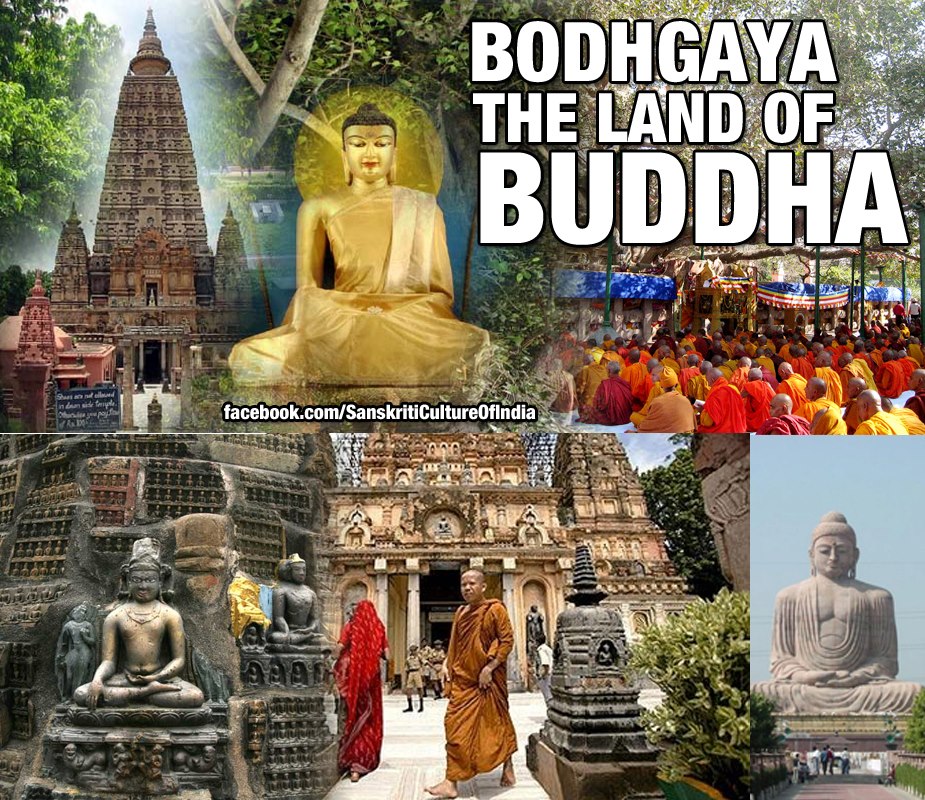
The Mahabodhi temple is located in Bodhgaya city in the state of Bihar, India. It is considered to be the holiest and oldest shrine devoted to Buddhism and a place where Gautama Buddha attained enlightenment. This temple is also the oldest and the first temple to be constructed using bricks.

History
The first temple was constructed by Ashoka around 260 B.C. near the Bodhi tree. An inscription datable to 1st – 2nd century A.D. mentions that the temple of Asoka was replaced by a new one. It provides exceptional records for the events associated with Buddha’s life and for subsequent worship. In addition a diamond throne was built marking the accurate location of Buddha’s enlightenment. In the 12th century Bodhgaya came under the control of Muslim authorities and during their reign temple was damaged and neglected. Restored in 1880 by the British government under the supervision of Sir Alexander Cunningham the temple was handed over to the Buddhists in 1949.

Architecture
The whole temple is built with bricks and is the oldest among the brick structures in India. The Mahabodhi temple tower stands at a height of about 55 meters, which is bounded by four more towers built in the same manner. The Mahabodhi temple is bound by railings made of stone two meters tall. In addition, the ancient railings are made of sandstone around 150 B.C. There are a few structures of Indian gods inside the temple namely “Surya”, the god of sun and “Lakshmi”, the goddess of wealth.

Attractions
The temple contains several towers which are built by many people from different parts of the world. A large amount of Buddha statues are clad in the Hindu style. In addition, there is the Niranjana River close to the temple, which has a great scenic beauty.

Currently, the Mahabodhi temple is maintained by the government of Bihar state which takes care of its protection and management.
UNESCO has listed the Mahabodhi Temple as a world heritage site in 2002.
You may also like

Search the website

Like us on Facebook

Get daily updates via Email

Enter your email address:

Recent Posts

Yogini Ekadashi 2026 — The Yaksha Who Missed the Morning Flowers, and the Ekadashi That Undid His Curse

On Friday, July 10, 2026, the rare Krishna Paksha Ekadashi of Nija Ashadha arrives. The Padma Purana tells the story of Hemamali — the Yaksha gardener of Bhagavan Kubera in Alaka, whose single morning of distraction with his wife Vishalakshi cost him his form, his wife, and his celestial city. Cursed to wander the earth of Bharata as a leper for a long time, he was at last shown the way back by Sage Markandeya — a single sincere keeping of Yogini Ekadashi.

Jamai Shashthi 2026 — The Story of Maa Shashthi, the Cat, and the Wife Who Was Forgiven

Jamai Shashthi 2026 — The Story of Maa Shashthi, the Cat, and the Wife Who Was Forgiven

On Saturday, June 20, 2026, Bengali households across Bharata will welcome their married daughters and sons-in-law home for the legendary jamai-aador feast and perform the Shashthi Vrata. But behind the warmth lies a story most Bengalis know by heart and most non-Bengalis have never heard — the wife who stole the hilsa, blamed the cat, lost six sons to Maa Shashthi’s wrath, and was finally forgiven. The Vrat Katha, the vidhi, the mantras, and the deeper teaching.

Vat Purnima 2026 — The Wife Who Argued Yama Into Returning Her Husband’s Life

On Monday, June 29, 2026, women across Maharashtra, Gujarat, and southern Bharata will tie red thread around banyan trees and hear the story of Savitri — the wife who walked behind Yamaraja Himself when He came for her husband, and out-argued the Lord of Dharma into returning Satyavan’s life. The Mahabharata’s Pativrata Mahatmya Parva, the vrat vidhi, and why the banyan witnessed everything.

Nija Jyeshtha 2026 — The Real Jyeshtha Begins, and the Calendar Resumes

Nija Jyeshtha 2026 — The Real Jyeshtha Begins, and the Calendar Resumes

With Adhik Maas now closed on the Somvati Amavasya of June 15, the long-postponed festivals of Jyeshtha return — Vat Purnima (June 29, the Savitri-Yamaraja katha), Jamai Shashthi (June 20, the Bengali festival of Maa Shashthi), Sankashti Chaturthi (June 28), Yogini Ekadashi (July 10), and Devshayani Ekadashi (July 16, opening the four-month Chaturmas of Bhagavan Vishnu’s yoga-nidra). A guide to what the next four weeks hold and what the household that kept Purushottam Maas now carries forward.

css.php





