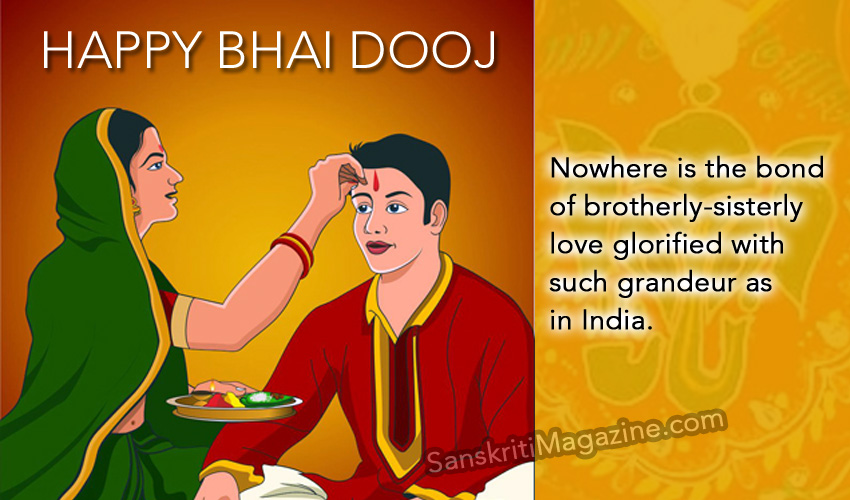
Nowhere is the bond of brotherly-sisterly love glorified with such grandeur as in India. Hindus celebrate this special relationship twice every year, with the festivals of Raksha Bandhan and Bhai Dooj.
What, When & How
After the high voltage celebrations of Diwali , the festival of lights and fire-crackers, sisters all over India get ready for ‘Bhai Dooj’ – when sisters ceremonize their love by putting an auspicious tilak or a vermilion mark on the forehead of their brothers and perform an aarti of him by showing him the light of the holy flame as a mark of love and protection from evil forces. Sisters are lavished with gifts, goodies and blessings from their brothers.
Bhai Dooj comes every year on the fifth and last day of Diwali, which falls on a new moon night. The name ‘Dooj’ means the second day after the new moon, the day of the festival, and ‘Bhai’ means brother.
Legends
Bhai Dooj is also called ‘Yama Dwiteeya’ as it’s believed that on this day, Yamaraj, the Lord of Death and the Custodian of Hell, visits his sister Yami, who puts the auspicious mark on his forehead and prays for his well being. So it’s held that anyone who receives a tilakfrom his sister on this day would never be hurled into hell.According to one legend, on this day, Lord Krishna, after slaying the Narakasura demon, goes to his sister Subhadra who welcomes him the lamp, flowers and sweets, and puts the holy protective spot on her brother’s forehead.
Yet another story behind the origin of Bhai Dooj says that when Mahavir, the founder ofJainism, attained nirvana, his brother King Nandivardhan was distressed because he missed him and was comforted by his sister Sudarshana. Since then, women have been revered during Bhai Dooj.
Bhai Phota
In Bengal this event is called ‘Bhai Phota’, which is performed by the sister who religiously fasts until she applies a ‘phota’ or mark with sandal wood paste on her brother’s forehead, offers him sweets and gifts and prays for his long and healthy life.Every brother eagerly awaits this occasion that reinforces the bond between brothers and sisters and their affectionate relationship. It’s an opportunity for a good feast at the sister’s place, coupled with an enthusiastic exchange of gifts, and merriment amid the resounding of conch shells in every Bengali household.
Underlying Significance
Like all other Hindu festivals , Bhai Dooj too has got a lot to do with family ties and social attachments. It serves as a good time, especially for a married girl, to get together with her own family, and share the post-Diwali glee.Nowadays, sisters who are unable to meet their brothers send their tika – the spot of protection – in an envelope by post. Virtual tilaks and Bhai Dooj e-cards have made it even easier for brothers and sisters, who’re far away from each other, specially remember their siblings on this propitious occasion.