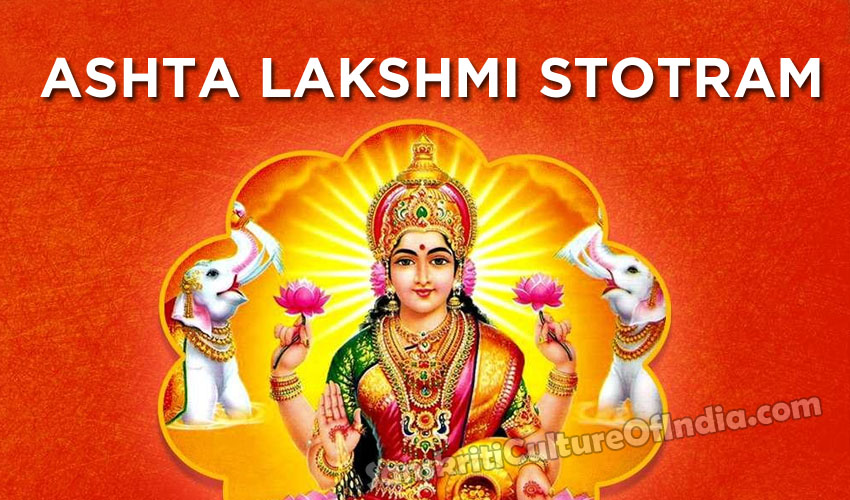
Lakshmi is commonly known as Goddess of wealth. Wealth is tradition and values, Family and progress, not simply money. Belongings such as land, property, animals, grains, etc as well as virtues like patience, persistence, purity etc in the form of a character are wealth and so is glory or victory.
Mother Lakshmi is the source and provider of the following well-known sixteen types of wealth and many more:
- Fame 9. Higher Aim, High Thinking and Meditation
- Knowledge 10. Bliss
- Courage and Strength 11. Morality and Ethics
- Victory 12. Good Health
- Good Children 13. Beauty
- Happiness 14. Long Life
- Valor 15. Grains in abundance
- Intelligence 16. Gold and other gross properties
Please click to hear the stotram:
The eight aspects of Mother Lakshmi are:
1. Adi Lakshmi – Wealth of endless prosperity:
“Adi” means eternal existence. Adi Lakshmi signifies the never-ending nature of the Goddess, She is continuous. Wealth should therefore, flow continuously also. It too has always been there and always will be there.
2. Dhan Lakshmi or Vaibhav Lakshmi – Wealth of money and riches:
“Dhan” and “Vaibhav” mean money, riches, fortune and income. It is the usual way we perceive and understand wealth. This wealth is of great importance to one who wishes to live an enriched and happy life.
3. Dhairya Lakshmi – Wealth of patience, strategy, planning, objectivity:
“Dhairya” means patience. This wealth gives us the spiritual strength to face good and bad times with equal ease. It signifies the importance of planning and strategy in all our actions so we may move with caution and reach our target each time.
4. Gaj Lakshmi – Wealth of Elephants or vehicles:
“Gaj” means elephant and it symbolizes the vehicles we use to transport ourselves. It also means mobility in life and ease of travel.
5. Santan Lakshmi – Wealth of children, legacy, family, friends, well wishers:
“Santan” means children. Goddess Lakshmi symbolizes the social nature of man. We need each other. Children are our wealth, they are our future. The family is the basic unit of people who bring up their children allowing life to move forward through its children.
6. Vijay Lakshmi – Wealth of victory, perseverance, courage, and confidence:
“Vijay” means victory. This Goddess symbolizes the wealth of courage, confidence, fearlessness and victory. This wealth strengthens our character and keeps us moving along successfully on our life path.
7. Vidya Lakshmi – Wealth of education, knowledge, skills:
“Vidya” means knowledge. To be knowledgeable means that we have skills of various kinds. We have general information about our local, national, and international issues. We can partake in sharing information.
8. Dhanya Lakshmi – Wealth of grain, food, nourishment, and health:
“Dhanya” means grain. Food is our most basic and most important wealth. We need food to sustain life. Being wealthy means we have abundance of food that keeps us nourished and healthy.
Ashta Lakshmi Stotram: अष्ठलक्ष्मी स्तोत्रम्
सुमनसवन्दित सुन्दरि माधवि चन्द्र सहोदरि हेममये ।
मुनिगणमण्डित मोक्षप्रदायिनि मञ्जुळभाषिणि वेदनुते ।।
पंकजवासिनि देवसुपूजिते सद्गुणवर्षिणि शान्तियुते ।
जय जय हे मधुसूदन कामिनि आदिलक्ष्मि जय पालय माम् ।। १ ।।
Oh, Adi Lakshmi, one who is worshiped by all good people, who is pretty. and sister of the moon,
who looks as if she is made of gold, who is saluted by all sages, who grants salvation, who talks sweet words,
who is praised in Vedas, who lives on the Lotus flower, who is worshiped by all Gods, who showers good qualities on people,
who is the personified with peace, victory, victory, Oh darling of the killer of Madhu, Adi lakshmi, please protect me always.
अहिकलि कल्मषनाशिनि कामिनि वैदिकरूपिणि वेदमये ।
क्षीरसमुद्भव मंगलरूपिणि मन्त्रनिवासिनि मन्त्रनुते ।।
मंगलदायिनि अम्बुजवासिनि देवगणाश्रित पादयुते ।
जय जय हे मधुसूदन कामिनि धान्यलक्ष्मि जय पालय माम् ।। २ ।।
Victory, victory to Danyalakshmi, Oh darling of the killer of Madhu,
who destroys bad effects of kali yuga, who is most desirable god, who is personification of Vedas,
who is pervaded by the Vedas, who arose out of milk, who is the form of all that is good,
who lives in the sacred chants, who lives on the lotus flower,
and whose feet are worshiped by devas, please protect me always.
जयवरवर्णिनि वैष्णवि भार्गवि मन्त्रस्वरूपिणि मन्त्रमये
सुरगणपूजित शीघ्रफलप्रद ज्ञानविकासिनि शास्त्रनुते।।
भवभयहारिणि पापविमोचनि साधुजनाश्रित पादयुते।
जय जय हे मधुसूदन कामिनि धैर्यलक्ष्मि जय पालय माम् ।। ३ ।।
Victory, victory to Dairyalakshmi, Oh, darling of the killer of Madhu,
who is described by victorious and blessed, who is the shakthi which came out of Vishnu,
who is the daughter of sage Bhargava, whose form is that of sacred chants,
who is pervaded by sacred chants, who is worshiped by all devas, who gives results fast,
who improves knowledge, who is worshiped by shastras, who destroys fear, who gives redemption from sins,
and whose feet are worshiped by holy people, who lives on the lotus flower, please protect me always.
जय जय दुर्गतिनाशिनि कामिनि सर्वफलप्रद शास्त्रमये ।
रथगज तुरगपदादि समावृत परिजनमण्डित लोकनुते ।।
हरिहर ब्रह्मसुपूजित सेवित तापनिवारिणि पादयुते ।
जय जय हे मधुसूदन कामिनि श्रीगजलक्ष्मि पालय माम् ।। ४ ।।
Victory, victory to Gajalakshmi, Oh darling of the killer of Madhu,
victory and victory to you , who removes bad fate, who is desirable God,
who is the personification of shastras, which bless one with all that is asked,
who is surrounded by an army of elephants, chariots, horses and cavalry, who is worshiped and served by,
Shiva, Vishnu and Brahma, and whose feet provides relief from suffering, please protect me always
अहिखग वाहिनि मोहिनि चक्रिणि रागविवर्धिनि ज्ञानमये ।
गुणगणवारिधि लोकहितैषिणि सप्तस्वर भूषित गाननुते ।।
सकल सुरासर देवमुनीश्वर मानववन्दित पादयुते ।
जय जय हे मधुसूदन कामिनि सन्तानलक्ष्मि पालय माम् ।। ५ ।।
Victory, victory to Santhanalakshmi, Oh, darling of the killer of Madhu,
who rides on the bird, who is an enchantress, who is the consort of he who holds the chakra,
who pacifies emotions, who is pervaded by knowledge, who is ocean of good qualities,
who has her mind in the good of all the world, who is worshiped by the music of seven swaras,
and who is worshiped by all devas, asuras, sages and all humans, please protect me always.
जय कमलासनि सद्गतिदायिनि ज्ञानविकासिनि गानमये ।
अनुदिनमर्चित कुंकुमधूसरभूषित वासित वाद्यनुते ।।
कनकधरास्तुति वैभव वन्दित शंकर देशिक मान्यपदे ।
जय जय हे मधुसूदन कामिनि विजयलक्ष्मी जय पालय माम् ।। ६ ।।
Victory, victory to Vijayalakshmi, the darling of the killer of Madhu,
victory to she who sits on the lotus, who blesses us with salvation, who spreads our knowledge,
who is pervaded with music, who is coated with the saffron powder,
which is daily used to worship her, who is worshipped by playing of musical instruments,
and who was pleased by the prayer, of the golden rain by the great Sankara, please protect me always.
प्रणत सुरेश्वरि भारति भार्गवि शोकविनाशिनि रत्नमये ।
मणिमयभूषित कर्णविभूषण शान्तिसमावृत हास्यमुखे ।।
नवनिधिदायिनि कलिमलहारिणि कामित फलप्रद हस्तयुते ।।
जय जय हे मधुसूदन कामिनि विद्यालक्ष्मि पालय माम् ।। ७ ।।
Victory, victory to Vidhyalakshmi Oh, darling of the killer of Madhu,
who is the pleased goddess of devas, who is he goddess of Bharatha, who is the daughter of sage Bhargava,
who removes all sorrows, who is fully ornamented by precious stones, who wears several gem studded ornaments,
whose ears are decorated, who is the abode of peace, who has a smiling face, who blesses us with nine types of wealth,
who steals away bad effects of kali and whose hands blesses us, for fulfillment of our wish, please protect me always.
धिमिधिमि धिमधिमि धिमधिमि धिमधिमि दुन्दुभि नाद सुपूर्णमये ।
घुमघुम घुंघुम घुंघुम घुंघुम शंखनिनाद सुवाद्यनुते ।।
वेदपुराणेतिहास सुपूजित वैदिकमार्ग प्रदर्शयुते ।
जय जय हे मधुसूदन कामिनि श्री धनलक्ष्मि पालय माम् ।। ८ ।।
Victory, victory to Danalakshmi hey, darling of the killer of Madhu,
Who is fully complete with, Dimidimi sounds of the drum, And the majestic sound of conch,
Gumguma, ghummkuma , gunguma, who is worshipped by Vedas and puranas,
and who shows the path of religious discipline, please protect me always.