IndianSanskriti
Defining Lord Shiva

Defining Lord Shiva

The Powerful God:

Shiva is ‘shakti’ or power, Shiva is the destroyer, the most powerful god of the Hindu pantheon and one of the godheads in the Hindu Trinity. Known by many names – Mahadeva, Mahayogi, Pashupati, Nataraja, Bhairava, Vishwanath, Bhava, Bhole Nath – Lord Shiva is perhaps the most complex of Hindu deities. Hindus recognize this by putting his shrine in the temple separate from those of other deities.

Shiva As Phallic Symbol:

Shiva, in temples is usually found as a phallic symbol of the ‘linga’, which represents the energies necessary for life on both the microcosmic and the macrocosmic levels, that is, the world in which we live and the world which constitutes the whole of the universe. In a Shaivite temple, the ‘linga’ is placed in the center underneath the spire, where it symbolizes the naval of the earth.

A Different Deity:

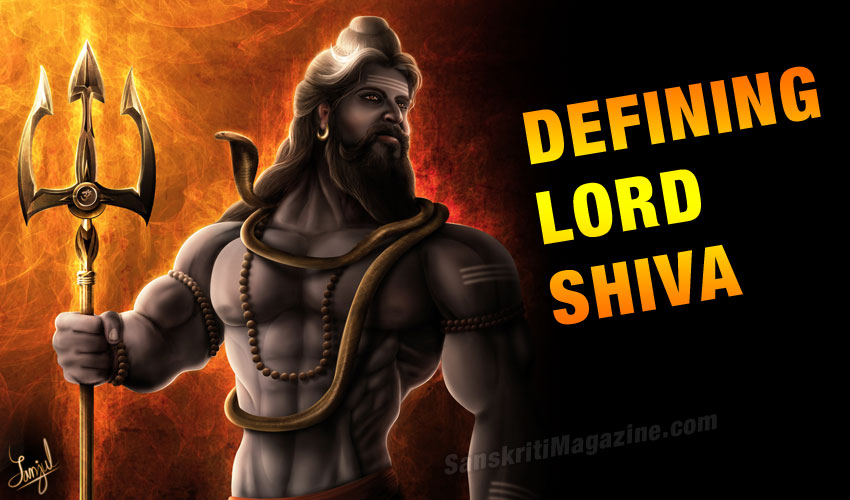
The actual image of Shiva is also distinct from other deities: his hair piled high on the top of his head, with a crescent tucked into it and the river Ganges tumbling from his hairs. Around his neck is a coiled serpent representing Kundalini or the spiritual energy within life. He holds a trident in his left hand in which is bound the ‘damroo’ (small leather drum). He sits on a tiger skin and on his right is a water pot. He wears the ‘Rudraksha’ beads and his whole body is smeared with ash.

The Destructive Force:

Shiva is believed to be at the core of the centrifugal force of the universe, because of his responsibility for death and destruction. Unlike the godhead Brahma, the Creator, or Vishnu, the Preserver, Shiva is the dissolving force in life. But Shiva dissolves in order to create, since death is the medium for rebirth into a new life. So the opposites of life and death and creation and destruction both reside in his character.

The Most Fascinating of Gods:

He is also often portrayed as the supreme ascetic with a passive and composed disposition. Sometimes he is depicted riding a bull called Nandi decked in garlands. Although a very complicated deity, Shiva is one of the most fascinating of Hindu gods.

The God Who’s Always High!:

Since Shiva is regarded as a mighty destructive power, to numb his negative potentials he is fed with opium and is also termed as ‘Bhole Shankar’, one who is oblivious of the world. Therefore, on Maha Shivratri, the night of Shiva worship, devotees, especially the menfolk, prepare an intoxicating drink called ‘Thandai’ (made from cannabis, almonds, and milk) sing songs in praise of the Lord and dance to the rhythm of the drums.
~ Subhamoy Das

You may also like

Search the website

Like us on Facebook

Get daily updates via Email

Enter your email address:

Recent Posts

Jamai Shashthi 2026 — The Story of Maa Shashthi, the Cat, and the Wife Who Was Forgiven

Jamai Shashthi 2026 — The Story of Maa Shashthi, the Cat, and the Wife Who Was Forgiven

On Saturday, June 20, 2026, Bengali households across Bharata will welcome their married daughters and sons-in-law home for the legendary jamai-aador feast and perform the Shashthi Vrata. But behind the warmth lies a story most Bengalis know by heart and most non-Bengalis have never heard — the wife who stole the hilsa, blamed the cat, lost six sons to Maa Shashthi’s wrath, and was finally forgiven. The Vrat Katha, the vidhi, the mantras, and the deeper teaching.

Vat Purnima 2026 — The Wife Who Argued Yama Into Returning Her Husband’s Life

On Monday, June 29, 2026, women across Maharashtra, Gujarat, and southern Bharata will tie red thread around banyan trees and hear the story of Savitri — the wife who walked behind Yamaraja Himself when He came for her husband, and out-argued the Lord of Dharma into returning Satyavan’s life. The Mahabharata’s Pativrata Mahatmya Parva, the vrat vidhi, and why the banyan witnessed everything.

Purushottam Maas — The Month No Deity Would Claim, and the Lord Who Made It Supreme

Every month of the Hindu calendar has a lord — except the rare thirteenth, the Adhika Maas, born an orphan and shunned as the “impure month.” The Puranas tell how this rejected month went in grief to Bhagavan Vishnu, who claimed it, gave it His own name — Purushottam — and made it the most fruitful month of all. The origin story, the teaching, and what it means for Purushottam Maas 2026 (May 17 – June 14).

Padmini Ekadashi 2026 — The Ekadashi Even the Devas Descend to Keep

Padmini Ekadashi 2026 — The Ekadashi Even the Devas Descend to Keep

The rarest Ekadashi of the entire Hindu calendar is three days away. The Padma Purana preserves a conversation between Bhagavan Krishna and Yudhishthira about a single Ekadashi the great Rishis spend lifetimes waiting for — Padmini. The Vrat Katha of Queen Padmini of Mahishmati, the lotus teaching, and why May 27, 2026 is the morning Vaishnavas across Bharata are preparing for.

Varada Chaturthi 2026 — The Rare Ganesha Day of Purushottam Maas

Varada Chaturthi 2026 — The Rare Ganesha Day of Purushottam Maas

Once every 2.5–3 years — when the rare 13th month of Adhika Maas opens — a thirteenth Vinayaka Chaturthi appears. The Mudgala Purana calls it Varada Chaturthi, the “boon-giving” Chaturthi, and holds it as the most fruit-bearing Ganesha day of the entire calendar. Today, Wednesday May 20, 2026, is that day.

css.php