If you open up your heart
You will know what I mean
We’ve been polluted so long
But here’s a way for you to get clean
By chanting the names of the Lord and you’ll be free
The Lord is awaiting on you all to awaken and see.
(“Awaiting On You All” – from the Beatles album All Things Must Pass)
George Harrison Made It Famous
In 1969, one of the Beatles, perhaps the most popular music group of all time, produced a hit single, “The Hare Krishna Mantra”, performed by George Harrison and the devotees of the Radha-Krishna Temple, London. The song soon topped the 10 best-selling record charts throughout UK, Europe, and Asia. Soon after the BBC featured the ‘Hare Krishna Chanters’, four times on the popular television program Top of the Pops. And the Hare Krishna chant became a household word, especially in parts of Europe and Asia.
Swami Prabhupada & the Krishna Consciousness Movement
Swami Prabhupada, believed to be a pure devotee of Lord Krishna, laid the foundations of the Hare Krishna Movement by coming to the USA at the advanced age of seventy in order to fulfill the desire of his own spiritual master who wanted him to spread Krishna consciousness in the Western countries. Aubrey Menen in his book The Mystics, while writing about Prabhupadas proselytization in the US, notes:
“Prabhupada presented them [Americans] with a way of life of an Arcadian simplicity. It is no wonder that he found followers. He opened his mission on the Lower East Side in New York in an empty shop, fitted with nothing but mats on the floor. One of his earliest disciples, with the swami’s permission has recorded an incident. Two or three were gathered together to listen to the swami, when an old grey Bowery drunk entered. He carried a pack of paper hand-towels and a roll of toilet paper. He walked past the Swami, placed the towels and the toilet paper carefully on a sink, and left. Prabhupada rose to the occasion. ‘Look,’ he said, ‘he has just began his devotional service. Whatever we have — it doesn’t matter what — we must offer to Krishna.'”
The Hare Krishna Mantra
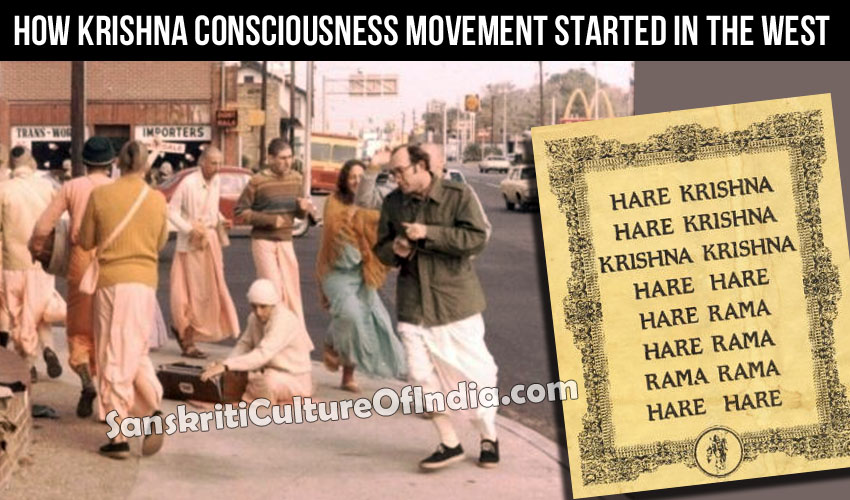
It was 1965 — the beginning of the “mid-twentieth century phenomenon” called the “Krishna Consciousness Movement”. The “saffron-robed, dance-happy, book-hawking” Krishna followers burst upon the world with the refrain:
Hare Krishna, Hare Krishna, Krishna, Krishna, Hare, Hare,
Hare Rama, Hare Rama, Rama, Rama, Hare, Hare
History of the Hare Krishna Chant
Everyone knows this mantra as the anthem of the International Society for Krishna Consciousness (ISKCON). However, the origin of this faith dates back to 5,000 years ago when Lord Krishna was born in Vrindavan to save the citizens from the tyrant King Kansa. Later in the 16th century Chaitanya Mahaprabhu revived the Hare Krishna Movement and preached that all can gain a personal relationship with the Lord throughsankirtana, ie, a collective chanting of the name of Krishna. Many religious leaders kept alive the faith of “leading the people towards god through devotional songs and selfless Bhakti” — the way of devotion, and Swami Prabhupada, the founder of ISKCON is the most notable among them.
~ Subhamoy Das