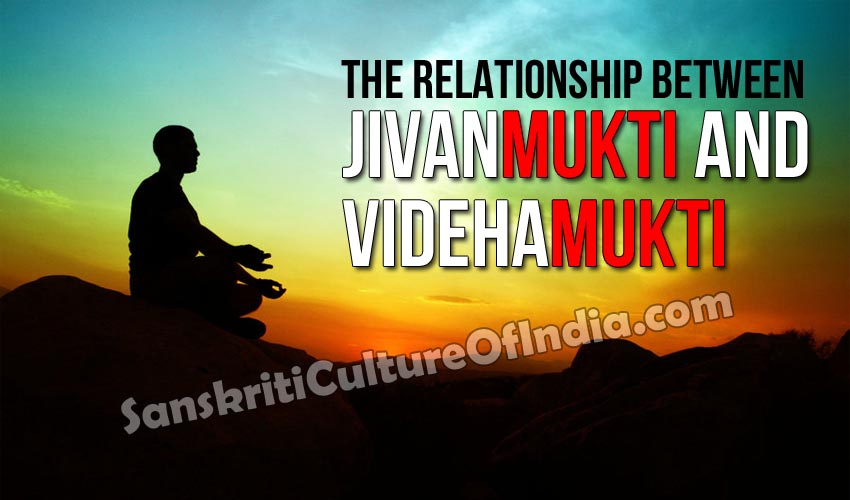
Samkhya philosophers have accepted both jivanmukti as well as videhamukti. The jiva attains freedom the moment he realizes the truth even though he may have to continue to live in the body for a short period because of actions accumulated in the past.
Just as the wheel continues to revolve for some time due to its prior motion, even after the potter has ceased moving it, in much the same way, the body of the jiva continues to exist for some time after the attainment of liberation because of the past actions of the body. But the liberated self does not experience any relation with body even though residing in it.
Thus no new karmas are accumulated and the earlier ones begin to lose their power. But final and complete liberation i attainable only after death, and in this there is no relation even with the body. This is videhamukti. In this state, complete liberation is attained after freedom from all kinds of bodies, subtle and gross, has been obtained.
According to Vijnanbhikshu, videhamukti is the only kind of liberation because as long as the body detains the soul, the latter is not entirely free from mental and physical distortions. According to the Vedanta, liberation is a state of happiness. According to Samkhya, both pain of suffering and pleasure are relative and inseparable. Hence, there is no happiness in the state of liberation. It is above pleasure and suffering. It is beyond all qualities.
Both liberation and bondage have only practical reality:
According to the Samkhya philosophy, the distinction between liberation and bondage is only practical. The self is not bound and it is the ego that is liberated. Self is beyond both liberation and bondage. If the self did actually become bound, it could not have freed itself even in hundred lives because real bondage cannot be destroyed.
It is the prakriti that is eventually liberated. Ishwar Krisna has said that in actual fact, self is neither bound, nor liberated nor is it reborn. Bondage, liberation and rebirth are the attributes of prakriti. Prakriti binds herself in her own seen forms. There is nothing more subtle than or superior to prakriti. It is so delicate that once the purusa sees her in her real form she does not confront him a second time.
Criticism:
The following are some objections raised against the Samkhya concept of liberation:
(1) If the purusa is the agent as well as the one who experiences, then how is it free by nature? And if the evolution of prakriti takes place in order to achieve its liberation, then how is it eternally free?
(2) According to Samkhya, there is no happiness in liberation. The Samkhyas have thus confused happiness with pleasure.
(3) According to Prasastapada, how can prakriti come to know that the purusa has recognized it? If prakriti is by nature dynamic then how will it remain inactive in a stale of liberation? If there can be no destruction of an object, then how can ignorance be destroyed?
Actually, the Samkhya concept of liberation fits better into the background of Advaita Vedanta than that of Samkhya itself.
~ Charkavarthy