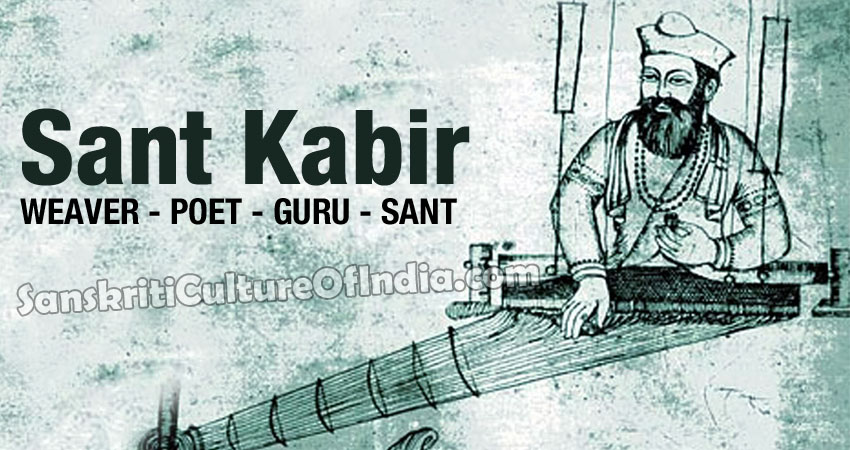
The saint poet Kabir is one of the most interesting personalities in the history of Indian mysticism. Born near Benaras or Varanasi, of Muslim parents, in c.1440, he became in early life a disciple of the celebrated 15th century Hindu ascetic Ramananda, a great religious reformer and founder of a sect to which millions of Hindus still belong.
Kabir’s Early Life in Varanasi
Kabir’s story is surrounded by contradictory legends that emanate from both Hindu and Islamic sources, which claim him by turns as a Sufi and a Hindu saint. Undoubtedly, his name is of Islamic ancestry, and he is said to be the actual or adopted child of a Muslim weaver of Varanasi, the city in which the chief events of his life took place.
How Kabir Became a Disciple of Ramananda
The boy Kabir, in whom the religious passion was innate, saw in Ramananda his destined teacher; but knew how slight were the chances that a Hindu guru would accept a Muslim as disciple. He therefore hid on the steps of the river Ganges, where Ramananda came to bathe often; with the result that the master, coming down to the water, trod upon his body unexpectedly, and exclaimed in his astonishment, “Ram! Ram!” – the name of the incarnation under which he worshipped God. Kabir then declared that he had received the mantra of initiation from Ramananda’s lips, and was by it admitted to discipleship. In spite of the protests of orthodox Brahmins and Muslims, both equally annoyed by this contempt of theological landmarks, he persisted in his claim.
Ramananda’s Influnce on Kabir’s Life and Works
Ramananda appears to have accepted Kabir, and though Muslim legends speak of the famous Sufi Pir, Takki of Jhansi, as Kabir’s master in later life, the Hindu saint is the only human teacher to whom in his songs he acknowledges indebtedness. Ramananda, Kabir’s guru, was a man of wide religious culture who dreamed of reconciling this intense and personal Mohammedan mysticism with the traditional theology of Brahmanism and even Christian faith: and it is one of the outstanding characteristics of Kabir’s genius that he was able in his poems to fuse these thoughts into one.
Was Kabir a Hindu or a Muslim?
Hindus called him Kabir Das, but it is impossible to say whether Kabir was Brahmin or Sufi, Vedantist or Vaishnavite. He is, as he says himself, “at once the child of Allah and of Ram.” Kabir was a hater of religious exclusivism, and seeking above all things to initiate human beings into the liberty of the children of God. Kabir remained for years the disciple of Ramananda, joining in the theological and philosophical arguments which his master held with all the great Mullahs and Brahmins of his day, which acquainted him to both Hindu and Sufi philosophy.
Kabir’s Songs are His Greatest Teachings
It is by his wonderful songs, the spontaneous expressions of his vision and his love, and not by the didactic teachings associated with his name, that he makes his immortal appeal to the heart. In these poems a wide range of mystical emotion is brought into play – expressed in homely metaphors and religious symbols drawn indifferently from Hindu and Islamic beliefs.
Kabir Lived a Simple Life
He may or may not have submitted to the traditional education of the Hindu or the Sufi contemplative and never adopted the life of an ascetic. Side by side with his interior life of adoration, its artistic expression in music and words, he lived the sane and diligent life of a craftsman. Kabir was a weaver, a simple and unlettered man, who earned his living at the loom. Like Paul the tentmaker, Boehme the cobbler, Bunyan the tinker, Tersteegen the ribbon-maker, he knew how to combine vision and industry. And it was from out of the heart of the common life of a married man and the father of a family that he sang his rapturous lyrics of divine love.
Kabir’s Mystical Poetry was Rooted in Life and Reality
Kabir’s works corroborate the traditional story of his life. Again and again he extols the life of home, the value and reality of diurnal existence, with its opportunities for love and renunciation. The “simple union” with Divine Reality was independent both of ritual and of bodily austerities; the God whom he proclaimed was “neither in Kaaba nor in Kailash.” Those who sought Him needed not to go far; for He awaited discovery everywhere, more accessible to “the washerwoman and the carpenter” than to the self-righteous holy man. Therefore the whole apparatus of piety, Hindu and Muslim alike – the temple and mosque, idol and holy water, scriptures and priests – were denounced by this inconveniently clear-sighted poet as mere substitutes for reality; as he said, “The Purana and the Koran are mere words.”
The Last Days of Kabir’s Life
Kabir’s Varansi was the very center of Hindu priestly influence, which made him subject to considerable persecution. There is a well-known legend about a beautiful courtesan, who was sent by Brahmins to tempt Kabir’s virtue. Another tale talks of Kabir being brought before the Emperor Sikandar Lodi, and charged with claiming the possession of divine powers. He was banished from Varanasi in 1495 when he was nearly 60 years old. Thereafter, he moved about throughout northern India with his disciples; continuing in exile a life of an apostle and a poet of love. Kabir died at Maghar near Gorakhpur in 1518.
~ Based on Evelyn Underhill’s introduction in Songs of Kabir translated by Rabindranath Tagore and published by The Macmillan Company, New York (1915)