IndianSanskriti
dogma

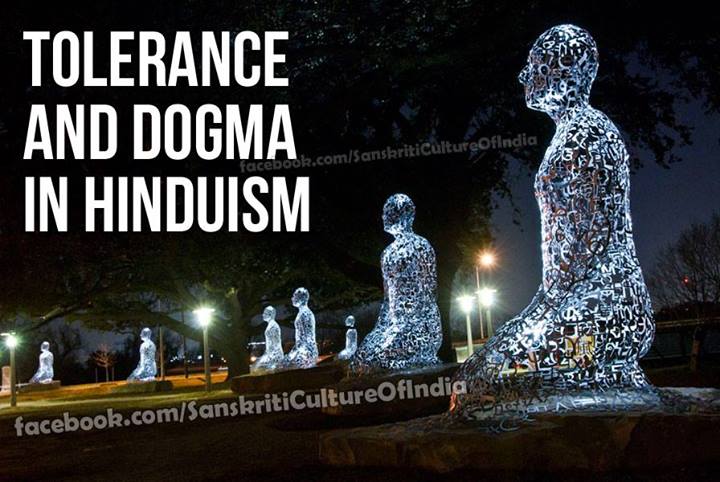
Tolerance and Dogma in Hinduism

In Sanskrit a religion is also known as matam. Thus Hinduism is also called Hindu Matam in Sanskrit and several native Indian languages, such as Telugu.A spokes person or messenger for a religion or religious movement is called mata pravakta, meaning he who speaks for that particular school of thought.Mata tirtha means a sacred place. Matacarya means a religious teacher. Mata bheda means differences of opinions.A missionary is called mata pracaraka. In recent times communal violence is often described in the newspapers as mata kalaha.

Mata is now increasingly used to denote a religion, but traditionally it was used in India to denote an opinion or belief.

Mata may have been the precursor for mattah, meaning the hut of a religious ascetic, a monastery, or a place of learning, such as those found by Shankaracarya.

The word amply illustrates the religious conditions that prevailed in ancient India and why Hinduism remained free from the restrictions of dogma and the authoritarianism of despotic religious institutions.

In a general sense matam means thought or opinion. Your matam means your thinking, belief or stand point. According to Monier Williams Sanskrit Dictionary, mata means a thought, opinion, sentiment, view, belief, intention, or doctrine. in other words, matam represents what is thought, believed, imagined or understood.

The meaning amply conveys why ancient India was noted for religious freedom and why Hinduism defies a clear definition and does not fit into the rigid concept of a religion.

In Hinduism there is nothing like a dogma, which needs to be accepted as inviolable by everyone because someone said so. There may be an opinion, school of thought or point of view, which some people may hold true, but not necessarily by everyone.

However, there was one criteria which the Vedic religion looked to as far as such opinions were considered. They must stand the scrutiny of truth. One must be able to validate them with direct knowledge or evidence or one must be able to submit proof from the Vedas as to their veracity.

In Hinduism, the Vedas are considered standard testimony to validate the thoughts and opinions held by different people, because they represent the higher knowledge and the word of God.

If someone holds an opinions and shows proof from the Vedas that they are in agreement with such opinions, the tradition accepts those opinions as valid and reliable.

Since, many opinions can be validated with the help of the Vedas, Hinduism allows diversity of opinions to prevail, without showing any open preference for any particular opinions. It is left to the people and the scholars to follow or accept whatever opinions that may suit them.

Thus, in Hinduism you do not find any dogma, but many points of view, schools of thought and diverse opinions, each having a following of its own. If there is an opinion which says, God is one and has no form, Hinduism allows that opinion because the Vedas describe Brahman as formless. If someone else want to worship numerous gods and make them offerings, Hinduism allows that also because, the same Vedas describe God as many.

Duality and diversity are the undeniable realities of life upon earth. Hinduism allows these two to prevail in religious life also as part of God’s creation. In the final journey of liberation, eventually one has to renounce all these opinions and attachment to them to cross over to the other side and become the truth itself.
You may also like

Search the website

Like us on Facebook

Get daily updates via Email

Enter your email address:

Recent Posts

Yogini Ekadashi 2026 — The Yaksha Who Missed the Morning Flowers, and the Ekadashi That Undid His Curse

On Friday, July 10, 2026, the rare Krishna Paksha Ekadashi of Nija Ashadha arrives. The Padma Purana tells the story of Hemamali — the Yaksha gardener of Bhagavan Kubera in Alaka, whose single morning of distraction with his wife Vishalakshi cost him his form, his wife, and his celestial city. Cursed to wander the earth of Bharata as a leper for a long time, he was at last shown the way back by Sage Markandeya — a single sincere keeping of Yogini Ekadashi.

Jamai Shashthi 2026 — The Story of Maa Shashthi, the Cat, and the Wife Who Was Forgiven

Jamai Shashthi 2026 — The Story of Maa Shashthi, the Cat, and the Wife Who Was Forgiven

On Saturday, June 20, 2026, Bengali households across Bharata will welcome their married daughters and sons-in-law home for the legendary jamai-aador feast and perform the Shashthi Vrata. But behind the warmth lies a story most Bengalis know by heart and most non-Bengalis have never heard — the wife who stole the hilsa, blamed the cat, lost six sons to Maa Shashthi’s wrath, and was finally forgiven. The Vrat Katha, the vidhi, the mantras, and the deeper teaching.

Vat Purnima 2026 — The Wife Who Argued Yama Into Returning Her Husband’s Life

On Monday, June 29, 2026, women across Maharashtra, Gujarat, and southern Bharata will tie red thread around banyan trees and hear the story of Savitri — the wife who walked behind Yamaraja Himself when He came for her husband, and out-argued the Lord of Dharma into returning Satyavan’s life. The Mahabharata’s Pativrata Mahatmya Parva, the vrat vidhi, and why the banyan witnessed everything.

Nija Jyeshtha 2026 — The Real Jyeshtha Begins, and the Calendar Resumes

Nija Jyeshtha 2026 — The Real Jyeshtha Begins, and the Calendar Resumes

With Adhik Maas now closed on the Somvati Amavasya of June 15, the long-postponed festivals of Jyeshtha return — Vat Purnima (June 29, the Savitri-Yamaraja katha), Jamai Shashthi (June 20, the Bengali festival of Maa Shashthi), Sankashti Chaturthi (June 28), Yogini Ekadashi (July 10), and Devshayani Ekadashi (July 16, opening the four-month Chaturmas of Bhagavan Vishnu’s yoga-nidra). A guide to what the next four weeks hold and what the household that kept Purushottam Maas now carries forward.

css.php