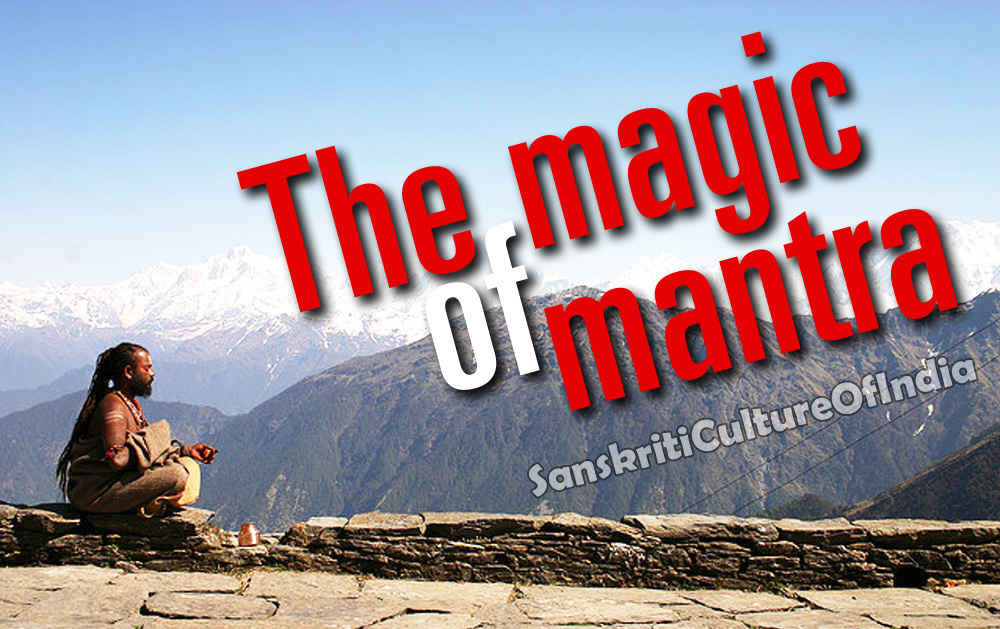
A mantra must be uttered, audibly or inaudibly, in a proper way, to produce its effect. The uchcharan or utterance or recitation in a proper way is important for Shabda, or sound, which is of the Brahman, and as such the cause of the Brahmanda, is the manifestation of Chit or Absolute Knowledge itself. Philosophically shabda is the guna of akasha, or ethereal space. It is not, however, produced by akasha, but manifests in it. In the same way, as in outer space, waves of sound are produced by movements of air, so in the space within the body, waves of sound are produced according to the movements of the vital air through the process of inhalation and exhalation.
Prana manifests in the human body as breath though inspiration (Sa) (or Shakti) and expiration (Ha) (or Shiva). Breathing is itself a Mantra, known as the Mantra which is not recited (Ajapa-Mantra), for it is said without volition.
A simple analysis of the above makes us observe that one is constantly breathing (“prana-mantra” – the eternal “Karmic” principle of nature !) without the application of one’s efforts or will. This is nature’s own principle of “Japa” and eternal “Karma” which regulates life. Once this “prana-mantra” is eliminated, the kinetic principle of life (evolving from Sat) changes into the static principle of life or death (dissolving in Sat).
The utterance of a mantra without knowledge of its meaning is a mere movement of the lips and nothing more. Without knowledge of the meaning, the mantra sleeps and is not potent. Only when one utters a mantra with full awareness of its meaning, only then the mantra is awake and vibrant with potent energy. Only then it is a magical and energized to permeate in the very being of the sadhaka.
Every mantra is a form of the Brahman and not merely letters of the alphabet. From manana or thinking, arises the real understanding that the substance of the Brahman and Brahmanda are one and the same.
Man – of mantra comes from the first syllable of manana, and – tra from trana, or liberation from the bondage of the sansara or the phenomenal world. By the combination of man- and -tra, is the mantra – a word of power – a compelling force that vibrates not only in the very being of the one who utters, but also subtly in the entire universe.
The mantra of a Devata (deity) is the Devata. The rhythmical vibrations of its sound not merely regulate the unsteady vibrations of the sheaths of the worshipper, thus transforming him, but from it arises the form of the Devata which it is.
The Gayatri Mantra:
The Gayatri Mantra is the most sacred of all Vaidik mantras. In it the Vedas lie embodied as in its seed.
ॐ भूर्भुवः स्वः
तत्सवितुर्वरेण्यं ।
भर्गो देवस्य धीमहि
धियो यो नः प्रचोदयात् ॥
Om Bhur Bhuvah Svah
Tat Savitur Varenyam
Bhargo Devasya Dhimahi
Dhiyo Yo Nah Prachodayat. Om.
Let us contemplate on the wondrous spirit of the Divine Creator of the earthly, atmospheric and celestial spheres. May He Himself illumine our minds!
The Gayatri Mantra is in true sense the acknowledgment of Surya (Sun) by our ancients as the most tangible God. Tat Savitur – That Bringer-forth – directly relates to Sun. The Sun is the cause of all that exists, and of the state in which they exist. Our Solar system has emanated from and will be again absorbed into Him. Time is of and in Him. He is the light of the light in the solar circle and is the light of the lives of all beings. As He is in the outer ether, so also is He in the ethereal region of the heart. In the outer ether He is Surya and in the inner ether He is the wonderful Light which is the smokeless Fire.
What today the scientists may call as the Laws of Physics, to the Hindu ancients too, perhaps it was the same. Understanding this secret is the revelation of the magic of mantra.
~ Rajender Krishan