IndianSanskriti
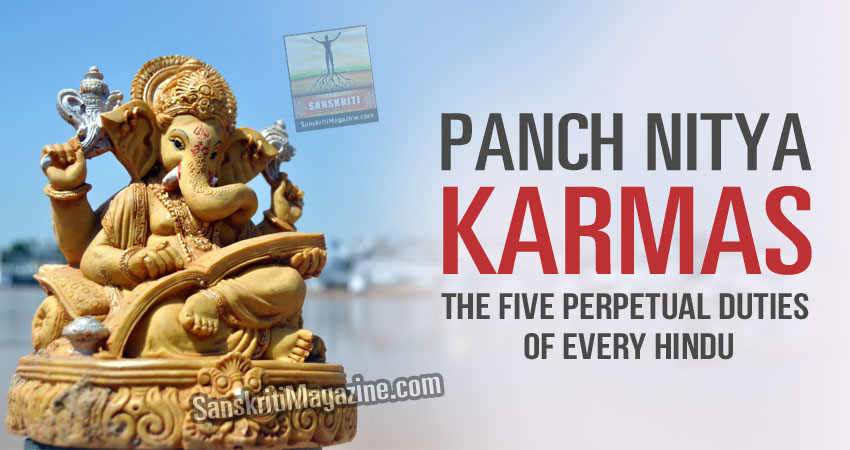
Panch Nitya Karmas

Panch Nitya Karmas

Pancha Nitya Karmas is a Sanskrit term that means, “The five perpetual duties of every Hindu.”  By living according to these noble religious principles, we spiritualize our religious life and come to realize our own divine nature. It is the duty of the parents and elder members of the family to inculcate in their children these simple principles that will allow them to grow up with a strong religious and spiritual base and become “BETTER HUMAN BEING”.

1. Upasana: Worship in the altar at home or in the temple

It refers to the religious education that the children receive at home, through the example of the adults, who teach them to duly carry out their rituals at the home altar on a daily basis.

2. Utsava: Holy days

Participation in the different festivals of Hinduism, as well as the participation on the holy days, is impressed upon the children, both at home and in the temple. Utsava also includes fasting on Ekadasi, as well as attending the temple during festivities.

3. Dharma: Living a virtuous life

It is impressed upon the children to live a life of high moral and ethical values; to comply with one’s duty and to maintain good behavior; to respect their elders and the sannyasis; to follow a life of respect for religious values, especially to maintain the principle of ahimsa, or not to damage or hurt any living being in thought, word or action; teaching the children and youth about Hinduism, its holy scriptures and the exemplary lives of its great saints and masters. These are instruments for the development, evolution and maturity of future generations.

4. Tirthayatra: Pilgrimage

The children are exposed to the value of making pilgrimages to holy places and temples, with the objective of receiving benedictions and inspiration from holy persons through darshan. It is important that the children acquire religious and spiritual values while making such journeys, where the central focus is not the satisfaction of the senses but God, the guru and the religion.

5. Samskara: Rites and ceremonies of passage

The children are taught to observe the different sacraments of Hinduism, which sanctify and emphasize the diverse transitions in one’s life. It is important to impress upon the children, from a young age, the meaning of the sacraments and an affection towards their tradition, culture and religion.

~  Avadhuta Sri Ramakrishnananda
You may also like

Search the website

Like us on Facebook

Get daily updates via Email

Enter your email address:

Recent Posts

Yogini Ekadashi 2026 — The Yaksha Who Missed the Morning Flowers, and the Ekadashi That Undid His Curse

On Friday, July 10, 2026, the rare Krishna Paksha Ekadashi of Nija Ashadha arrives. The Padma Purana tells the story of Hemamali — the Yaksha gardener of Bhagavan Kubera in Alaka, whose single morning of distraction with his wife Vishalakshi cost him his form, his wife, and his celestial city. Cursed to wander the earth of Bharata as a leper for a long time, he was at last shown the way back by Sage Markandeya — a single sincere keeping of Yogini Ekadashi.

Jamai Shashthi 2026 — The Story of Maa Shashthi, the Cat, and the Wife Who Was Forgiven

Jamai Shashthi 2026 — The Story of Maa Shashthi, the Cat, and the Wife Who Was Forgiven

On Saturday, June 20, 2026, Bengali households across Bharata will welcome their married daughters and sons-in-law home for the legendary jamai-aador feast and perform the Shashthi Vrata. But behind the warmth lies a story most Bengalis know by heart and most non-Bengalis have never heard — the wife who stole the hilsa, blamed the cat, lost six sons to Maa Shashthi’s wrath, and was finally forgiven. The Vrat Katha, the vidhi, the mantras, and the deeper teaching.

Vat Purnima 2026 — The Wife Who Argued Yama Into Returning Her Husband’s Life

On Monday, June 29, 2026, women across Maharashtra, Gujarat, and southern Bharata will tie red thread around banyan trees and hear the story of Savitri — the wife who walked behind Yamaraja Himself when He came for her husband, and out-argued the Lord of Dharma into returning Satyavan’s life. The Mahabharata’s Pativrata Mahatmya Parva, the vrat vidhi, and why the banyan witnessed everything.

Nija Jyeshtha 2026 — The Real Jyeshtha Begins, and the Calendar Resumes

Nija Jyeshtha 2026 — The Real Jyeshtha Begins, and the Calendar Resumes

With Adhik Maas now closed on the Somvati Amavasya of June 15, the long-postponed festivals of Jyeshtha return — Vat Purnima (June 29, the Savitri-Yamaraja katha), Jamai Shashthi (June 20, the Bengali festival of Maa Shashthi), Sankashti Chaturthi (June 28), Yogini Ekadashi (July 10), and Devshayani Ekadashi (July 16, opening the four-month Chaturmas of Bhagavan Vishnu’s yoga-nidra). A guide to what the next four weeks hold and what the household that kept Purushottam Maas now carries forward.

css.php