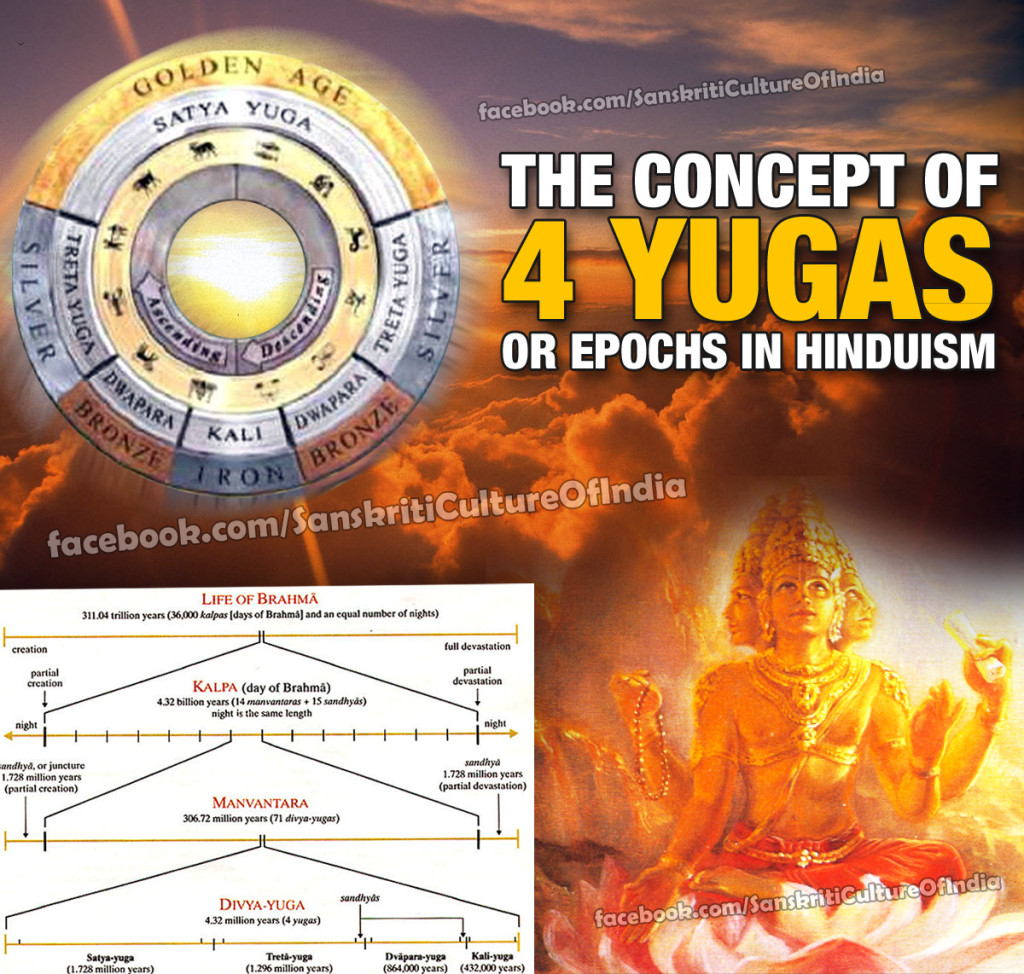
According to Hindu scriptures, all mortal beings are destined to pass through four great epochs in every cycle of creation and destruction. This divine cycle turns full-circle at the end of what is known as kalpa. A kalpa is a yuga cycle, which is a period of 10,000 divine years, and is divided into four ages or yugas (Sanskrit yuga = age/epoch). According to one calculation, one yuga cycle is estimated to be 4,320,000 years, and one kalpa 4,320,000,000 years.
 About the 4 Yugas
The four great epochs in Hinduism are: Satya Yuga, Treta Yuga, Dwapar Yuga and Kali Yuga. Satya Yug or the Age of Truth is said to last for four thousand divine years, Treta Yuga for three thousand, Dwapara Yug for two thousand and Kali Yuga will last for one thousand divine Years that equals to 432,000 earthly years.
It is also believed that three of these great ages have already passed away, and we are now living in the fourth one. What these ages exactly mean, and why this division, it’s hard to explain, because they appear too unrealistic to be true for the rational mind.
Songs of Innocence & Experience!
The four ages symbolize the four phases of involution during which man gradually lost the awareness of his inner selves and subtle bodies. Hinduism believes that human beings have five kinds of bodies, called annamayakosa, pranamayakosa, manomayakosa vignanamayakosa and anandamayakosa, which represent the ‘gross body’, the ‘breath body’, the ‘psychic body’, the ‘intelligence body’ and the ‘bliss body’ respectively.
Another theory explains these epochs of time on the basis of the degree of loss of righteousness in the world. It says, during Satya Yuga only truth prevailed (Sanskrit Satya = truth), Treta lost ¼ truth, Dwapar lost ½ truth and Kali is left with only ¼ truth. Evil and dishonesty has replaced truth in the last three ages or yugs.
 Dasavatara: The 10 Avatars
Throughout these four yugas, Lord Vishnu is said to incarnate ten times in ten different avatars. This is known as ‘Dasavatara’ (Sanskrit dasa = ten). During the Age of Truth, human beings were spiritually most advanced and had great psychic powers. In the Treta Yuga people still remained righteous and adhered to moral ways of life. Lord Rama of the fabled Ramayana lived in Treta Yuga. In the Dwapara Yuga, men had lost all knowledge of the intelligence and bliss bodies. Lord Krishna was born in this age. The present Kali Yuga is the most degenerated of the Hindu epochs.
Living in the Kali Yuga!
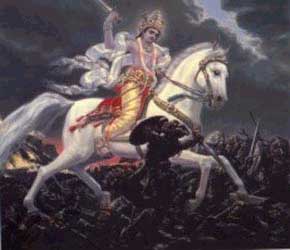
We live in the Kali Yuga — in a world infested with impurities and vices. People possessing genial virtues are diminishing day by day. Floods and famine, war and crime, deceit and duplicity characterize this age. But, say the scriptures, final emancipation is possible only in this age.
 The Signs of Kali Yuga!
Kali Yuga has two phases: In the first, humans — having lost the knowledge of the two higher selves — had knowledge of the ‘breath body’ apart from the physical self. During the second phase even this knowledge has deserted mankind, leaving us only with the awareness of the gross physical body. This explains why we are now more preoccupied with our physical self than anything else.
Due to our preoccupation with our physical bodies and our lower selves, and because of our emphasis on the pursuit of gross materialism, this age has been termed the ‘Age of Darkness’ — an age when we have lost touch with our inner selves, an age of profound ignorance!
What the Scriptures Say
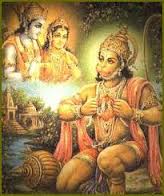 Both the two great epics – The Ramayana & Mahabharata – have spoken about the Kali Yuga. In the Tulasi Ramayana, we find Kakbhushundi foretelling: “In the Kali Yuga, the hot-bed of sin, men and women are all steeped in unrighteousness and act contrary to the Vedas… every virtue had been engulfed by the sins of Kali Yuga; all good books had disappeared; impostors had promulgated a number of creeds, which they had invented out of their own wit. The people had all fallen prey to delusion and all pious acts had been swallowed by greed.”
In the Mahabharata (Santi Parva) Yudhishthir says: “… The ordinances of the Vedas disappear gradually in every successive age… the duties in the Kali age are entirely of another kind. It seems, therefore, that duties have been laid down for the respective age according to the powers of human beings in the respective ages.” The sage Vyasa later on clarifies: “In the Kali Yuga, the duties of the respective order disappear and men become afflicted by inequity.”
What Happens Next?
It is predicted that at the end of the Kali Yuga, Lord Shiva shall destroy the universe and all the physical body would undergo a great transformation. After such dissolution, Lord Brahma would recreate the universe and mankind will become the ‘Beings of Truth’ once again.
~ Subhamoy Das