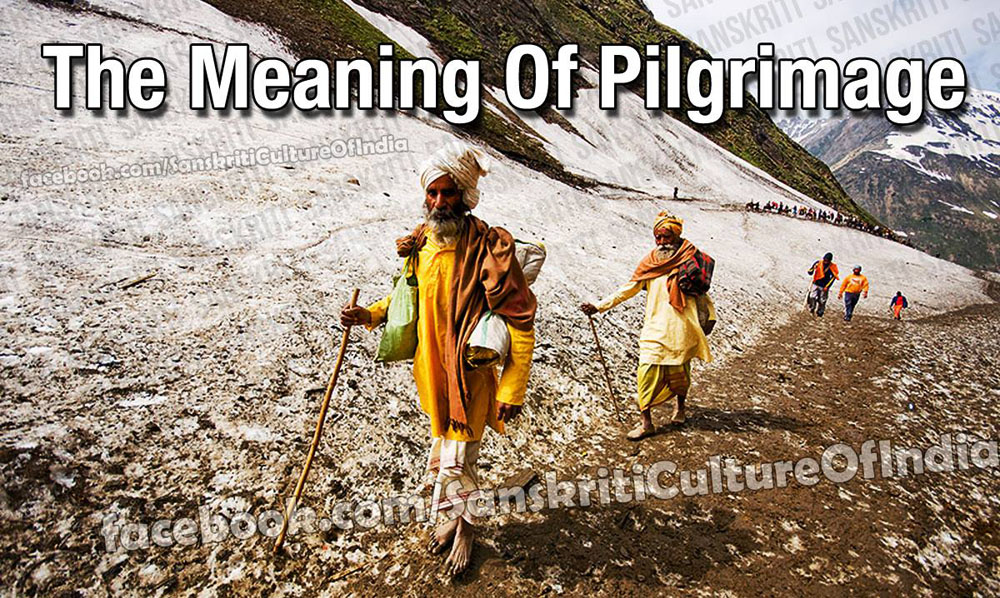
Pilgrimages are intentionally difficult journeys of devotion. By making a long journey to these powerful places, pilgrims achieve a degree of personal growth. The act of pilgrimage serves as a bridge between the known realm of earth, nature, society, and the unknown world of divine beings, from the ephemeral and illusory to reality and eternity.
A place of pilgrimage is known as a ‘tirtha sthana’ – ‘which is associated with or inhabited by sages deserving reverence, who are without desire, egoism or delusion and who have been purified by a performance of penance’ says the Garuda Purana. A tirtha refers to ‘crossing the ford’ – to cross is to be transformed. Among the holiest Hindu tirthas are sacred rivers, especially the Ganges. Its entire length is sacred, yet at some points t is believed that its sanctity comes to a focus. One of these points is Kashi. A tirtha is directly experienced as an intensification of the sacred or supernatural power in time and space. It is there – to be seen, to be felt, to enter, rather as the hearth is the centre of the home, to which all who enter naturally gravitate. And this, despite the fact that home and tirtha are essentially opposites…..
The pilgrim makes a transformative journey to a tirtha in order to see, to have darshan – which means ‘seeing’: Kashi darshan, Vishwanath darshan, Himalaya darshan. All nature is capable of revealing itself as cosmic sacrality. An integral religious society like India’s, searches for identity in the cosmos. The cosmos in its entirety can become a hierophany – a ‘divine showing’. The struggle to overcome difficulties of journey opens up to pilgrims deeper realities and resources of their own being and of the surrounding world. Pilgrimage brings together inner and outer worlds, the physical landscape serving as a mirror for the inner one. The pilgrim is cast from the relatively closed home world onto the vastness of nature…. Indian pilgrimages…. reflects a belief that there is something close to the essence, to beauty and truth in the landscape through which the seeker journeys. Pilgrimage is metaphysical sightseeing….
Eliade points out, man does not ‘choose’ these places: they are merely ‘discovered’ by him. Such tirthas, to which the faithful have made pilgrimage since time immemorial, usually possess palpably ‘magical’ atmosphere and physical beauty….. The sheer size of the subcontinent has traditionally provided little stimulus to venture abroad. But the need of the landlocked to break out, to get up and go, abandon stale routine for a while and be free spirits, has fostered the urge to undertake pilgrimage on an unprecedented scale.
To attract large numbers, the tirtha sthana must both be an accessible crossway and yet distant enough to be reached from afar by an arduous journey – like Mecca, Jerusalem, Delos Compostella, Benaras, located at a territorial midpoint, at the intersection of transcontinental trade routes…. The essence of pilgrimage is movement outwards and away from the home base. Even those who are permanently resident in places of pilgrimage have the same urge to take off on a journey to some distant tirtha.
Pilgrimage is a universal feature in the religious life of man – and even those who profess no religion still feel the urge to make an arduous journey to some distant and elevating goal that transcends the normal parameters of their lives. To benefit from the spiritual and moral qualities of a holy place both pilgrims and secular-intentional seekers must approach their goal in the right frame of mind.
~Richard Lannoy