IndianSanskriti
Bhut Jolokia - One of World's Hottest Chilli

Bhut Jolokia – One of World’s Hottest Chilli

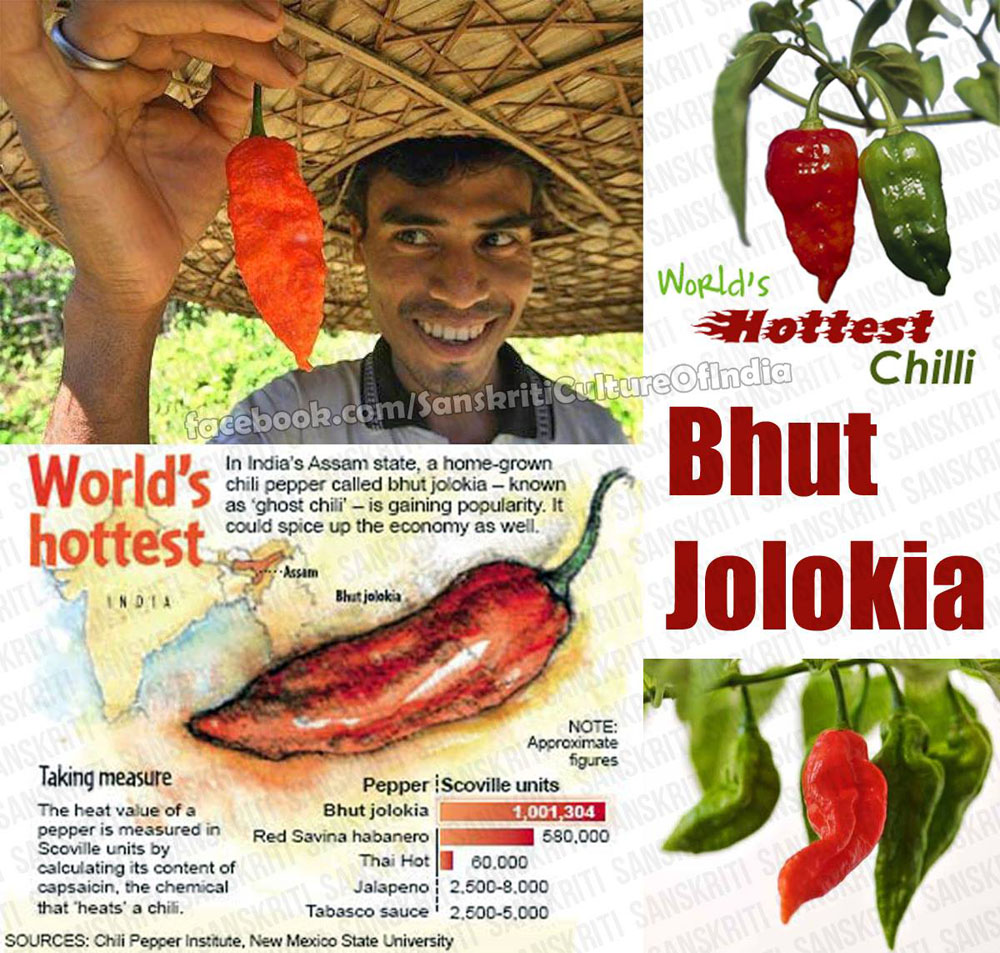
The Naga Jolokia Chili Pepper is also known as Bhut Jolokia, Ghost Chili, Ghost Pepper or Naga Morich – this is a chili pepper recognized as the hottest in the world. In 2007, the Guinness World Records held it to be the hottest chili, replacing the Red Savina strain of habanero chili. It is a naturally occurring interspecific hybrid originating from the northeast of India, particularly Assam, Nagaland and Manipur.

The name Naga Jolokia means in English (King Cobra Chili) due to the extreme heat of the Chili being compared to the deadly poison in the venomous snake, Bhut translated into English is ghost and is probably used as a name to its ghostly bite.

In 2000, India’s Defence Research Laboratory (DRL) reported a rating of 855,000 units on the Scoville scale, and in 2004 a rating of 1,041,427 units was made using HPLC analysis.

One seed from a Bhut Jolokia (Hottest Chilli in the World) can sustain intense pain sensations in the mouth for up to 30 minutes before subsiding. Ripe Bhuts measure 60 mm (2.4 in) to 85 mm (3.3 in) long and 25 mm (1.0 in) to 30 mm (1.2 in) wide with an orange or red color.

The pepper is used as a cure for stomach ailments. It is also used as a spice as well as a remedy to summer heat, presumably by inducing perspiration in the consumer. In northeastern India, the peppers are smeared on fences or incorporated in smoke bombs as a safety precaution to keep wild elephants at a distance.

In 2009, scientists at India’s Defence Research and Development Organisation announced plans to use the chillies in hand grenades, as a less lethal way to control rioters.

However, current hottest chilli is the Trinidad Scorpion “Butch T” which was grown by The Chilli Factory (Australia) and rated at 1,463,700 Scoville Heat Units (SHU) according to tests conducted by EML Consulting Services in Morisset, New South Wales, Australia, on 1 March 2011. The chilli is of the Capsicum genus and a hybrid of the Chinese and frutescens species.

You may also like

Search the website

Like us on Facebook

Get daily updates via Email

Enter your email address:

Recent Posts

Adi Shankaracharya Jayanti 2026 — Advaita Vedanta, Om symbol, and four Amnaya Peethas

Adi Shankaracharya — The Monk Who Reunited Bharata

Shankaracharya Jayanti 2026 — the 1238th birth anniversary of Adi Shankaracharya. His extraordinary life, the Digvijaya, the debate with Mandana Mishra, Advaita Vedanta, the four Amnaya Peethas, and his timeless literary legacy.

Akshaya Tritiya 2026 — royal purple hero banner with Akshaya Patra vessel and Devanagari text

Akshaya Tritiya 2026 — The Day That Never Diminishes

Akshaya Tritiya (April 19, 2026) is one of the most auspicious days in the Vedic calendar — when any act of dharma, dana, or japa yields imperishable merit. Discover the five sacred Puranic events, complete puja vidhi, timings, mantras, and the deeper spiritual teaching beyond gold-buying.

Baisakhi 2026 — Mesha Sankranti Hindu Solar New Year hero banner with rising sun, Om symbol and wheat harvest

Baisakhi 2026 — Harvest, Hope, and the Hindu Solar New Year

Baisakhi 2026 falls on Tuesday, April 14 — the day Bhagavan Surya enters Mesha Rashi at 9:39 AM, marking the Hindu Solar New Year. Discover the sacred science of Mesha Sankranti, the Punya Kaal rituals, and how this one cosmic moment is celebrated across Bharata as Vishu, Puthandu, Pohela Boishakh, Bohag Bihu, and Pana Sankranti.

css.php