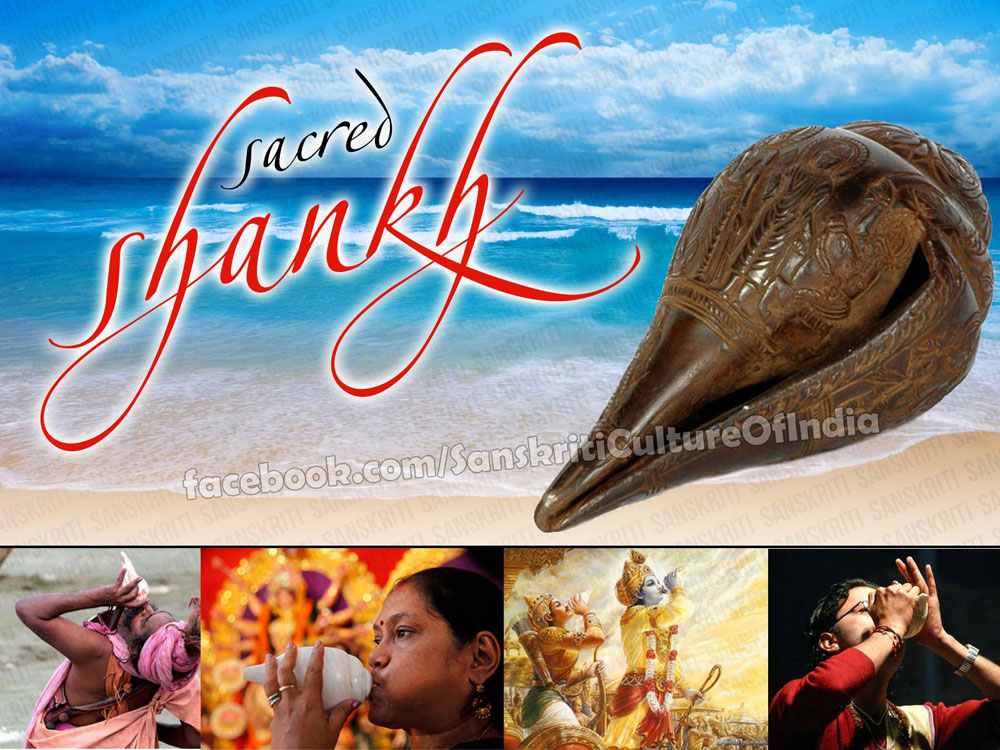
The conch shell is a major Hindu article of prayer, used as a trumpet and in order to get rid of negative energy and evil spirits. It is also used as a container for holy water (shankha teertham). The shankha (conch shell) mudra is also used during various tantric rituals and meditation. “Shankha” is considered to be one of the most auspicious objects that emerged from the sea during the Ksheera Sagara Samudra Manthan.
Our Ancestors knew that when a Shankh is blown, its cosmic vibrations can cure diseases. Shankh or Shankham in sanskrit means “a conch holding the sacred water”. Earliest written documentation of Shankh can be traced back to Vedas and other Holy Hindu texts like Bhagwad Gita and Vishnu Purana. They are widely used in many Hindu rituals from bathing of a deity to the starting and ending of a holy ritual.
Religious Significance
In Hinduism, the Shankha is regarded sacred and very auspicious. To initiate religious ceremonies, a shankha (conch shell) is blown. It is a major Hindu article of prayer. God Vishnu, the God of Preservation, is shown with a shankha in one hand and a disc or a chakra in the other.
Each hindu shankha has a specific name. Vishnu’s shankha is called “Panchajanya” . It is believed that when it is blown, it announces the victory of good over evil. In the epic war, Mahabharata, the conch shell held a significant place. Arjuna’s shankha was called “Devdutta” , Bhima’s “Paundra”, Yudhisthira’s “Anantavijaya”, Nakula’s “Sughosa” and Sahadeva’s was known as “Manipushpaka”.
The sacred conch shell is an integral part of Hindu symbolic and religious tradition. Even today, all Hindus use the conch as a part of their religious practices. Whenever the conch shell is blown, it is said to purify the environment from all evil effects.
Scientific significance
Leaving aside the mythology part, the conch shell’s significance can also be corroborated by science. If you try holding a shankha near your ear, the sound of the gently humming ocean can be heard. This is actually the natural vibration or cosmic energy of the Earth which gets magnified on entering the conch shell.
The vibrations from these conch shells can overpower evil forces from the Earth and at the same time also clear environmental pollution including healing the hole in the ozone layer which causes global warming. According to science, the blowing of a conch shell enhances the positive psychological vibrations such as courage, determination, hope, optimism, willpower, etc. in the blower as well as those around him.
Following type of Shankhas are considered very sacred and pure in Hinduism:-
- Dakshinavarti Shankha
- Vamavarti Shankha
- Gaumukhi Shankha
- Ganesha Shankha
- Kauri Shankha
- Moti Shankha
- Heera Shankha