What kolam is, and why the dot grid matters
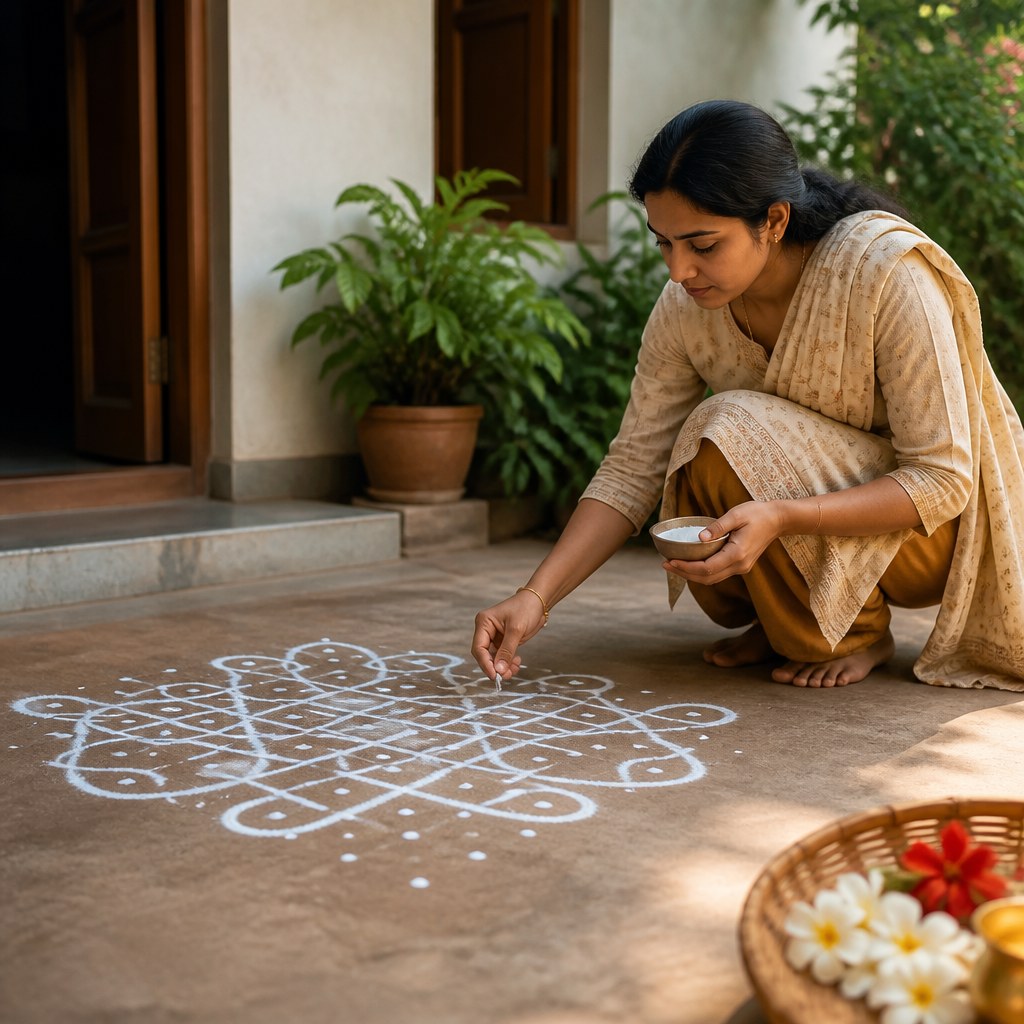
Kolam is a daily floor drawing made with rice flour or other natural powder, usually placed at the threshold of a home. For beginners, the main challenge is not artistic skill but learning how the dot pattern works, because the dots guide every line, curve, and loop.
When you understand the grid, you can draw a simple kolam quickly and repeat it with confidence. You also begin to see why the tradition matters: it is a small act of care, discipline, and welcome that belongs to ordinary life, not only festivals.
How dot patterns work
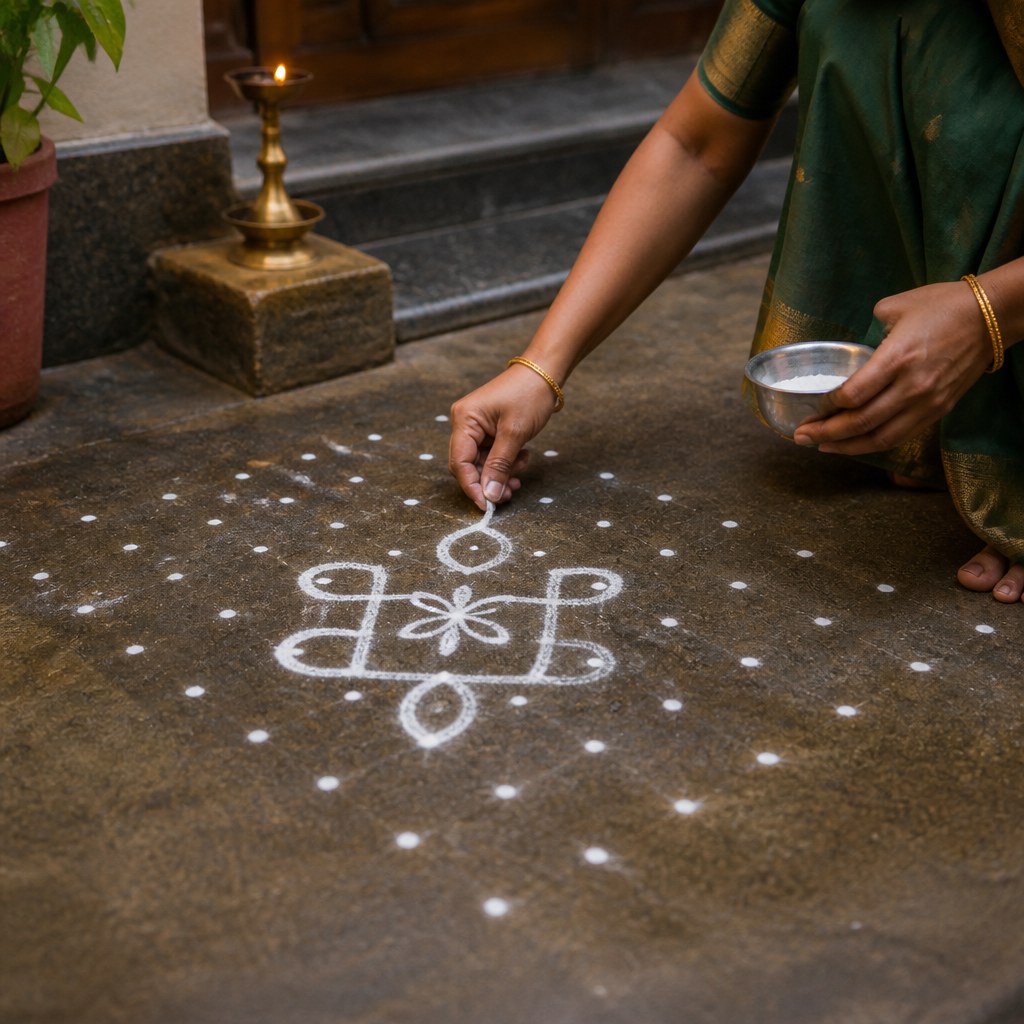
Most beginner kolam designs begin with a set of dots arranged in rows. You may see a square grid, a diamond shape, or a staggered arrangement. The design is drawn around the dots, between the dots, or by connecting them in repeated curves.
The easiest way to start is with a small, balanced pattern. A 3-by-3 or 5-by-5 dot grid is enough for practice. As you improve, you can try larger grids and more complex loops. The goal is not to fill space. The goal is to keep the pattern even and symmetrical.
Three common beginner approaches
- Dot-to-dot curves. You place the dots first, then draw flowing loops around them.
- Freehand border kolam. You use the dots as a guide for a simple frame or repeated motif.
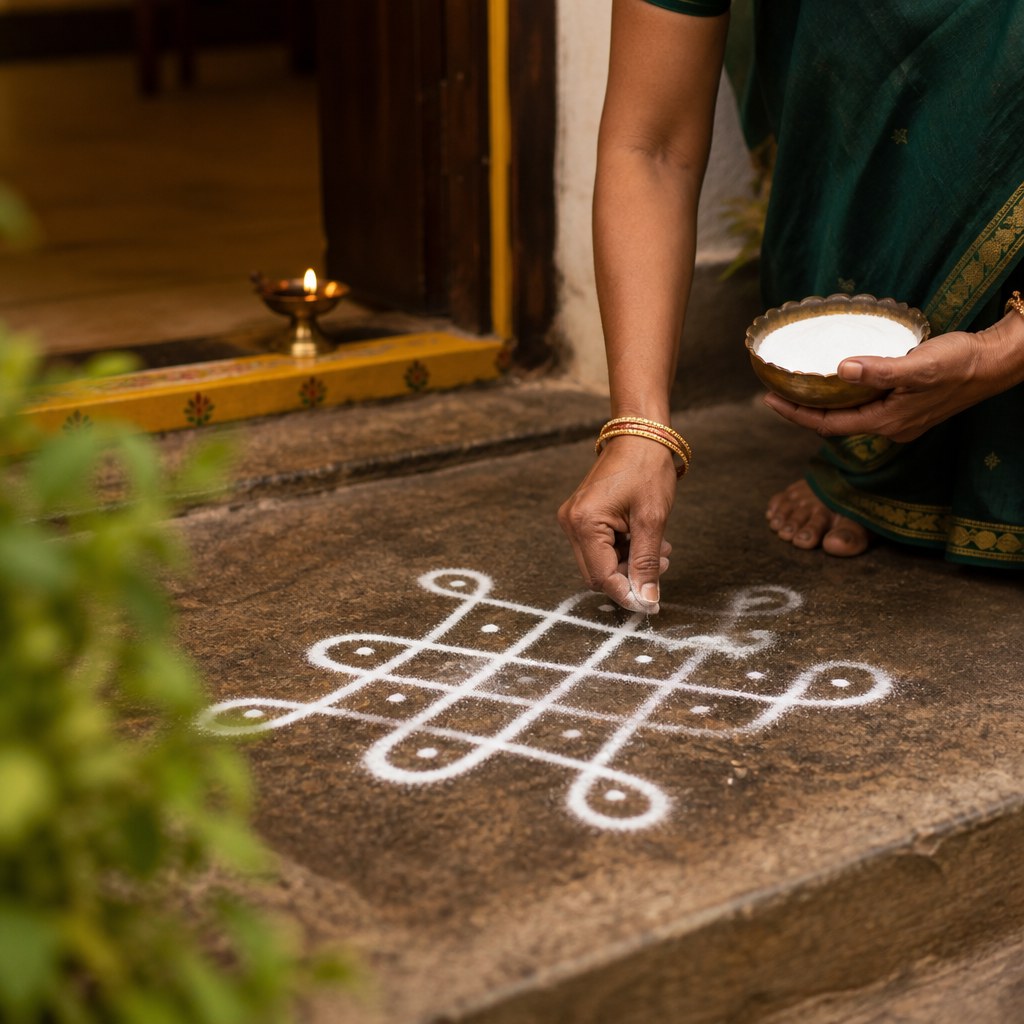
- Connected-loop kolam. You trace one continuous line that moves around the grid and returns to the start.
If you are uncertain, start with one repeated shape, such as a circle, petal, or loop. Repetition helps your hand stay steady. These are practice exercises, rather than rules for every traditional kolam style. For festival context, explore our guide to Pongal.
What the daily tradition means
Kolam is part of a household rhythm. It is often drawn early in the morning after sweeping the entrance. In traditional practice, this order matters. Clean ground, fresh powder, and a careful pattern show readiness for the day.
Kolam has a close connection with Tamil household traditions. In Sahapedia’s study of kolam, Anni Kumari describes threshold drawings made with rice flour and patterns built by joining or looping around dots. The study discusses kolam as an auspicious practice and notes that its origins remain debated. A field account from the India China Institute also describes the morning routine of cleaning the entrance and drawing patterns from memory. Practices vary between families and regions.
For many families, the act itself is as important as the finished design. A kolam can mark devotion, hospitality, patience, and continuity. It is also temporary. Wind, footsteps, and the day’s activity will erase it, so the drawing becomes a lesson in renewal.
A practical way to draw your first kolam
Use rice flour or a beginner-friendly powder. Stand where you can see the entrance clearly. Then follow this simple process.
- Clean and dry the surface.
- Mark a small dot grid with even spacing.
- Choose one shape and repeat it around the dots.
- Draw slowly in one motion when possible.
- Check symmetry before adding extra lines.
- Fill gaps only after the main form is complete.
If your lines shake, reduce the size of the grid. Small kolam designs are easier to control. If the powder spreads too much, use less at a time and let it fall in a thin stream from your fingers.
Common mistakes and how to recover
The most common beginner mistake is choosing a pattern that is too large. A dense grid can make the lines uneven and hard to finish. Start smaller and scale up only when the motion feels natural.
Another mistake is uneven spacing between dots. If the grid is irregular, the pattern will look unbalanced even if your drawing is neat. Use the same finger width or a simple ruler mark while practicing on paper first.
If a line breaks, do not restart the whole design. Many traditional kolam styles allow small corrections. You can add a gentle curve, extend a loop, or simplify the shape so the whole pattern still feels complete.
A simple way to decide what to draw
If you want a beginner-friendly kolam, choose a pattern that matches your time, your surface, and your confidence level. Use fewer dots when you want speed. Use repeated curves when you want a calmer, more decorative result. Use a larger grid only when you can keep the pattern balanced from start to finish.
That is the practical value of kolam. It gives you a daily ritual that is both useful and expressive. You do not need a complex design to take part in it. You only need a clear grid, steady hands, and a willingness to begin again tomorrow.
Start with one small dot pattern today
Choose a 3-by-3 or 5-by-5 grid, draw one repeating shape, and practice until the movement feels natural.