This is Somvar — the day of Soma, the day of Chandra, the day of Mahadeva.
Of all the days of the week, none is held closer to Bhagavan Shiva than the second. The Shiva Purana, the Skanda Purana, and the Linga Purana each return to the same teaching: that one who observes the Somvar Vrat with sincerity walks under the protective gaze of the Lord of Kailasa, and that the merit accumulated through such an observance is among the most enduring a householder can earn.
In the month of Vaishakha — the month we are now in — that merit is said to multiply many times over. Today, Monday, the 4th of May, is one such day.
The Chandra–Shiva Bond — Why Monday Belongs to Mahadeva
To understand why Monday is sacred to Lord Shiva, we must first travel to a story preserved in the Shiva Purana and echoed in the Skanda Purana — the story of how Chandra, the Moon, came to rest on the matted jata of Mahadeva.
Chandra was the son-in-law of Daksha Prajapati. He had been given twenty-seven wives — the twenty-seven Nakshatras, daughters of Daksha, who together would carry the Moon through his monthly journey across the heavens. But of the twenty-seven, Chandra loved only one: Rohini, the gentlest and most beautiful. He neglected the others entirely.
The slighted Nakshatras returned to their father in tears. Daksha, whose temper was famously short, summoned his son-in-law, warned him once, and then — when the warning bore no fruit — pronounced a terrible shaap: “Wane, then, until you waste away to nothing. Lose your light. Lose your form. Disappear.”
The curse took hold at once. Night by night, the Moon began to dwindle. The tides slowed. The herbs of the forest, which take their nourishment from his light, began to wilt. The Devas grew alarmed; the Rishis grew alarmed; the very ocean grew alarmed. For if Chandra were extinguished, the rhythm of the cosmos itself would falter.
Chandra, broken and dimming, fled to Prabhasa Tirtha on the western shore of Bharata. There, he established a Shivalinga and performed tapasya for many years, fasting and chanting the Mahamrityunjaya Mantra, calling out for the only one who could lift a curse so absolute.
And the Lord came.
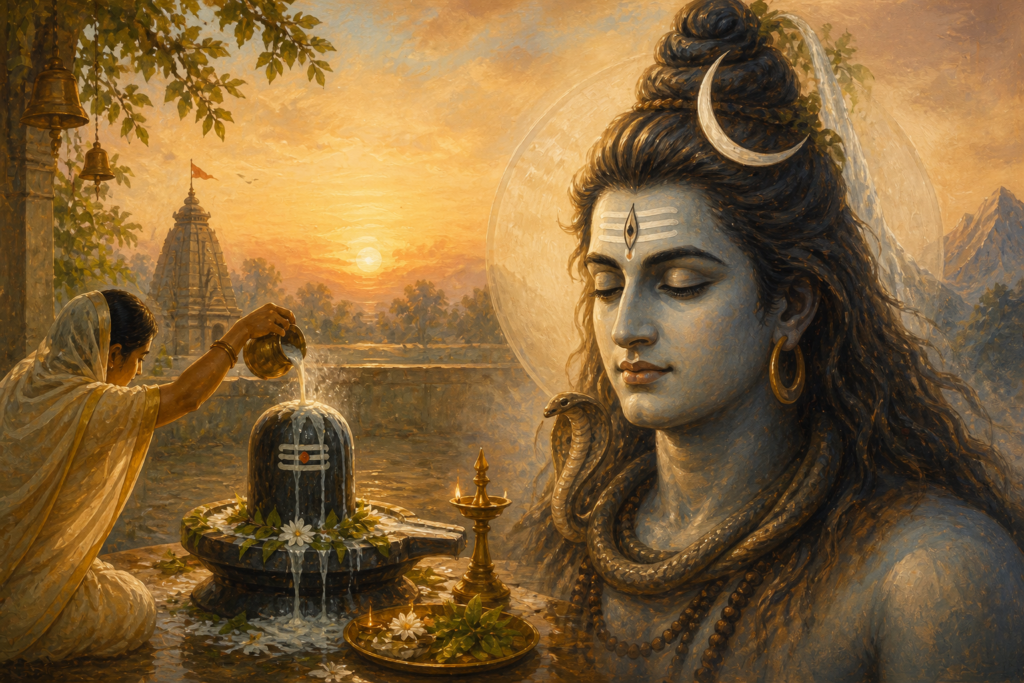
Bhagavan Shiva, Mahadeva, Chandrashekhara, took the wasted Moon onto His own matted hair and placed him as a crescent above His brow. By that touch, Chandra was saved — though Daksha’s shaap could not be undone entirely, it was bent into a softer shape: the Moon would wane for one half of the month and wax for the other, and so live forever in that rhythm of dying and rising.
The shrine where this took place is the Somnath Jyotirlinga — Soma-natha, the Lord of Soma, the Lord of Chandra. The first of the twelve Jyotirlingas. The place where the Moon was rescued.
From that day, Chandra has worn the gaze of Mahadeva, and Mahadeva has worn Chandra. And the day of the week named after Soma — Somvar — has belonged to Lord Shiva ever since.
The Scriptural Foundation of the Somvar Vrat
The practice of observing Mondays for the worship of Lord Shiva is not folk custom layered onto faith — it is enjoined directly in the Puranas.
The Shiva Purana (Vidyeshwara Samhita) declares that one who fasts on Mondays and worships the Shivalinga with bilva, milk, and bhasma earns the company of Mahadeva for kalpas to come. The Skanda Purana counts the Somvar Vrat among the foremost of the vaaravrata — the weekday observances — and assigns to it the power to dissolve grahadosha, especially those of an afflicted Chandra in one’s janma kundali.
The Linga Purana is more specific still: it names the four orders of phala — Dharma, Artha, Kama, Moksha — that the sincere observer of the Somvar Vrat may receive, and it singles out two categories of devotee for whom the vrat is especially indicated: the unmarried young woman who seeks a worthy husband, and the householder whose marriage or family life has fallen under strain.
Both groups are guided to a particular form of the vrat: the Solah Somvar.
The Solah Somvar — Sixteen Mondays of Tapasya
The Solah Somvar Vrat — the observance of sixteen consecutive Mondays — is rooted in a story that every Hindu household knows.
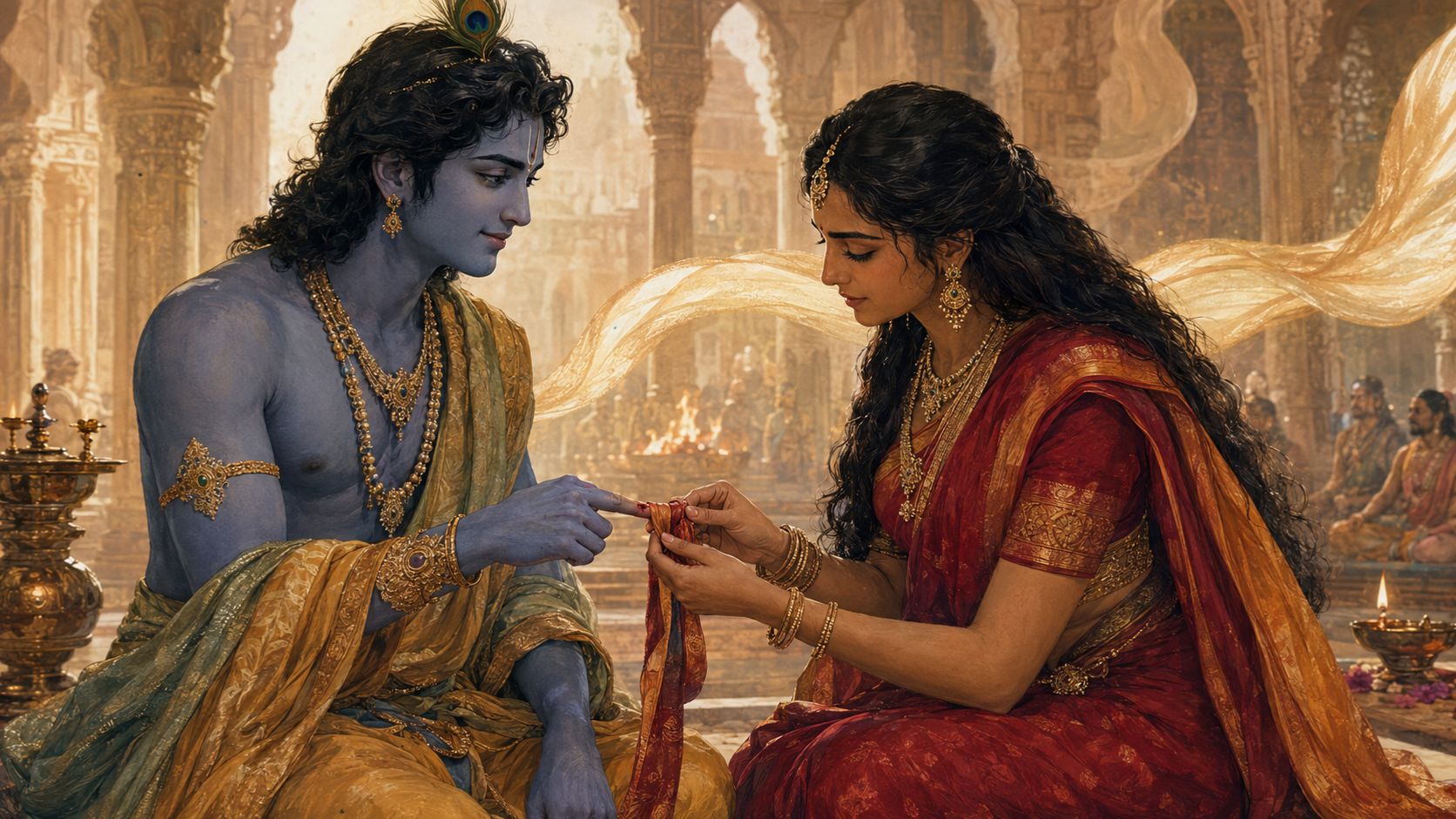
When Maa Parvati had resolved that no one but Bhagavan Shiva would be Her husband, She did not weep. She did not wait. She climbed into the Himalayas and undertook a tapasya so severe that the snow itself began to warm around Her stillness. She lived on bilva leaves, then on water, then on air. And among the practices She kept through that long austerity was the Somvar Vrat — sixteen Mondays of fasting, japa, and worship of the Shivalinga.
When at last Bhagavan Shiva opened His eyes from samadhi and accepted Her, the Devas asked Him: “Bhagavan, what is the secret of Her tapasya? What practice carried Her to You?”
And Mahadeva replied: “The Somvar Vrat. Let any jiva who longs for the right marriage, the right family, the right turn of life observe sixteen Mondays as Parvati did — and what was given to Her shall not be withheld from them.”
This is the Solah Somvar. It is begun on a Monday in the bright fortnight (Shukla Paksha) of an auspicious month — Shravana, Vaishakha, and Kartika are the most favoured — and is carried through sixteen Mondays without a break. On the seventeenth Monday, the Udyapan — the formal completion ceremony — is performed.
A Monday begun this Vaishakha would carry the observer well into the season of Shravana — the month most beloved of Mahadeva. Many Acharyas regard a Solah Somvar begun in Vaishakha and completed across Shravana as among the most fruit-bearing forms of the vrat.
Why Mondays in Vaishakha Carry Special Weight
The month of Vaishakha is held in the Puranas as one of the four holiest months of the Hindu year. The Skanda Purana devotes an entire mahatmya to it — the Vaishakha Mahatmya — and within that text, the Mondays of Vaishakha are singled out as days when even small acts of devotion yield disproportionate merit.
Three reasons converge. The Sun has entered Mesha and the days are at their longest, so the window for sadhana is widest. The waters of Bharata’s sacred rivers — the Ganga, the Narmada, the Godavari — are considered most charged through Vaishakha; a Monday snan in any of them is held equal to many ordinary observances. And the cooling worship of the Shivalinga with milk, water, and bilva is the most natural answer to the rising heat of the month — it is ritu-anukula, in harmony with the season.
For the devotee who cannot reach a tirtha, the Puranas are clear: a single lota of clean water poured upon a Shivalinga in one’s home, with sincerity, on a Vaishakha Somvar, is enough.
Vidhi — How to Observe the Somvar Vrat
The Somvar Vrat is among the gentlest of the vratas in its outward form and among the deepest in its inward effect. The vidhi below follows the Shiva Purana and the common practice of Acharyas across Bharata.
On Sunday evening: Take a single sattvic meal before sunset. Avoid grains heavy with tamas, onion, garlic, and intoxicants. Sleep early.
On Monday morning: Rise during Brahma Muhurta. Bathe in cool water — a touch of Ganga jal added to one’s bath is the practice of many households. Wear clean, preferably white clothes. Take the sankalpa — a quiet vow before the Shivalinga to keep the vrat with sincerity until the parana on Tuesday morning.
The puja: Establish or approach a Shivalinga. Perform abhisheka with — in this order — clean water, raw cow’s milk, dahi, ghee, honey, sugarcane juice (if available), and water again. Apply bhasma in three lines (tripundra) upon the linga and upon one’s own forehead. Offer bilva patra — three-leafed, with the smooth side facing the linga — and white flowers. Light a ghee deepa and a stick of pure sandal dhoop. Read or recite the Rudrashtakam, the Shiva Tandava Stotram, or the Mahamrityunjaya Mantra as time permits.
Through the day: Keep the fast. Phalahari — fruits, milk, and water — is the form most commonly kept; the strict observe nirjala until evening. Avoid sleep during the day. Keep japa of the Panchakshara on the breath as one moves through the day’s work.
In the evening: Worship the Shivalinga a second time at twilight. Hear or read the Somvar Vrat Katha. Take a single sattvic meal — typically sabudana khichdi, singhare ke aate ka halwa, or fruit and milk — without grains, lentils, or salt other than sendha namak.
On Tuesday morning: Bathe, complete a brief puja, feed a Brahmana or a hungry person, give dakshina, and only then return to ordinary food. The vrat is closed with the same quiet sincerity in which it was begun.
Mantras for the Somvar Vrat
The Panchakshara Mantra:
Om Namah Shivaya
The Mahamrityunjaya Mantra:
उर्वारुकमिव बन्धनान् मृत्योर्मुक्षीय माऽमृतात् ॥
Om Tryambakam Yajamahe Sugandhim Pushtivardhanam |
Urvarukamiva Bandhanan Mrityor Mukshiya Maamritat ||
The Bija Mantra of Shiva:
Om Hreem Namah Shivaya
A mala — 108 repetitions — of any one of these mantras during the morning puja and another at twilight is the householder’s measure for an ordinary Somvar. For the Solah Somvar, the count is doubled.
Recommended recitations through the day: the Rudrashtakam of Tulsidas, the Shiva Tandava Stotram of Ravana, the Bilvashtakam, and any one chapter of the Shiva Mahapurana.
The Deeper Teaching — The Lord Who Holds the Moon
Every devotee who looks at an image of Mahadeva sees the same small detail above His brow: a single curved line of crescent. It is easy to pass over. It is the most quietly powerful symbol in the entire Sanatana Dharma.
That crescent is Chandra — and Chandra, in our scriptures, is the deity of manas, the mind. The waxing and waning of the Moon is the waxing and waning of every thought we have ever had: hope to despair, desire to disgust, certainty to doubt, peace to storm. Our minds are not steady. They were not made to be steady. They rise and fall, and there are days when we feel ourselves wasting like Chandra under his curse, fading toward a darkness we cannot name.
The Somvar Vrat is the practice of placing that mind, just for a day, where Mahadeva placed Chandra: above the brow of the Lord, held safely in His matted hair, bent gently into a rhythm that no longer destroys.
And the teaching of the Puranas is that He does not refuse.