IndianSanskriti
dharma-is-not-religion

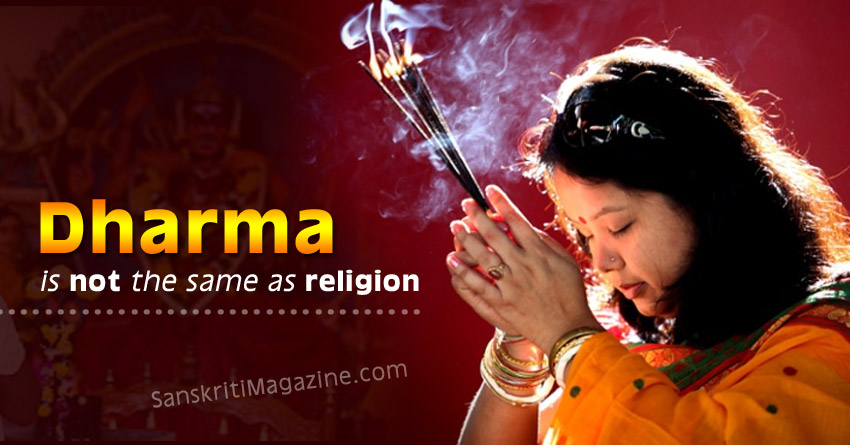
Dharma is not the same as religion

The word “dharma” has multiple meanings depending on the context in which it is used. Monier-Williams’ Sanskrit-English Dictionary lists several, including: conduct, duty, right, justice, virtue, morality, religion, religious merit, good work according to a right or rule, etc. Many other meanings have been suggested, such as law or “torah” (in the Judaic sense), “logos” (Greek), “way” (Christian) and even ‘tao” (Chinese). None of these is entirely accurate and none conveys the full force of the term in Sanskrit. Dharma has no equivalent in the Western lexicon.Dharma has the Sanskrit root dhri, which means “that which upholds” or “that without which nothing can stand” or “that which maintains the stability and harmony of the universe.” Dharma encompasses the natural, innate behavior of things, duty, law, ethics, virtue, etc. Every entity in the cosmos has its particular dharma — from the electron, which has the dharma to move in a certain manner, to the clouds, galaxies, plants, insects, and of course, man. Man’s understanding of the dharma of inanimate things is what we now call physics.
British colonialists endeavored to map Indian traditions onto their ideas of religion so as to be able to comprehend and govern their subjects; yet the notion of dharma remained elusive. The common translation into religion is misleading since, to most Westerners, a genuine religion must:
1) be based on a single canon of scripture given by God in a precisely defined historical event;
2) involve worship of the divine who is distinct from ourselves and the cosmos;
3) be governed by some human authority such as the church;
4) consist of formal members;
5) be presided over by an ordained clergyman; and
6) use a standard set of rituals.But dharma is not limited to a particular creed or specific form of worship. To the Westerner, an “atheistic religion” would be a contradiction in terms, but in Buddhism, Jainism and Carvaka dharma, there is no place for God as conventionally defined. In some Hindu systems the exact status of God is debatable. Nor is there only a single standard deity, and one may worship one’s own ishta-devata, or chosen deity.
Dharma provides the principles for the harmonious fulfillment of all aspects of life, namely, the acquisition of wealth and power (artha), fulfillment of desires (kama), and liberation (moksha). Religion, then, is only one subset of dharma’s scope.Religion applies only to human beings and not to the entire cosmos; there is no religion of electrons, monkeys, plants and galaxies, whereas all of them have their dharma even if they carry it out without intention.

Since the essence of humanity is divinity, it is possible for them to know their dharma through direct experience without any external intervention or recourse to history. In Western religions, the central law of the world and its peoples is singular and unified, and revealed and governed from above.

In dharmic traditions, the word a-dharma applies to humans who fail to perform righteously; it does not mean refusal to embrace a given set of propositions as a belief system or disobedience to a set of commandments or canons.

Dharma is also often translated as “law,” but to become a law, a set of rules has to be present which must: (i) be promulgated and decreed by an authority that enjoys political sovereignty over a given territory, (ii) be obligatory, (iii) be interpreted, adjudicated and enforced by courts, and (iv) carry penalties when it is breached. No such description of dharma is found within the traditions.

The Roman Emperor Constantine began the system of “canon laws,” which were determined and enforced by the Church. The ultimate source of Jewish law is the God of Israel. The Western religions agree that the laws of God must be obeyed just as if they were commandments from a sovereign. It is therefore critical that “false gods” be denounced and defeated, for they might issue illegitimate laws in order to undermine the “true laws.” If multiple deities were allowed, then there would be confusion as to which laws were true.

In contrast with this, there is no record of any sovereign promulgating the various dharma-shastras (texts of dharma for society) for any specific territory at any specific time, nor any claim that God revealed such “social laws,” or that they should be enforced by a ruler. None of the compilers of the famous texts of social dharma were appointed by kings, served in law enforcement, or had any official capacity in the state machinery. They were more akin to modern academic social theorists than jurists. The famous Yajnavalkya Smriti is introduced in the remote sanctuary of an ascetic. The well-known Manusmriti begins by stating its setting as the humble abode of Manu, who answered questions posed to him in a state of samadhi (higher consciousness). Manu (1.82) tells the sages that every epoch has its own distinct social and behavioral dharma.

Similarly, none of the Vedas and Upanishads was sponsored by a king, court or administrator, or by an institution with the status of a church. In this respect, dharma is closer to the sense of “law” we find in the Hebrew scriptures, where torah, the Hebrew equivalent, is also given in direct spiritual experience. The difference is that Jewish torah quickly became enforced by the institutions of ancient Israel.

The dharma-shastras did not create an enforced practice but recorded existing practices. Many traditional smritis (codified social dharma) were documenting prevailing localized customs of particular communities. An important principle was self-governance by a community from within. The smritis do not claim to prescribe an orthodox view from the pulpit, as it were, and it was not until the 19th century, under British colonial rule, that the smritis were turned into “law” enforced by the state.

The reduction of dharma to concepts such as religion and law has harmful consequences: it places the study of dharma in Western frameworks, moving it away from the authority of its own exemplars. Moreover, it creates the false impression that dharma is similar to Christian ecclesiastical law-making and the related struggles for state power.

The result of equating dharma with religion in India has been disastrous: in the name of secularism, dharma has been subjected to the same limits as Christianity in Europe. A non-religious society may still be ethical without belief in God, but an a-dharmic society loses its ethical compass and falls into corruption and decadence.

~Rajiv Malhotra
Founder, Infinity Foundation
You may also like

Search the website

Like us on Facebook

Get daily updates via Email

Enter your email address:

Recent Posts

Purushottam Maas — The Month No Deity Would Claim, and the Lord Who Made It Supreme

Every month of the Hindu calendar has a lord — except the rare thirteenth, the Adhika Maas, born an orphan and shunned as the “impure month.” The Puranas tell how this rejected month went in grief to Bhagavan Vishnu, who claimed it, gave it His own name — Purushottam — and made it the most fruitful month of all. The origin story, the teaching, and what it means for Purushottam Maas 2026 (May 17 – June 14).

Padmini Ekadashi 2026 — The Ekadashi Even the Devas Descend to Keep

Padmini Ekadashi 2026 — The Ekadashi Even the Devas Descend to Keep

The rarest Ekadashi of the entire Hindu calendar is three days away. The Padma Purana preserves a conversation between Bhagavan Krishna and Yudhishthira about a single Ekadashi the great Rishis spend lifetimes waiting for — Padmini. The Vrat Katha of Queen Padmini of Mahishmati, the lotus teaching, and why May 27, 2026 is the morning Vaishnavas across Bharata are preparing for.

Varada Chaturthi 2026 — The Rare Ganesha Day of Purushottam Maas

Varada Chaturthi 2026 — The Rare Ganesha Day of Purushottam Maas

Once every 2.5–3 years — when the rare 13th month of Adhika Maas opens — a thirteenth Vinayaka Chaturthi appears. The Mudgala Purana calls it Varada Chaturthi, the “boon-giving” Chaturthi, and holds it as the most fruit-bearing Ganesha day of the entire calendar. Today, Wednesday May 20, 2026, is that day.

Padmini Ekadashi 2026 — The Rare Ekadashi That Comes Only in Purushottam Maas

Padmini Ekadashi 2026 — The Rare Ekadashi That Comes Only in Purushottam Maas

Padmini Ekadashi 2026 falls on Wednesday, May 27 — the Shukla Paksha Ekadashi of Adhika Maas, the rarest Ekadashi in the entire Hindu calendar (it appears only every 2.5–3 years). The Padma Purana conversation between Bhagavan Krishna and Yudhishthira, the Vrat Katha of Queen Padmini, complete vrat vidhi with jagrana, mantras, and the lotus symbolism that gives the Ekadashi its name.

Ganga Dussehra 2026 — The Day Maa Ganga Came Down to Bhagiratha

Ganga Dussehra falls on Monday, May 25, 2026 — commemorating the day Maa Ganga descended from Vaikuntha to the earth through the millennia-long tapasya of King Bhagiratha. The full account from the Valmiki Ramayana, snan vidhi, dana traditions, mantras, and the teaching of sustained sincerity.

css.php