IndianSanskriti

What Does the Name “Hanuman” Really Mean?

Uncovering the Power and Symbolism Behind a Beloved Name

When we chant “Jai Hanuman!” we are invoking more than just a name — we are calling upon a legacy of strength, devotion, and eternal wisdom. But have you ever paused to wonder what the name Hanuman actually means?

Let’s dive into the story behind the name and why it continues to inspire millions across the world.

🔍 The Literal Meaning

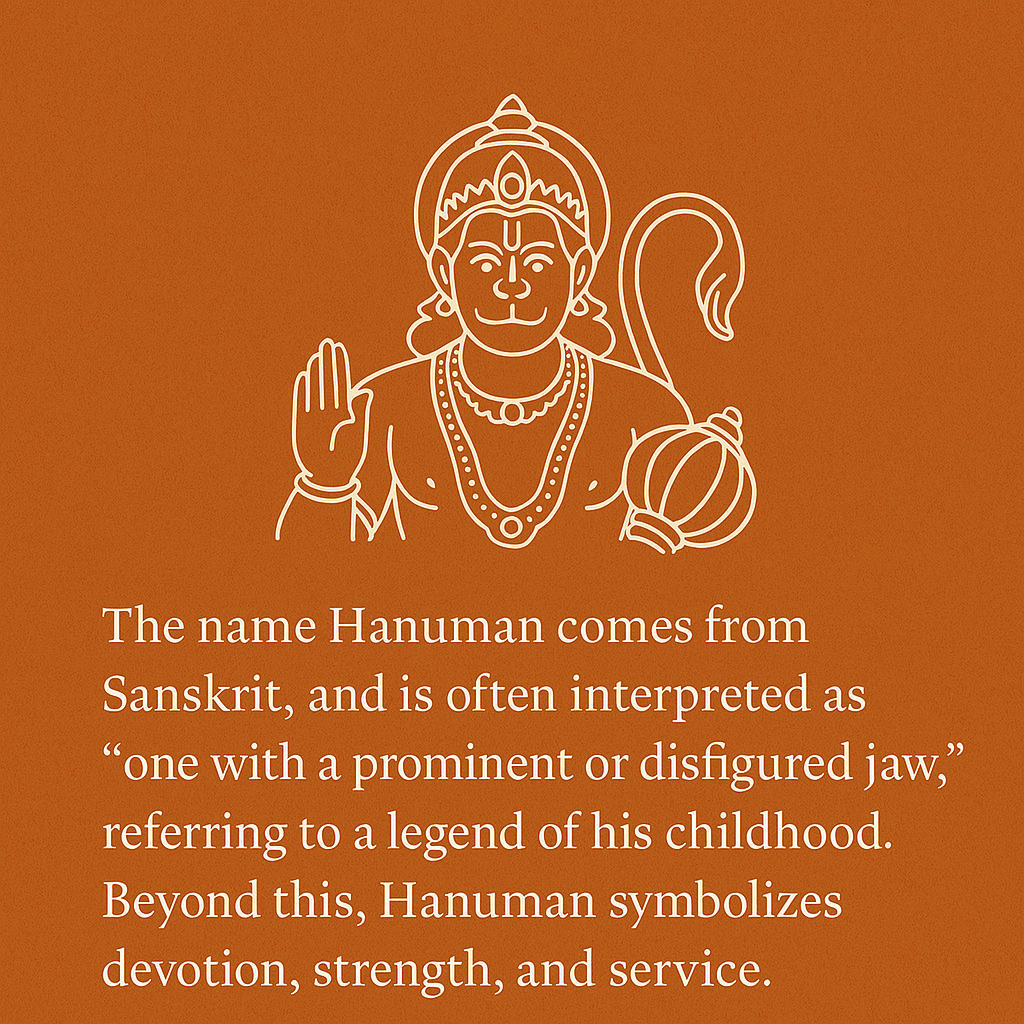
The name Hanuman is rooted in Sanskrit, where it’s believed to be made up of two words:

  • “Hanu” (हनु) – meaning jaw
  • “Man” (मान) – meaning disfigured, prominent, or proud

According to one of the most well-known legends from Hanuman’s childhood, the young divine being once mistook the sun for a juicy fruit and leapt into the sky to grab it. To stop him, Lord Indra struck him with a thunderbolt (vajra), injuring his jaw. That incident gave rise to the name Hanuman — “the one with the disfigured jaw.”

But beyond this story lies a name that represents much more.


🌟 A Symbol of Strength and Selflessness

In Indian tradition, Hanuman is not just remembered for his might, but for what he used that might for. His power was always placed in the service of righteousness, loyalty, and love — especially his undying devotion to Lord Rama.

Thus, the name Hanuman has become a symbol of:

  • Fearless strength
  • Unwavering devotion
  • Selfless service
  • Childlike curiosity balanced by divine wisdom

📿 Many Names, Many Meanings

Hanuman is known by many other names that reflect his qualities and stories:

NameMeaning
AnjaneyaSon of Anjana
MarutiSon of the wind god (Marut/Vayu)
BajrangbaliThe strong one with a body like thunder
Sankat MochanRemover of obstacles and sorrows
MahaveerThe great and fearless warrior

Each name reminds us of a value we can embody in our daily lives — courage, humility, energy, and devotion.


👧🏼 A Name Kids Can Learn From

For young minds, Hanuman is more than just a god — he’s a relatable hero. Curious, powerful, loving, and a little mischievous, he teaches kids that true greatness lies in using your talents to help others.

Try this with your child:
Ask them, “What does being strong really mean?”
Then tell them the story of how Hanuman used his strength to serve, not to show off. That’s the real magic of his name.


🙏 Jai Hanuman – In Every Heart

So next time you say “Jai Hanuman”, remember — you’re not just calling a name. You’re invoking:

  • The spirit of bravery
  • The heart of service
  • And the mind of wisdom

Let that name echo not just in temples and chants, but in how we live our lives.


📖 Want more such stories and insights? Stay tuned to Sanskriti Magazine — where every name has a story, and every story has a soul.
You may also like

Search the website

Like us on Facebook

Get daily updates via Email

Enter your email address:

Recent Posts

Yogini Ekadashi 2026 — The Yaksha Who Missed the Morning Flowers, and the Ekadashi That Undid His Curse

On Friday, July 10, 2026, the rare Krishna Paksha Ekadashi of Nija Ashadha arrives. The Padma Purana tells the story of Hemamali — the Yaksha gardener of Bhagavan Kubera in Alaka, whose single morning of distraction with his wife Vishalakshi cost him his form, his wife, and his celestial city. Cursed to wander the earth of Bharata as a leper for a long time, he was at last shown the way back by Sage Markandeya — a single sincere keeping of Yogini Ekadashi.

Jamai Shashthi 2026 — The Story of Maa Shashthi, the Cat, and the Wife Who Was Forgiven

Jamai Shashthi 2026 — The Story of Maa Shashthi, the Cat, and the Wife Who Was Forgiven

On Saturday, June 20, 2026, Bengali households across Bharata will welcome their married daughters and sons-in-law home for the legendary jamai-aador feast and perform the Shashthi Vrata. But behind the warmth lies a story most Bengalis know by heart and most non-Bengalis have never heard — the wife who stole the hilsa, blamed the cat, lost six sons to Maa Shashthi’s wrath, and was finally forgiven. The Vrat Katha, the vidhi, the mantras, and the deeper teaching.

Vat Purnima 2026 — The Wife Who Argued Yama Into Returning Her Husband’s Life

On Monday, June 29, 2026, women across Maharashtra, Gujarat, and southern Bharata will tie red thread around banyan trees and hear the story of Savitri — the wife who walked behind Yamaraja Himself when He came for her husband, and out-argued the Lord of Dharma into returning Satyavan’s life. The Mahabharata’s Pativrata Mahatmya Parva, the vrat vidhi, and why the banyan witnessed everything.

Nija Jyeshtha 2026 — The Real Jyeshtha Begins, and the Calendar Resumes

Nija Jyeshtha 2026 — The Real Jyeshtha Begins, and the Calendar Resumes

With Adhik Maas now closed on the Somvati Amavasya of June 15, the long-postponed festivals of Jyeshtha return — Vat Purnima (June 29, the Savitri-Yamaraja katha), Jamai Shashthi (June 20, the Bengali festival of Maa Shashthi), Sankashti Chaturthi (June 28), Yogini Ekadashi (July 10), and Devshayani Ekadashi (July 16, opening the four-month Chaturmas of Bhagavan Vishnu’s yoga-nidra). A guide to what the next four weeks hold and what the household that kept Purushottam Maas now carries forward.

The Closing of Purushottam Maas 2026 — Adhik Amavasya and the Sealing of the Month-Long Vrat

On Monday, June 15, 2026 — a rare Somvati Amavasya — the intercalary month that bears Bhagavan Vishnu’s own name comes to its close. The Acharyas teach that a vrat is not measured by its duration but by its closing. Here are the Padma Purana’s instructions for sealing the month-long Purushottam Maas vrat: the morning snan, the closing puja with the Vishnu Sahasranama, the day of dana, the Somvati Amavasya gift, and the final sarva-arpana — the offering of all merit at the feet of the Lord.

css.php