IndianSanskriti
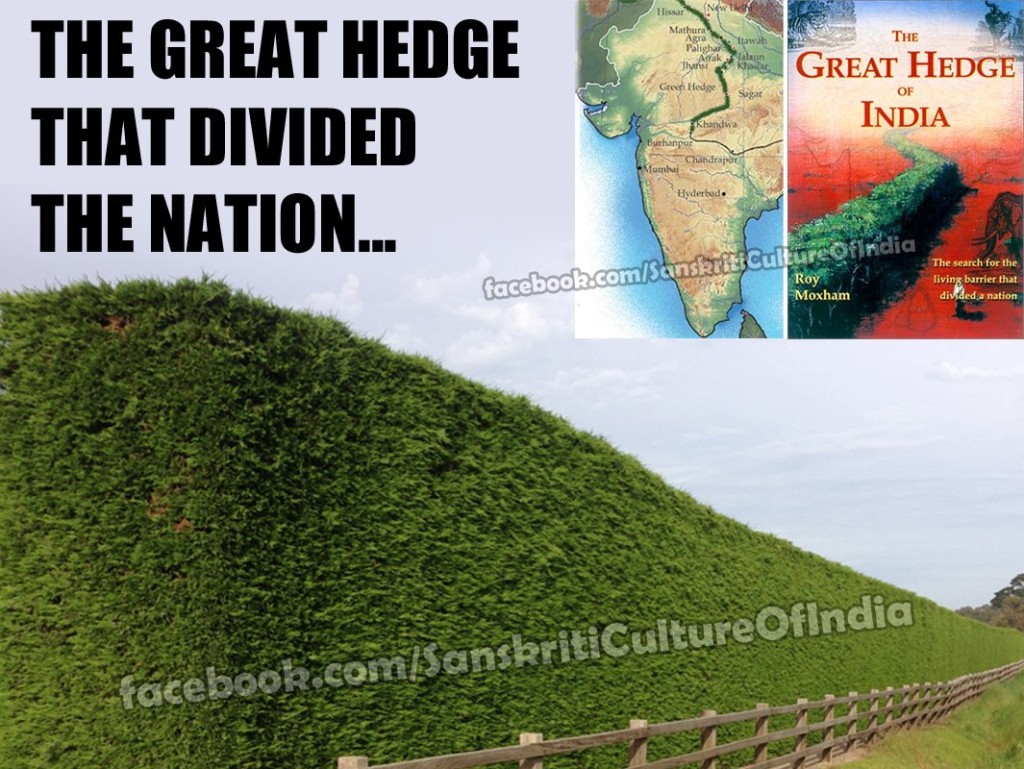
Hedge that divided the India

Hedge that divided the India

India was once divided by a wall that ran from Punjab to Orissa. It was a customs barrier built by the British across India primarily to collect the salt tax.

The wall had its beginnings in a series of customs houses that were established in Bengal in 1803 to prevent the smuggling of salt to avoid the tax because salt was one of the most smuggled item back then due to high prices.

Salt tax brought East India Company the biggest chunk of their revenue. In 1784-85 alone salt tax brought them revenue of 62,57,470 rupees.

The wall was more than 4000 km long .It was initially made of dead, thorny material such as the Indian Plum and not built out of mortar or bricks.

But later it evolved into a living hedge known as The Great Hedge or Inland Customs Line. The hedge was 12 feet high in some parts.

The line ran from the Punjab till Orissa. The Inland Customs Department employed customs officers, Jemadars and men to patrol the line.

The line consisted of a customs post every one mile linked by raised pathways to allow people cross it every 4 miles.

The line and hedge were considered to be an infringement on the freedom of Indians and in opposition to free trade policies and were eventually abandoned in 1879 when the tax was applied at point of manufacture.The salt tax itself would remain in place until 1946.
You may also like

Search the website

Like us on Facebook

Get daily updates via Email

Enter your email address:

Recent Posts

Adi Shankaracharya Jayanti 2026 — Advaita Vedanta, Om symbol, and four Amnaya Peethas

Adi Shankaracharya — The Monk Who Reunited Bharata

Shankaracharya Jayanti 2026 — the 1238th birth anniversary of Adi Shankaracharya. His extraordinary life, the Digvijaya, the debate with Mandana Mishra, Advaita Vedanta, the four Amnaya Peethas, and his timeless literary legacy.

Akshaya Tritiya 2026 — royal purple hero banner with Akshaya Patra vessel and Devanagari text

Akshaya Tritiya 2026 — The Day That Never Diminishes

Akshaya Tritiya (April 19, 2026) is one of the most auspicious days in the Vedic calendar — when any act of dharma, dana, or japa yields imperishable merit. Discover the five sacred Puranic events, complete puja vidhi, timings, mantras, and the deeper spiritual teaching beyond gold-buying.

Baisakhi 2026 — Mesha Sankranti Hindu Solar New Year hero banner with rising sun, Om symbol and wheat harvest

Baisakhi 2026 — Harvest, Hope, and the Hindu Solar New Year

Baisakhi 2026 falls on Tuesday, April 14 — the day Bhagavan Surya enters Mesha Rashi at 9:39 AM, marking the Hindu Solar New Year. Discover the sacred science of Mesha Sankranti, the Punya Kaal rituals, and how this one cosmic moment is celebrated across Bharata as Vishu, Puthandu, Pohela Boishakh, Bohag Bihu, and Pana Sankranti.

css.php