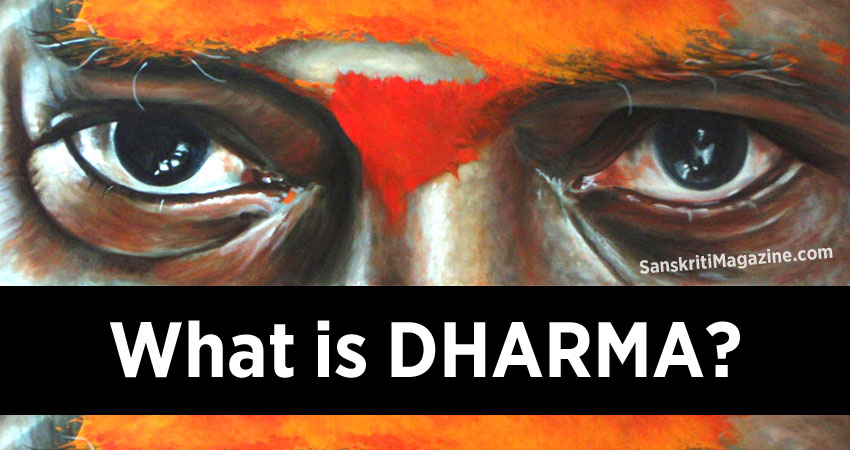
Dharma is perhaps the key term for the great spiritual traditions of India and East Asia, Hindu and Buddhist, whether relative to their understanding of the outer world of nature or the inner realm of consciousness. It is the basis of India’s vast and diverse culture and its deep commitment to Yoga and meditation as tools of self-realization for all. A respect for Dharma is said to be more important even than a belief in God, because it implies certain values and a way of life that promotes truth, unity and respect for all life above ideas or emotions.
Dharma in Sanskrit comes from the root ‘dhri’ meaning ‘to uphold’ and is symbolized by a pillar. It refers to the spiritual, ethical and natural principles that uphold the entire universe. Dharma has always been linked to Veda or vidya, which refers to an inner capacity to perceive the nature of things. It reflects a higher awareness pervades and underlies all existence.
Dharma is a very difficult term to define and eventually must be understood in its own right. To provide a basis for this, we could say that Dharma indicates both the nature of reality at a universal level as well as the proper place for each thing in the universe according to its particular qualities and capacities. There is a specific dharma relative to each creature and every aspect of nature, as well as to the whole of existence. Dharma indicates the harmony both of the totality and the individual, which are complementary and interdependent. According to a dharmic view, the entire universe is present in each object and in every creature, which in some way embody or express the totality.
There is a dharma or natural way of working behind the great forces of nature, the five elements of earth, water, fire, air and ether, the seasons, the three worlds as earth, atmosphere and the heavens, and the different aspects of the cosmos as matter, energy, and light, which follow interrelated laws and patterns.
There is a dharma or unique quality and energy in every plant and animal which serves to make it what it is. Everything has its place in the Dharma, which reflects its role in the cosmic order. And there is a special dharma or role on Earth for the human being, which is to seek to embody a higher truth and work to promote a higher consciousness in the world. The universe is an organically connected vibratory field in which all things are linked together into a greater network of harmony, beauty and vitality. This is the universal ‘web of dharma’.
There is dharma or way of right action relative to all aspects of human life and culture: a dharma of art, a dharma of business, a dharma of communication, a dharma of relationship, a dharma of science, a dharma of religion, and so on – each of which requires its own examination. What is done according to dharma is performed with grace, intelligence and respect for the natural order. Each different domain of our lives has certain principles and practices necessary to unfold its full potential, which constitute its dharma. If we follow the dharma in what we do, we will not only be successful, but will act so in a way that promotes the well-being of all.
We have our own individual or ‘svadharma’ that reflects our capacities and aspirations in life. Yet this is not something that divides us from others. Each person has similar potentials that we must honor.
– Vedacharya David Frawley (Pandit Vamadeva Shastri)