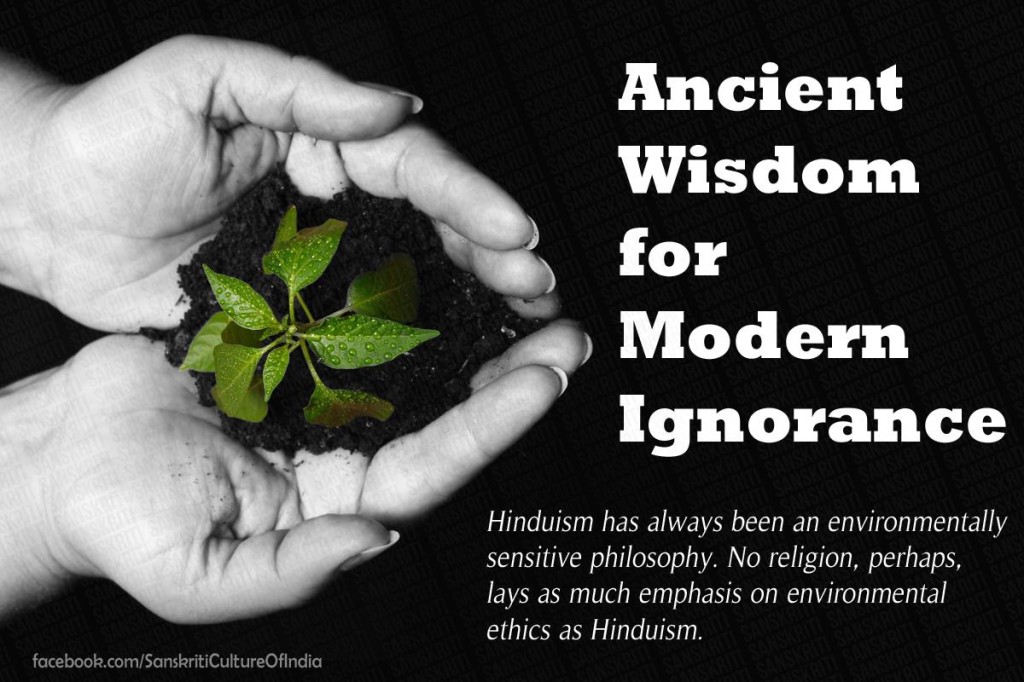
Hinduism has always been an environmentally sensitive philosophy. No religion, perhaps, lays as much emphasis on environmental ethics as Hinduism. The Mahabharata, Ramayana, Vedas, Upanishads, Bhagavad Gita, Puranas and Smriti contain the earliest messages for preservation of environment and ecological balance. Nature, or Earth, has never been considered a hostile element to be conquered or dominated. In fact, man is forbidden from exploiting nature. He is taught to live in harmony with nature and recognize that divinity prevails in all elements, including plants and animals. The rishis of the past have always had a great respect for nature. Theirs was not a superstitious primitive theology. They perceived that all material manifestations are a shadow of the spiritual. The Bhagavad Gita advises us not to try to change the environment, improve it, or wrestle with it. If it seems hostile at times tolerate it. Ecology is an inherent part of a spiritual world view in Hinduism.
 According to Swami B. V. Tripurari, in his book, Ancient Wisdom for Modern Ignorance, ” Our present environmental crisis is in essence a spiritual crisis. We need only to look back to medieval Europe and the psychic revolution that vaulted Christianity to victory over paganism to find the spirit of the environmental crisis. Inhibitions to the exploitation of nature vanished as the Church took the “spirits” out of the trees, mountains, and seas. Christianity’s ghost-busting theology made it possible for man to exploit nature in a mood of indifference to the feelings of natural objects. It made nature man’s monopoly. This materialist paradigm has dominated the modern world for last few centuries.The current deplorable environmental crisis demands a spiritual response. A fundamental reorientation of human consciousness, accompanied by action that is born out of inner commitment, is very much needed. One of the measures that could help a great deal to fulfill this need is to regenerate and rejuvenate basic values of Hindu culture and propagate them.
“Hinduism has often been coined as a “environmental friendly” religion. Hindus regard everything around them as pervaded by a subtle divine presence, may it be rivers, mountains, lakes, animals, flora, the mineral world, as well as the stars and planets. It is so because the Divine reality is present as Prana/Shakti energy, power, in every electron, particle, atom, cell and in every manifestation of matter. It is its very fabric. Just like the sparks of a fire are of the same essence as the fire they were issued forth from, so is the entire creation, of the same essence as the Divine. Just as Hindus greet each other saying “Namaste”, which means: I recognize and salute the Divine within you, so do they recognize the same Divine essence, in all around them.
Ayurveda, the science of life, which is a complete health and medicine system based on nature and its regenerating forces. Then we have Vastu Shastra, upon which the now well-known Feng Shui is based. Vastu, teaches us how to place and build dwellings, according to the environment it is situated in. It is done in such a way that the surroundings are not damaged by the building’s presence, and so that all the natural energies are flowing uninterrupted and freely, providing comfort, peace and prosperity for the dwellers.
In the Indian context, the worship of the Mother entity is traced back to pre-Vedic culture. The earliest Mother Goddess figurine unearthed in India, near Allahabad district of UP, belongs to approximately circa 20,000. One of the most important Neolithic sites in world archeology, and a precursor to the Indus Valley Civilization, is Mehargarh, where thousands of female statuettes, dated as early as circa 5500, have been recovered.
The Rig Veda calls the Female power ‘Mahimata’, a term which literally means Mother Earth. The essential elements of religion in the Rig Veda were deeply impressed by the great phenomena of nature, which they conceived as alive and usually represented in anthropomorphic form. The chief deities in early days grew out of personification of natural phenomena and Earth (Prithvi) was one of them. But in the later Vedic period, the simple ceremonial worshipping gave way to elaborate sacrifices, and some old deities like Prithvi along with Varuna passed into insignificance.
Although ecology is claimed to be a modern concept, the best tribute ever paid to environment is found in the Atharva Veda, where as many as 63 mantras pertain to Prithvi-Sukta (Hymn to Earth), glorifying Mother Earth. Vedic sages regarded Earth as sacred and inviolable.
Prithvi Sukta talks about human dependence on nature and the respect for it that follows naturally: “Mata bhumih, putro aham, prithivyaha”.
Further, according to Prithvi Sukta, Mother Earth is adorned with heights, slopes, plains, hills, mountains, forests, plants, herbs and treasures; She takes care of every creature that breathes and stirs. May She give us joy, wealth, prosperity, good fortune and glory!
Universal peace and harmony are integral to the Vedas. The immortal Shanti Mantra (Hymn of Peace) in Yajur Veda which is chanted for peace and harmony to pervade the entire universe, is as follows: “I pray for peace to pervade all the worlds; I pray for peace in the Sky and Earth; peace in waters; peace in herbs, vegetation and forests; peace among all people and rulers of the world; peace in entire universe; peace for everyone everywhere. Peace, real peace. I pray for that very peace!”
Since time immemorial, peace and harmony with Earth and nature are considered essential for human survival.
Therefore on the occasion of the Earth Day, it is not only our duty, but also a demand of the time that we repose faith in the belief of ancient sages, who gave utmost respect to Mother Earth for giving all the joys, wealth and prosperity to all living beings. Let us make every possible attempt to save the Earth, in order to save humanity.