IndianSanskriti

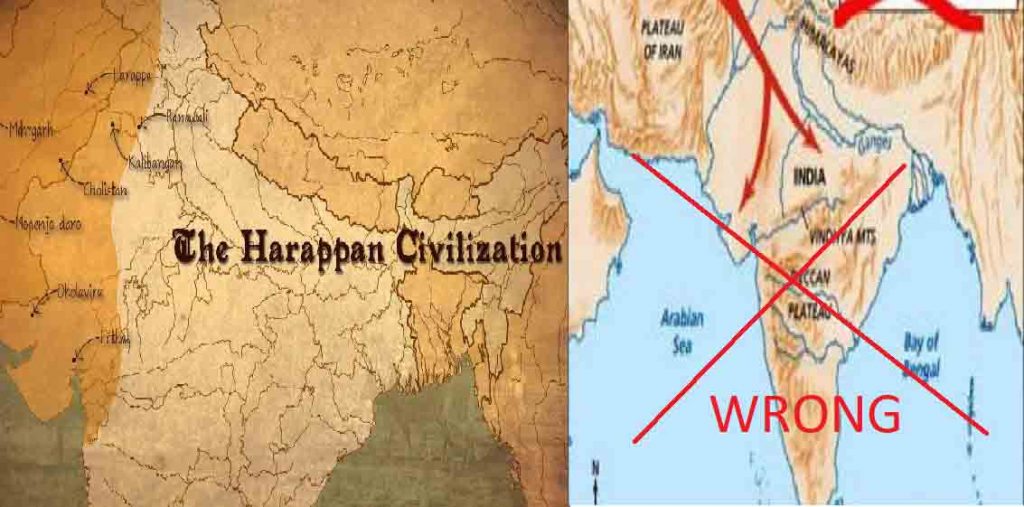
Harappan site of Rakhigarhi: DNA study finds Aryan Invasion theory wrong

Harappan site of Rakhigarhi: DNA study finds no Central Asian trace, junks Aryan invasion theory
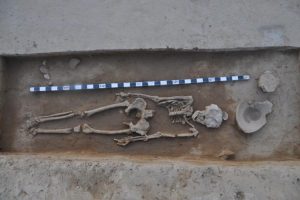
 A human skeleton found at the Rakhigarhi site. (pic via Twitter)


The much-awaited DNA study of the skeletal remains found at the Harappan site of Rakhigarhi, Haryana, shows no Central Asian trace, indicating the Aryan invasion theory was flawed and Vedic evolution was through indigenous people.

According to archaeologist Vasant Shinde of the Deccan College, Pune and Neeraj Rai the head of the ancient DNA laboratory at Lucknow’s Birbal Sahni Institute of Palaeosciences (BSIP), the DNA extracted from Rakhigarhi sites, reveal no ‘Central Asian/Steppe element in the genetic make-up’ of the Harappans.

“The Rakhigarhi human DNA clearly shows a predominant local element — the mitochondrial DNA is very strong in it. There is some minor foreign element which shows some mixing up with a foreign population, but the DNA is clearly local,” Shinde told ET. He went on to add: “This indicates quite clearly, through archeological data, that the Vedic era that followed was a fully indigenous period with some external contact.”

According to the findings, the manner of burial is quite similar to the early Vedic period, also known as the Rigvedic Era. The pottery, the brick type used for construction and the general ‘good health’ of the people ascertained through the skeletal remains in Rakhigarhi, he said, pointed to a well-developed knowledge system that evolved further into the Vedic era.

The continuity of culture from Harappan to post-Harappan period, which these authors consider as Vedic, clearly suggests that there were no major population intervention from outside.

According to this report, the evidence points to a predominantly indigenous culture that voluntarily spread across other areas, not displaced or overrun by an Aryan invasion.

This research findings add more proof to challenge the validity of Aryan Invasion theory that seems to be more “made up” by historians to suit a specific western narrative, based on recent research findings along these lines.

Refernece:
Econimic Times Report: https://economictimes.indiatimes.com/
http://journals.plos.org/plosone/article?id=10.1371/journal.pone.0192299
You may also like

Search the website

Like us on Facebook

Get daily updates via Email

Enter your email address:

Recent Posts

Yogini Ekadashi 2026 — The Yaksha Who Missed the Morning Flowers, and the Ekadashi That Undid His Curse

On Friday, July 10, 2026, the rare Krishna Paksha Ekadashi of Nija Ashadha arrives. The Padma Purana tells the story of Hemamali — the Yaksha gardener of Bhagavan Kubera in Alaka, whose single morning of distraction with his wife Vishalakshi cost him his form, his wife, and his celestial city. Cursed to wander the earth of Bharata as a leper for a long time, he was at last shown the way back by Sage Markandeya — a single sincere keeping of Yogini Ekadashi.

Jamai Shashthi 2026 — The Story of Maa Shashthi, the Cat, and the Wife Who Was Forgiven

Jamai Shashthi 2026 — The Story of Maa Shashthi, the Cat, and the Wife Who Was Forgiven

On Saturday, June 20, 2026, Bengali households across Bharata will welcome their married daughters and sons-in-law home for the legendary jamai-aador feast and perform the Shashthi Vrata. But behind the warmth lies a story most Bengalis know by heart and most non-Bengalis have never heard — the wife who stole the hilsa, blamed the cat, lost six sons to Maa Shashthi’s wrath, and was finally forgiven. The Vrat Katha, the vidhi, the mantras, and the deeper teaching.

Vat Purnima 2026 — The Wife Who Argued Yama Into Returning Her Husband’s Life

On Monday, June 29, 2026, women across Maharashtra, Gujarat, and southern Bharata will tie red thread around banyan trees and hear the story of Savitri — the wife who walked behind Yamaraja Himself when He came for her husband, and out-argued the Lord of Dharma into returning Satyavan’s life. The Mahabharata’s Pativrata Mahatmya Parva, the vrat vidhi, and why the banyan witnessed everything.

Nija Jyeshtha 2026 — The Real Jyeshtha Begins, and the Calendar Resumes

Nija Jyeshtha 2026 — The Real Jyeshtha Begins, and the Calendar Resumes

With Adhik Maas now closed on the Somvati Amavasya of June 15, the long-postponed festivals of Jyeshtha return — Vat Purnima (June 29, the Savitri-Yamaraja katha), Jamai Shashthi (June 20, the Bengali festival of Maa Shashthi), Sankashti Chaturthi (June 28), Yogini Ekadashi (July 10), and Devshayani Ekadashi (July 16, opening the four-month Chaturmas of Bhagavan Vishnu’s yoga-nidra). A guide to what the next four weeks hold and what the household that kept Purushottam Maas now carries forward.

css.php