Lecture by Srila Prabhupada, Bombay 30.09.1973
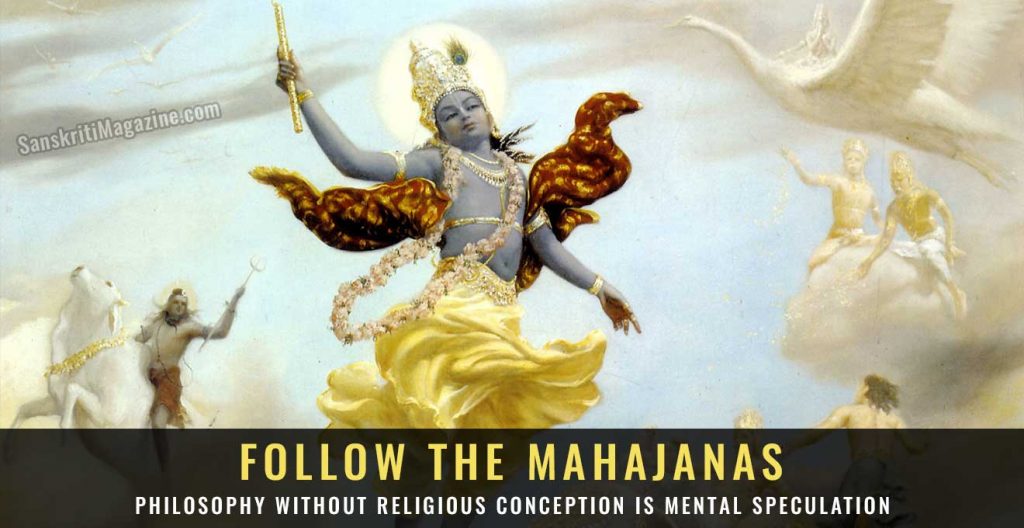
Philosophy without religious conception is mental speculation
People are searching after Isvara, “Can you show me God?” “There is no God.” “God is dead.” So many philosophers and theories are there, but actually there is God. Here is God, Krsna. Isvarah paramah krsnah sac-cid-anandah vigrahah [Bs. 5.1]. Ekale isvara krsna. In Caitanya-caritamrta it is said that “Only isvara is Krsna, the Supreme.” Ekala isvara krsna, ara saba bhrtya. “All others, they are servants.” Nobody is actually isvara. And we find it practically. Everyone in this material world, he may become an isvara is his group, but he is also controlled by somebody superior. That is the position of this relative isvara. But Krsna is absolute isvara. Nobody is isvara above Him. That is Krsna. So, everyone is trying to be isvara. This is the material world. Everyone is trying to be isvara.
Because everyone is trying to be superior. Nasau rsir yasya matam na bhinna, that every philosopher must give his own opinion and it must be refuted by another. Therefore sastra says that in this way you cannot ascertain what is the reality. Tarko ‘pratistha. If you want to understand the reality by your arguments, reasoning power, that is not possible. Because I may be very nice arguer, but another person may be better arguer, he can defeat me. And that is going on.
Therefore simply by arguments, you cannot reach the Absolute Truth. That is not possible. Tarko ‘pratistha. And if you simply depend on the sruti, srutayo vibhinnah. The Vedic literatures are different: Sama, Yajur, Rg, Artharva. And not only that, other scriptures there are. So Srutayor vibhinnah nasau rsir yasya matam na bhinna, dharmasya tattvam nihito guhayam. To understand religious principle, it is very difficult.
Therefore our duty is, mahajano yena gatah sa panthah. “We have to accept that way which is given by the mahajana.” Mahajana. So sastra… We are sometimes in difficulty to find out the mahajana, who is mahajana. That mahajana is also described in the sastras, who can be accepted the greatest authority, mahajana. That is stated in the Sixth Canto of Srimad-Bhagavatam. Svayambhur naradah sambhuh [SB 6.3.20]. They are mahajanas. Svayambhuh means Brahma. Brahma is mahajana. Svayambhu, Narada. Narada Muni is mahajana. And Sambhu, Lord Siva, he is also mahajana. Svayambhur naradah sambhuh kumarah [SB 6.3.20], four Kumaras. Sanat-kumaradi, they are also mahajanas. Kapila, Kapiladeva who expounded that Sankhya philosophy, Kapiladeva. He is incarnation of God. Kumarah kapilo manuh.
Svayambhuva Manu, he is also authority. Manu’s name is also mentioned in the Bhagavad-gita. Imam vivasvate yogam proktavan aham avyayam vivasvan manave prahuh [Bg. 4.1]. So therefore Manu is also mahajana, he’s authority. There is Manu-samhita. Our Vedic system is conducted, the law, the law-giver is Manu. From Manu, the manusya, “man”, these words have come, Manu. Descendant of Manu, human society, manusya.
So Prahlada, Prahlada Maharaja is mahajana. Janaka, Janaka Maharaja. Prahlado janako bhismah, Bhismadeva, grandfather Bhismadeva, the grandfather of the Pandus. He is also mahajana. Prahlado janako bhismo balih, Bali Maharaja, he is mahajana. Vaiyasakih, Sukadeva Gosvami, and Yamaraja, he is also mahajana.
So we have to follow the footsteps of the mahajana. Otherwise we shall be bewildered. Krsna therefore, He says, rsibhir bahudha gitam: “There are many saintly persons, great sages, and they have spoken in various ways.” But Krsna concludes, the Vedanta-sutra. Vedanta-sutra, He gives reference because this Vedanta-sutra comes from the disciplic succession of Brahma. Brahma-sutra. Lord Brahma, Krsna instructed Brahma. Tene brahma hrda adi-kavaye. Adi-kavi is Brahma, and Krsna instructed him. Tene brahma… Brahma means Vedas. Sabda-brahma. The sabda-brahma was instructed to Lord Brahma by Krsna. Therefore Krsna is the original guru.
Any understanding without philosophy, that is sentiment. And philosophy without religious conception is mental speculation. These two things are going on, not combined. All over the world there are many so-called religious systems, but there is no philosophy. Therefore the so-called religious system does not appeal to the modern educated persons. They are giving up religion, either Christian, Muslim, Hindu. Simply formalities, rituals, they do not like. They want to know everything on the basis of philosophy.
sarvasya caham hrdi sannivistho
mattah smrtir jnanam apohanam ca
vedais ca sarvair aham eva vedyo
vedanta-krd vedanta-vid caham
[Bg. 15.15]
So Krsna is vedanta-krd, the compiler of Vedanta-sutra. Because Vyasadeva is incarnation of Krsna, therefore Krsna is vedanta-krd. And one who has compiled Vedanta-sutra, he is vedanta-vid also. He knows what is Vedanta. Not by others. Vedanta-vid vedanta-krd. So both vedanta-krd is Krsna, vedanta-vid is Krsna. So what Krsna says, that is Vedanta. Vedanta means… Veda means knowledge, and anta means the ultimate, anta. Every knowledge has got the ultimate end. So everyone is acquiring knowledge, but what is the end of knowledge? The end of knowledge is to understand Krsna. That is end of knowledge. Vedais ca sarvair aham eva vedyah vedanta-krd vedanta-vid caham [Bg. 15.15]. So Krsna therefore says, brahma-sutra-padais caiva. He’s recommending. He is Vedanta. Therefore whatever Krsna says, that is the ultimate conclusion of Vedanta.