IndianSanskriti
Sri-Hastamalakacharya----Head-of-Dwaraka-Monastery-appointed-by-Adi-Shankara

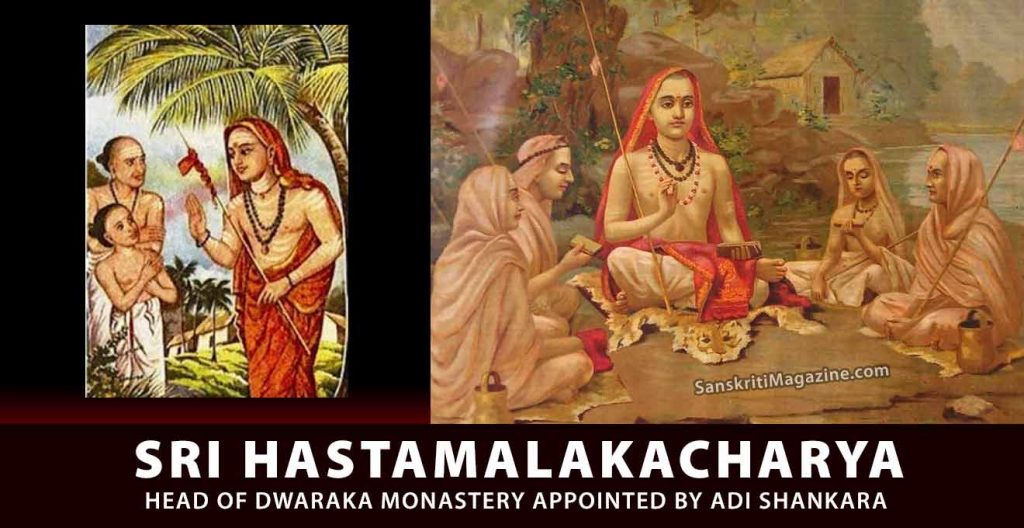
Sri Hastamalakacharya – Head of Dwaraka Monastery appointed by Adi Shankara

In the early part of the 9th century, when Adi Shankaracharya was wandering in the southern part of the India, he happened to pass through a village called Sri Bali (Shivalli, near Udupi in present day India).

In that village there was a pious and learned Brahmin named Prabhakara, he had a 13 year old son who had a pleasant, angel like face; his actions appeared rather strange to the people around. So they thought that the boy was simply an idiot.

The boy was now 13 year old and he never spoke a word. So everyone believed him to be dumb. When Prabhakara (the boy’s father), heard of this sage who would be visiting his village, he went to see Adi Shankara and requested him to come to his house and bless the unfortunate child.

Lord Shankara visited brahmin’s house and saw the child sitting outside quietly. When the boy saw this true sage, he prostrated in front of him.

Lord Shankara knowing the child to be a spiritually advanced soul, asked the boy “My child! why don’t you talk?”

“What about?” The child replied to everyone’s surprise. “It is of no use to speak, ‘that which is’ (referring to God) can’t be grasped through words”

“Tell me, who are you?” questioned Lord Shankara with the intention of letting everyone know about the greatness of the child.

The boy composed 12 Sanskrit verses summarizing the teachings of Vedanta on the nature of ‘SELF’, thus answering Adi Shankara’s question.

Lord Shankara took him as his disciple with his parents’ consent and walked to the next village with his battalion.

Later Adi Shankara established 4 monasteries, and named the boy who was now called ‘Hastamalaka’ as the head of Dwaraka Monastery. Hastamalaka also wrote extensively on spiritual subjects, his own Guru Shankara wrote commenteries on some of the works of Hastamalaka.

Hastamalaka=Hasta (palm)+ Amlaka (gooseberry fruit); Hastamalaka is one who has the knowledge of the Brahman (God) comfortably like a fruit in his palm. The word ‘Karatalamalaka’ also means the same.
You may also like

Search the website

Like us on Facebook

Get daily updates via Email

Enter your email address:

Recent Posts

Purushottam Maas — The Month No Deity Would Claim, and the Lord Who Made It Supreme

Every month of the Hindu calendar has a lord — except the rare thirteenth, the Adhika Maas, born an orphan and shunned as the “impure month.” The Puranas tell how this rejected month went in grief to Bhagavan Vishnu, who claimed it, gave it His own name — Purushottam — and made it the most fruitful month of all. The origin story, the teaching, and what it means for Purushottam Maas 2026 (May 17 – June 14).

Padmini Ekadashi 2026 — The Ekadashi Even the Devas Descend to Keep

Padmini Ekadashi 2026 — The Ekadashi Even the Devas Descend to Keep

The rarest Ekadashi of the entire Hindu calendar is three days away. The Padma Purana preserves a conversation between Bhagavan Krishna and Yudhishthira about a single Ekadashi the great Rishis spend lifetimes waiting for — Padmini. The Vrat Katha of Queen Padmini of Mahishmati, the lotus teaching, and why May 27, 2026 is the morning Vaishnavas across Bharata are preparing for.

Varada Chaturthi 2026 — The Rare Ganesha Day of Purushottam Maas

Varada Chaturthi 2026 — The Rare Ganesha Day of Purushottam Maas

Once every 2.5–3 years — when the rare 13th month of Adhika Maas opens — a thirteenth Vinayaka Chaturthi appears. The Mudgala Purana calls it Varada Chaturthi, the “boon-giving” Chaturthi, and holds it as the most fruit-bearing Ganesha day of the entire calendar. Today, Wednesday May 20, 2026, is that day.

Padmini Ekadashi 2026 — The Rare Ekadashi That Comes Only in Purushottam Maas

Padmini Ekadashi 2026 — The Rare Ekadashi That Comes Only in Purushottam Maas

Padmini Ekadashi 2026 falls on Wednesday, May 27 — the Shukla Paksha Ekadashi of Adhika Maas, the rarest Ekadashi in the entire Hindu calendar (it appears only every 2.5–3 years). The Padma Purana conversation between Bhagavan Krishna and Yudhishthira, the Vrat Katha of Queen Padmini, complete vrat vidhi with jagrana, mantras, and the lotus symbolism that gives the Ekadashi its name.

Ganga Dussehra 2026 — The Day Maa Ganga Came Down to Bhagiratha

Ganga Dussehra falls on Monday, May 25, 2026 — commemorating the day Maa Ganga descended from Vaikuntha to the earth through the millennia-long tapasya of King Bhagiratha. The full account from the Valmiki Ramayana, snan vidhi, dana traditions, mantras, and the teaching of sustained sincerity.

css.php