Tales from the past came alive at Chithra Madhavan’s talk on inscriptions in temples
We listened in awed silence as words inscribed on temple walls thousands of years ago reverberated inside that tiny room. Who were the people who wrote them? What did they convey? Historian Chithra Madhavan told us these fascinating stories in her talk Written Inscriptions In Temple Architecture at Apparao Galleries recently.
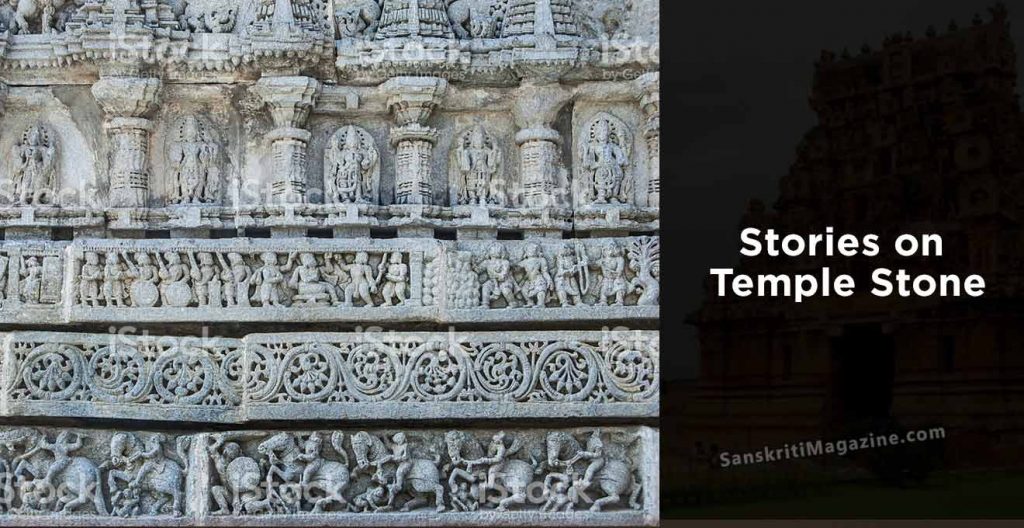
“All of Indian history is based on inscriptions,” said Chithra. They are our clues to the lives of the kings of our past. Inscriptions give us snapshots about the world of conquests and defeats; of poets, warriors and scholars whose names we would never have known otherwise.
A temple, those days, was not merely a place of worship, the historian said. “It was a centre of learning, music and dance. A little boy running about a temple compound would hear the beats of music, see people singing… he would imbibe it all. You wouldn’t have to drive to an AC auditorium to listen to music back then,” she said.
A lot of hard work
![Ranakpur-Jain-Temple-13[2]](https://www.sanskritimagazine.com/wp-content/uploads/2018/03/Ranakpur-Jain-Temple-132.jpg) It takes a lot of hard work to read inscriptions, she said. Epigraphists spend hours tracing them on paper from temple walls and deciphering them back at their office. But, it’s all worth it. How else would we know that there was an architect called Ravi who rebuilt a temple in 11th Century in Thiruvottiyur? Or that there was a vedic college, hostel and a hospital named Veera Chozhan Hospital by a temple premises in the village of Thirumukkoodal near Kanchipuram? Or that the construction of the magnificent Thanjavur Brihadeeswara temple was completed in 1010?
It takes a lot of hard work to read inscriptions, she said. Epigraphists spend hours tracing them on paper from temple walls and deciphering them back at their office. But, it’s all worth it. How else would we know that there was an architect called Ravi who rebuilt a temple in 11th Century in Thiruvottiyur? Or that there was a vedic college, hostel and a hospital named Veera Chozhan Hospital by a temple premises in the village of Thirumukkoodal near Kanchipuram? Or that the construction of the magnificent Thanjavur Brihadeeswara temple was completed in 1010?
The next time you go to the Kanchi Kailasanatha Temple, look out for the inscriptions. Written in calligraphic style, they carry some 300 titles of one man — King Rajasimha who built the temple. We also infer that the king was fond of elephants. These inscriptions, felt Chithra, were “worth their weight in gold”. Artists, architects… imagine the number of people who benefitted from the work due to the employment opportunities it provided.
Inscriptions give us a “wealth of information”, said Chithra. For instance, the village of Ennayiram in Villupuram had a vedic college during Rajendra Chola’s time. An inscription on a temple wall in the village talks about the kind of subjects taught, the number of students, teachers etc.
The walls of the Chidambaram Temple carry verses from the Natyasastra, while the Tamil inscriptions in the Brihadeeswara temple speak of the donations made to the temple by Raja Raja Chola and his family. The Vaikunta Perumal temple in Kanchipuram, built by Pallava king Nandivarman — II has inscriptions that detail “the entire history of the Pallava dynasty”. Wars, deaths, conquests… they are all there. The story of how Nandivarman came to rule the kingdom when he was just a boy of 12 is also detailed.
Apart from the walls, copper plates too carry inscriptions. “These were given to a person or a temple by a ruler for a grant of land given by him,” explained Chithra. Despite their priceless nature, there is “a blatant disregard of inscriptions”, she concluded. “It is a fantastic subject. But has few takers.”
Did you know that there is a curse inscribed inside the Ganesha Ratha in Mamallapuram? “Be cursed, be cursed…” begins the inscription. Who is the curse for? Ask the walls the next time you’re there.