IndianSanskriti
The Curse of Rishi Gautama From Varaha Purana

The Curse of Rishi Gautama From Varaha Purana

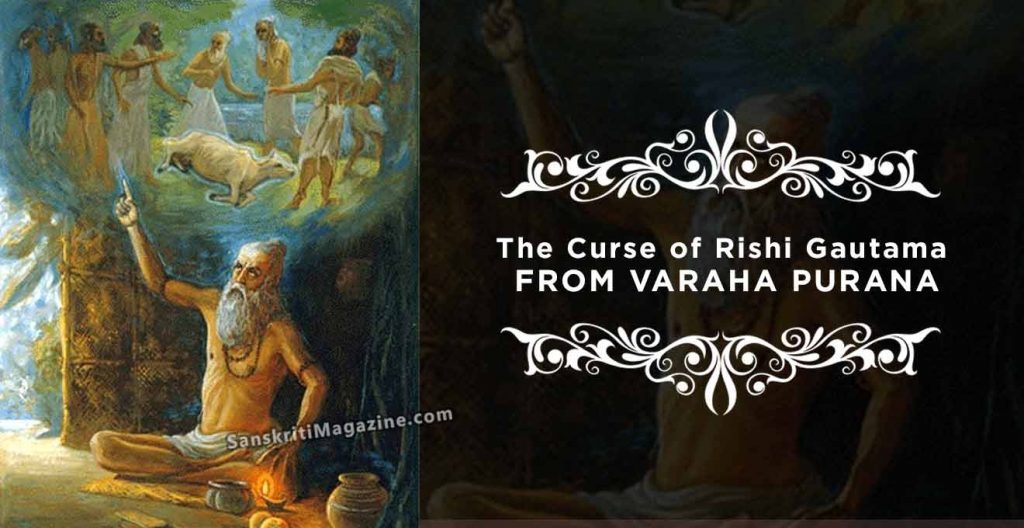
Gautama’s curse on the brahmanas who wished to leave, creating a deception as an excuse to do so. From Varaha Purana.

In ancient times, the sage Gautama performed austerities in Dandakaranya forest. Lord Brahma became pleased and gave him some divine seeds capable of producing eternal crops. Gautama then went to Saptasring mountain and made his hermitage there. He sowed the seeds and was very pleased to see rice grains sprouting up within moments. Gautama lived there happily with his disciples. In due course of time, the whole country was plagued by a great famine — everywhere except at the hermitage of Gautama.

One day, a few sages arrived at Gautama’s hermitage, and he treated them with all respect. These sages enjoyed the hospitality of Gautama, staying at his hermitage and engaging in long discussions with him, until eventually the famine was over. Then they decided to go back to their respective native places. When they sought Gautama’s permission, he requested them to stay for a few more days.

The sages then decided to use deceitful means for taking their leave of Gautama’s association. They created a superficial cow with the help of their illusionary powers and left it near the hermitage of Gautama.

Gautama was very pleased to see that cow. He eulogised it by sprinkling water on it. Hardly had he finished his act than the cow died. All the deceitful sages then returned to the scene, and cursed Gautama for killing an innocent cow. They told him that they could never live along with a person who had killed a cow, and on this excuse, they took their leave, just as they had meant to do all along.

Gautama then strictly observed the prescribed atonement for such an inauspicious act as killing a cow. Afterwards he discovered that the cow had simply been an illusion created by the brahmanas as part of their deception. He angrily cursed them to lose their Vedic knowledge. In this way, knowledge turned to ignorance.


You may also like

Search the website

Like us on Facebook

Get daily updates via Email

Enter your email address:

Recent Posts

Purushottam Maas — The Month No Deity Would Claim, and the Lord Who Made It Supreme

Every month of the Hindu calendar has a lord — except the rare thirteenth, the Adhika Maas, born an orphan and shunned as the “impure month.” The Puranas tell how this rejected month went in grief to Bhagavan Vishnu, who claimed it, gave it His own name — Purushottam — and made it the most fruitful month of all. The origin story, the teaching, and what it means for Purushottam Maas 2026 (May 17 – June 14).

Padmini Ekadashi 2026 — The Ekadashi Even the Devas Descend to Keep

Padmini Ekadashi 2026 — The Ekadashi Even the Devas Descend to Keep

The rarest Ekadashi of the entire Hindu calendar is three days away. The Padma Purana preserves a conversation between Bhagavan Krishna and Yudhishthira about a single Ekadashi the great Rishis spend lifetimes waiting for — Padmini. The Vrat Katha of Queen Padmini of Mahishmati, the lotus teaching, and why May 27, 2026 is the morning Vaishnavas across Bharata are preparing for.

Varada Chaturthi 2026 — The Rare Ganesha Day of Purushottam Maas

Varada Chaturthi 2026 — The Rare Ganesha Day of Purushottam Maas

Once every 2.5–3 years — when the rare 13th month of Adhika Maas opens — a thirteenth Vinayaka Chaturthi appears. The Mudgala Purana calls it Varada Chaturthi, the “boon-giving” Chaturthi, and holds it as the most fruit-bearing Ganesha day of the entire calendar. Today, Wednesday May 20, 2026, is that day.

Padmini Ekadashi 2026 — The Rare Ekadashi That Comes Only in Purushottam Maas

Padmini Ekadashi 2026 — The Rare Ekadashi That Comes Only in Purushottam Maas

Padmini Ekadashi 2026 falls on Wednesday, May 27 — the Shukla Paksha Ekadashi of Adhika Maas, the rarest Ekadashi in the entire Hindu calendar (it appears only every 2.5–3 years). The Padma Purana conversation between Bhagavan Krishna and Yudhishthira, the Vrat Katha of Queen Padmini, complete vrat vidhi with jagrana, mantras, and the lotus symbolism that gives the Ekadashi its name.

Ganga Dussehra 2026 — The Day Maa Ganga Came Down to Bhagiratha

Ganga Dussehra falls on Monday, May 25, 2026 — commemorating the day Maa Ganga descended from Vaikuntha to the earth through the millennia-long tapasya of King Bhagiratha. The full account from the Valmiki Ramayana, snan vidhi, dana traditions, mantras, and the teaching of sustained sincerity.

css.php