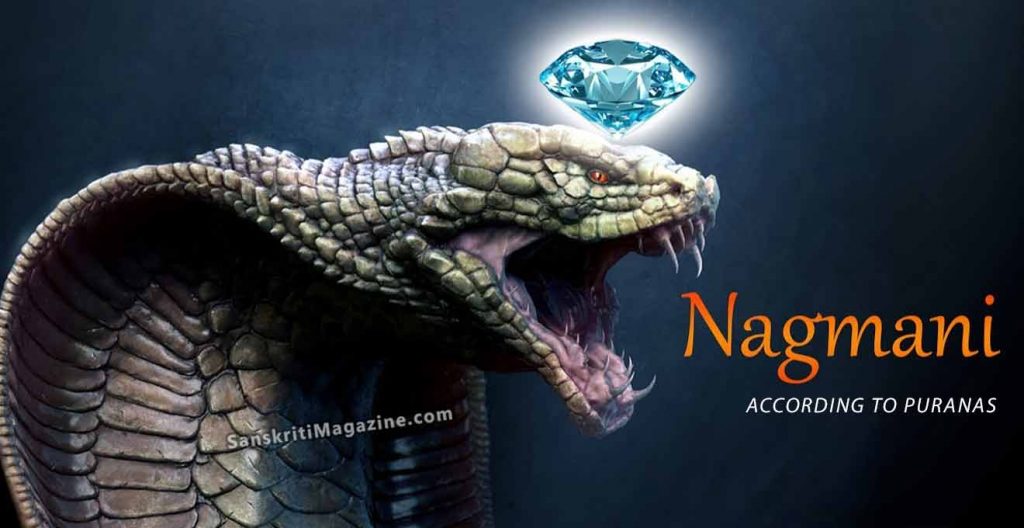
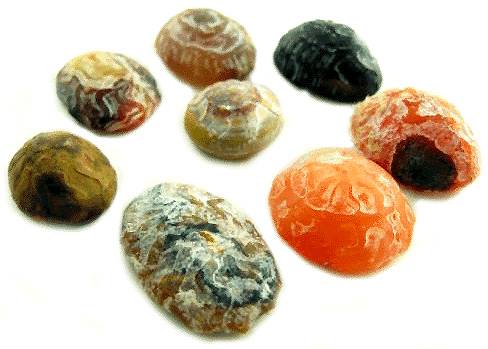
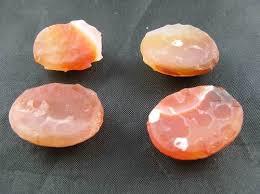
Among the Nava Moti, or nine pearls most often in sastra is probably the Cobra Pearl, or Sri Naga Mani. These translucent, transparent, and semi-translucent gems are egg-shaped and appear in a variety of colors: golden, green, red, blue, pink, white, black. Some have stratification or marbling on the surface, and they vary greatly in size and shape.
Aside from the many legends to be found about cobra pearls amongst members of the Naga tribe, they are described in some detailed in various Puranic literatures.
The Agni Purana:
“Under the earth is the underworld. This too, consists of seven regions and their names are Atala, Vitala, Sutala, Talatala, Mahatala, Rasatala and Patala. The daityas and the danavas live in the underworld. Vishnu is also there in the underworld, in his form of the great snake Shesha. The snake Shesha holds up the earth on its hood.”
The Vayu Purana:
“Snakes and demons live in the underworld. Atala is ruled by the demon Namuchi; Sutala by the demon Mahajambha; Vitala by the demon Prahlada; Gabhastala by the demon Kalanemi: Mahatala by the demon Virochana; Shritala by the demon Kesari; and Patala by the demon Vali. The great snake Vasuki lives in Shritala and the great snake Shesha lives in Patala. The eyes of the snake Shesha are like red lotuses. His complexion is white and he wears blue, His thousand hoods glow with radiance.”
The Vishnu Purana:
“There are seven underworlds on earth…. Here live the Danavas, Daityas, Yakshas and Nagas. Narada once went on a trip to Patala and discovered that Patala was more beautiful than Svaraga. It was a place full of jewels. During the day, the sun only provided light, but no heat. And, during the night, the moonbeams provided light, but no cold. Patala was full of rivers, forests and lakes. The inhabitants of Patala wore beautiful clothes, rubbed scented paste on their bodies and loved music. At the bottom of Patala was Vishnu in the form of a thousand-headed snake. This snake was known as Shesha.”
The Bhagavata Purana:
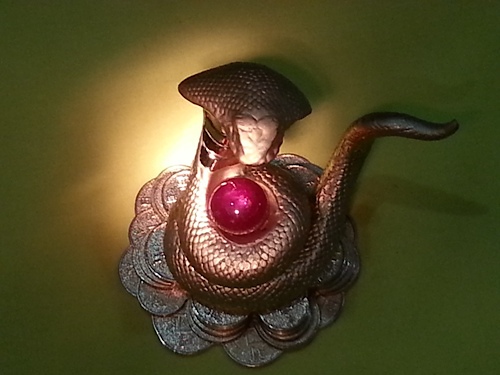
“Since there is no sunshine in those subterranean planets, time is not divided into days and nights, and consequently fear produced by time does not exist. Many great serpents reside there with gems on their hoods, and the effulgence of these gems dissipates the darkness in all directions.
Beneath Rasatala is another planetary system, known as Patala or Nagaloka, where there are many demoniac serpents, the masters of Nagaloka, such as Shankha, Kulika, Mahashankha, Shveta, Dhananjaya, Dhrtarashtra, Shankhacuda, Kambala, Ashvatara and Devadatta. The chief among them is Vasuki. They are all extremely angry, and they have many, many hoods – some snakes five hoods, some seven, some ten, others a hundred and others a thousand. These hoods are bedecked with valuable gems, and the light emanating from the gems illuminates the entire planetary system of bila-svarga.”
The Brahma Purana:
“The underworld is a wonderful place, more beautiful than heaven itself. The sage Narada once went on a trip to the underworld and was bowled over by its beauty. It is full of palaces and jewels. The sun rises there, but does not radiate too much of heat. The moon also rises, but its beams are not at all chilly. The forest are populated by beautiful trees and the ponds are thick with lotus flowers, the songs of cuckoo birds are heard everywhere. Below the underworld sleeps a great snake, known as Shesha or Anata. It has a thousand hoods, all covered with jewels.”
The Matsya Purana:
“The Creation. In the beginning, there was nothing in the universe. There was only darkness. When the time came for creation to begin, Vishnu removed the darkness and expanded into three. These three parts came to be known as Brahma, Vishnu and Shiva. The first object that appeared was water and Vishnu slept on this water. Since nara means water and ayana means resting-place, Vishnu is accordingly also known as Narayana.
In this water next appeared a golden egg. The egg shone with the radiance of a thousand suns. Inside the egg, Brahma grew from the navel of Vishnu. The egg was golden. Garbha means womb, and since Vishnu appeared inside a golden egg, he is also known as Hiranyagarbha.
For a thousand years Brahma stayed inside the egg. He then split the shell into two and emerged out. Heaven (svarga) was made from one half of the shell and the earth from the remaining half. All the land masses, the oceans, the rivers and the mountains, had been inside the egg in embryonic form.”
 The Mahabharata:
“Ulupi then thought of the gem that has the virtue of reviving a dead man. The gem, the great refuge of the snakes, thus thought of, came there. The daughter of the prince of snakes taking it up… then placed that gem on the breast of Pritha’s son of immeasurable energy. After the gem had been placed on his breast; the heroic and puissant Jishnu became revived. Opening his red eyes he rose up like one who had slept long. Beholding his sire, the high-souled hero of great energy, restored to consciousness and quite at his ease…”
Sri Garuda Purana:
“A pearl found in the hood of a cobra is round in shape like the one obtained from the mouth of a fish and emits a dazzling effulgence from its own natural seat. After copious washing such a pearl assumes the lustre of a well-polished sword. The possessor of a cobra or serpent pearl meets with rare good fortune, and becomes a pious and illustrious king in time, with a treasury full of other species of precious gems.
Dark clouds, hung down and heavily charged with rain, and roaring with the voice of the eternal trumpets blown upon at the time of universal dissolution and spangled with flashes of lightning, closely envelop the sky, at the time, when the Brahmana, well versed in the religious and ceremonial proceedings, after inquiring about the acquisition of such a pearl, and having done the necessary rite of protection unto it, formally takes it into the interior of the house of its possessor. Neither the serpents, nor the Rakshas, nor diseases, nor disturbances of any kind would assail the man amidst whose treasure such a snake pearl would lie.”
The Puranas describe the rituals performed by a brahmana who is installing a Cobra Pearl into the home of one who comes to possess it. It is said that during the installation ceremony, very severe weather will manifest. If it does not, then the Cobra Pearl is not authentic. Once a Cobra Pearl has been installed, it must remain there, and can only be moved to a temple. However, very few temples are willing to receive Naga Manis due to the burden of responsibilities attendant to giving shelter to one. It is said that Naga Manis have a tendency to gravitate back to Nagaloka, and may thus draw along with them the life of one whose duty is to offer service to the pearl.