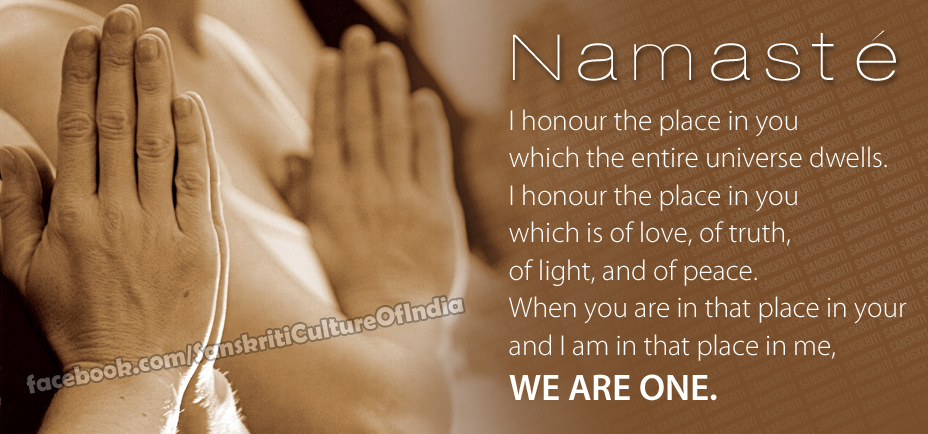
‘Namaste’ or ‘namaskar’ is the Bharatiya way of greeting each other. Wherever they are – on the street, in the house, in public transport, on vacation or on the phone – when Hindus meet people they know or strangers with whom they want to initiate a conversation, namaste is the customary courtesy greeting to begin with and often to end with. It is not a superficial gesture or a mere word, and is for all people – young and old, friends and strangers.
Namaste and its common variants ‘namaskar,’ ‘namaskaara’ or ‘namaskaram’, is one of the five forms of formal traditional greeting mentioned in the Vedas. This is normally understood as prostration but it actually refers to paying homage or showing respect to one another, as is the practice today, when we greet each other.
The Meaning of Namaste:
In Sanskrit the word is namah + te = namaste which means “I bow to you” – my greetings, salutations or prostration to you. The word ‘namaha’ can also be literally interpreted as “na ma” (not mine). It has a spiritual significance of negating or reducing one’s ego in the presence of another.
How to Namaste:
Bend the arms from the elbow upwards and face the two palms of the hands. Place the two palms together and keep the folded palms in front of the chest. Utter the word Namaste and while saying the word bow the head slightly.
Why Namaste:
Namaste could be just a casual or formal greeting, a cultural convention or an act of worship. However, there is much more to it than meets the eye. The real meeting between people is the meeting of their minds.
When we greet one another with namaste, it means, ‘may our minds meet’, indicated by the folded palms placed before the chest. The bowing down of the head is a gracious form of extending friendship in love, respect and humility.
Spiritual Significance of Namaste:
The reason why we do Namaste has a deeper spiritual significance. It recognizes the belief that the life force, the divinity, the Self or the God in me is the same in all. Acknowledging this oneness with the meeting of the palms, we honor the god in the person we meet.
Namaste in Prayers:
During prayers, Hindus not only do namaste but also bow and close their eyes, as it were, to look into the inner spirit. This physical gesture is sometimes accompanied by names of gods like ‘Ram Ram’, ‘Jai Shri Krishna’, ‘Namo Narayana’, ‘Jai Siya Ram’ or just ‘Om Shanti’ – the common refrain in Hindu chants. This is also quite common when two devout Hindus meet – indicating the recognition of the divinity within ourselves and extending a warm welcome to each other.