IndianSanskriti
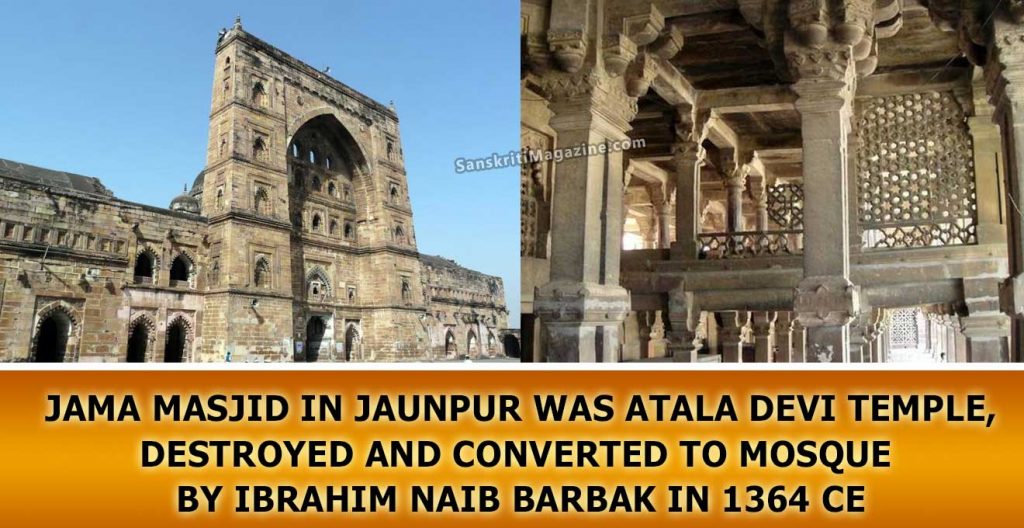
Jama Masjid in Jaunpur was Atala Devi Temple, destroyed and converted to mosque by Ibrahim Naib Barbak 1364 CE

Jama Masjid in Jaunpur was Atala Devi Temple, destroyed and converted to mosque by Ibrahim Naib Barbak

Atala Devi Temple was destroyed by Ibrahim Naib Barbak, the brother of Sultan Firoz Shah Tughlaq III (1351–1388 CE).

Temple was demolished in 1364 CE, Ibrahim started construction in 1377 CE and completed the mosque in 1408 CE.

Atala Masjid or Atala Mosque, as it is popularly called is located 2.2 km north-northeast of Jaunpur, 7.3 km northwest of Zafarābād, 16.8 km north-northeast of Mariāhū, 26.3 km west-northwest of Kirākat.

The Gazetteer of Jaunpur district dated 1908 CE, written by H.R. Nevill, the district collector of Jaunpur, confirms the destruction and construction dates.

Sultan Firoz Shah Tughlaq who erected the Jhanjhari masjid in honour of a saint called Hazrat Ajmali.
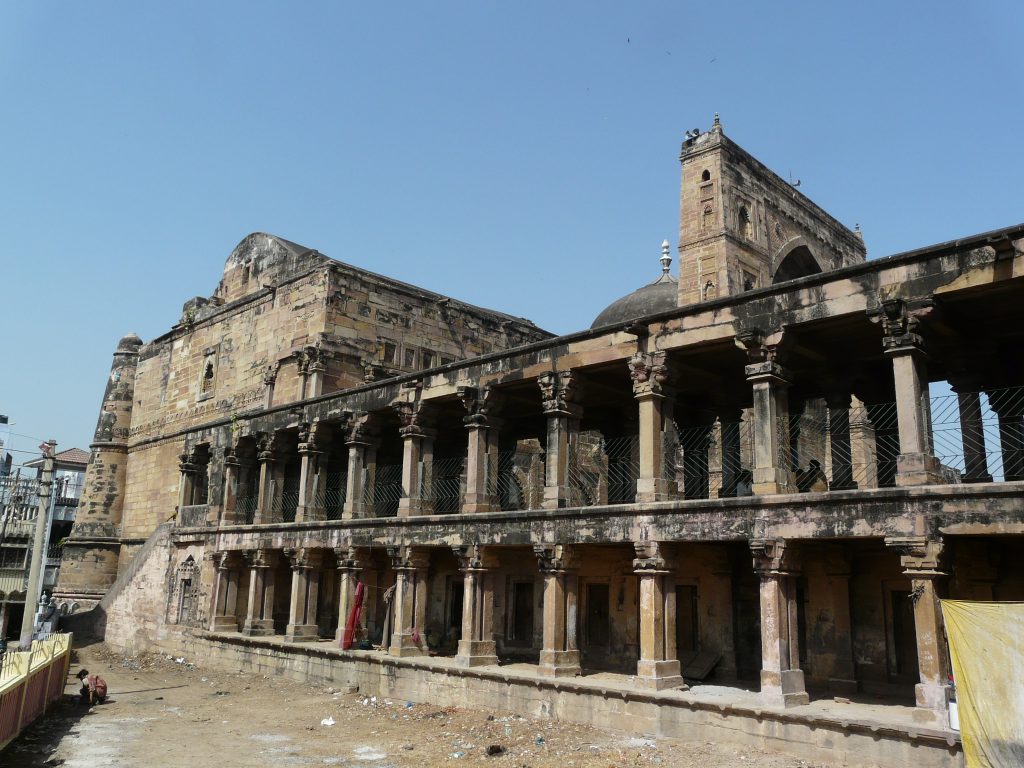
According to the gazetteer, there stood an equally large temple of Mukatghat, built by Raja Vijaya Chandra of Kannauj, the father of Jaichand (father-in-law of Prithviraj Chauhan).

Atala Devi is a Hindu goddess of inexorable fate. Her worship almost ended after destruction of that temple.

She was believed to change fate, which is even unavoidable.

Eventhough, the outer structure is changed, the inner walls, pillars of this masjid have retained the original hindu temple structures.

Atala Devi Mandir was also built by Raja Vijaya Chandra.

The impressive central dome almost 17 meters high above the ground can not be noticed from the front because of the presence of a tall tower (at 23 meters).

The nearby Jhanjhari Mosque is also known by the name of Chachikpur.
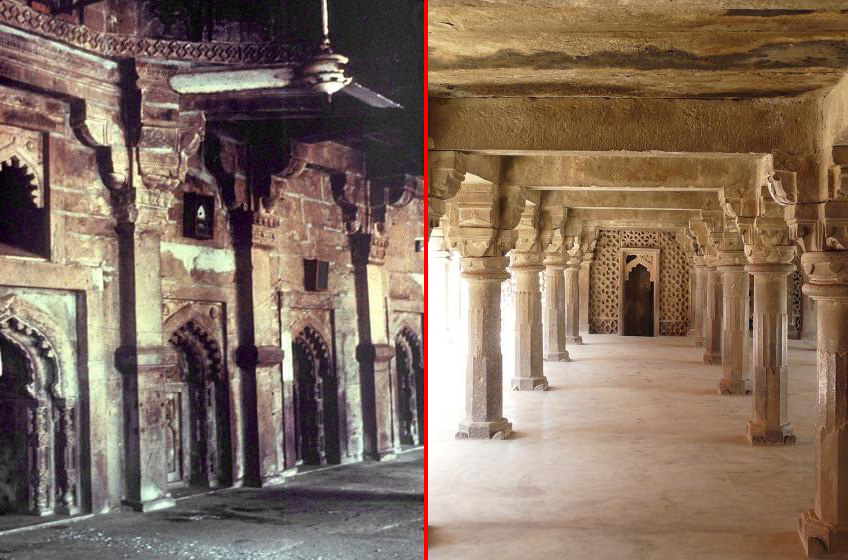

Sultan Ibrahim built it for the convenience of the celebrated saint, Sayyid Sadr Jahan Ajmali, who had once been his prime minister and who, after retiring from that post, used to live in the Muhalla of Shaikhuwarah, which is quite close to it.

This was once destroyed by Sikandar Lodi, and later suffered major damage due to floods of Gomti river.

Source : Book Facts.
You may also like

Search the website

Like us on Facebook

Get daily updates via Email

Enter your email address:

Recent Posts

Adi Shankaracharya Jayanti 2026 — Advaita Vedanta, Om symbol, and four Amnaya Peethas

Adi Shankaracharya — The Monk Who Reunited Bharata

Shankaracharya Jayanti 2026 — the 1238th birth anniversary of Adi Shankaracharya. His extraordinary life, the Digvijaya, the debate with Mandana Mishra, Advaita Vedanta, the four Amnaya Peethas, and his timeless literary legacy.

Akshaya Tritiya 2026 — royal purple hero banner with Akshaya Patra vessel and Devanagari text

Akshaya Tritiya 2026 — The Day That Never Diminishes

Akshaya Tritiya (April 19, 2026) is one of the most auspicious days in the Vedic calendar — when any act of dharma, dana, or japa yields imperishable merit. Discover the five sacred Puranic events, complete puja vidhi, timings, mantras, and the deeper spiritual teaching beyond gold-buying.

Baisakhi 2026 — Mesha Sankranti Hindu Solar New Year hero banner with rising sun, Om symbol and wheat harvest

Baisakhi 2026 — Harvest, Hope, and the Hindu Solar New Year

Baisakhi 2026 falls on Tuesday, April 14 — the day Bhagavan Surya enters Mesha Rashi at 9:39 AM, marking the Hindu Solar New Year. Discover the sacred science of Mesha Sankranti, the Punya Kaal rituals, and how this one cosmic moment is celebrated across Bharata as Vishu, Puthandu, Pohela Boishakh, Bohag Bihu, and Pana Sankranti.

Varuthini Ekadashi 2026 — sacred vrat guide hero banner with Vishnu Chakra mandala

Varuthini Ekadashi 2026 — The Sacred Vrat That Shields from Sin

Varuthini Ekadashi (April 13, 2026) is one of the most powerful Ekadashi vrats — dedicated to Lord Vamana, it dissolves lifetimes of karmic burden and shields the devoted soul with Bhagavan Vishnu’s protective grace. Complete vrat vidhi, timings, mantra, and the sacred Vrat Katha from the Bhavishya Purana.

css.php