~ by Pratha Sharma
Hindu temples have been since time immemorial the epitome centre of worship in India. There are temples dedicated to these gods and goddesses, along with animals and non living creatures.
Hindu gods and goddesses alike are depicted as the protector of animals by the very fact that they are supposed to be riding animals or birds.
Lord Shiva is said to ride the Nandi bull, Lord Vishnu rides the Garuda eagle, Lord Ganesh rides the rat, Lord Murugan rides the peacock and Goddess Durga rides the lion, to name a few.
Lord Shiva is also known by the name of “Pashupatinath”. ‘Pashu’ in Sanskrit means ‘animals’ and some texts refer it to particularly the ‘cow’.
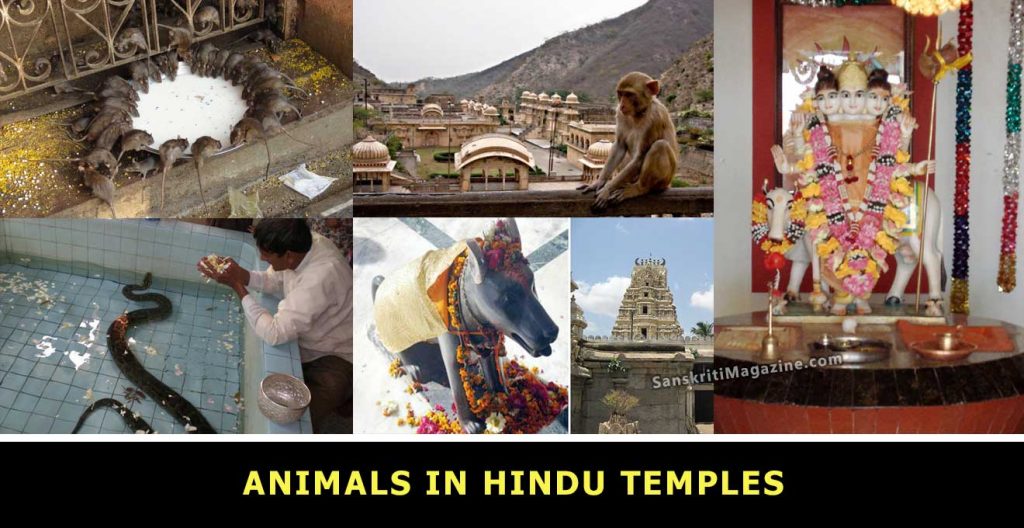
Every Shiva temple is accompanied by the figurine or sculpture of the Nandi Bull right in front of the Shiva Linga.
Not only did all the major temples maintain goshalas, but animals were inherent in the temple architecture.
A huge ancient sculpture of Nandi is seen in the Brihadeshwara temple in Thanjavur.
A remarkable demonstration of the importance of animals in Hindu temples is by the fact that some temple’s worship is incomplete without the animals. Some examples of such temples are the following:
The Rat temple or Karni Devi Temple:
This temple is located about 30 kms from Bikaner in Rajasthan state. The Karni Devi temple is regarded as the rat temple due to it’s famous 20,000 rats that live here. Never has their number been seen to increase or reduce, and no one has ever seen a baby rat. The Prasad cooked here is shared by the rats and humans alike, and not a single case of disease or plague has ever been reported.
The Monkey Temple or the Galtaji Temple:
Monkeys are sacred in Hinduism since the time Lord Hanuman helped Lord Ram in his fight against Ravana. Several temples are dedicated to Lord Hanuman, but a special one 10 kms from Jaipur is famous for it’s monkey inhabitants.
The Snake Temples:
Various festivals exist in India that worship snakes as on Shivratri and Nag Panchami, serpents occupy a special place in Hinduism.
The Mannorasala Temple in Kerala has 30,000 images of snake idols along it’s path. Women come here seeking fertility.
The Kukke Subramanya Temple in Karnataka is dedicated to Lord Subramanium and devotes come here for Sarpa Dosha Nivarana that is inherent in the natal birth chart.
Other examples are the Bhujang Nath Temple in Gujarat, the Tirunageshwaram Temple, and the Sheshnag Lake in the Kashmir valley. stories says that it was created by Sheshnag himself, on whom Lord Vishnu rest.
Temple for Dog:
In Chennapatna taluk in Karnataka, there are two idols of dogs that are worshipped.
Dattatreya Temple at Kala Dungar:
Another classic example of animal worship in temples is the Kala Dungar.
The “Kala Dungar” or the Black Hill is the highest point in the Rann of Kutch. A panoramic view of the Rann and the forest is possible from here. It is famous for it’s Dattatreya Temple.
Legend has it that when Lord Dattatreya practiced penance at this place, a band of starving jackals came there. Lord Dattatreya offered a part of his body, and the parts or limbs regenerated themselves. However the hungry jackals refused to eat his body parts. Then Lord offered his sweet rice which they readily ate. After that they came everyday twice to eat the sweet rice. This practice is continued and each day rice cooked with jaggery is offered after noon and evening arti, and they come and take the Prasad.
It is considered inauspicious if the jackals do not come to eat. So it happened in 2001, and soon after a few days there was a major earthquake in the region.
Hindu philosophy not only emphasizes the great importance of the animal kingdom in it’s temple worship, but the very manifestation of nature or “Prakriti” is itself colorized as the worship of Uma nor Shakti, the consort of Lord Shiva.