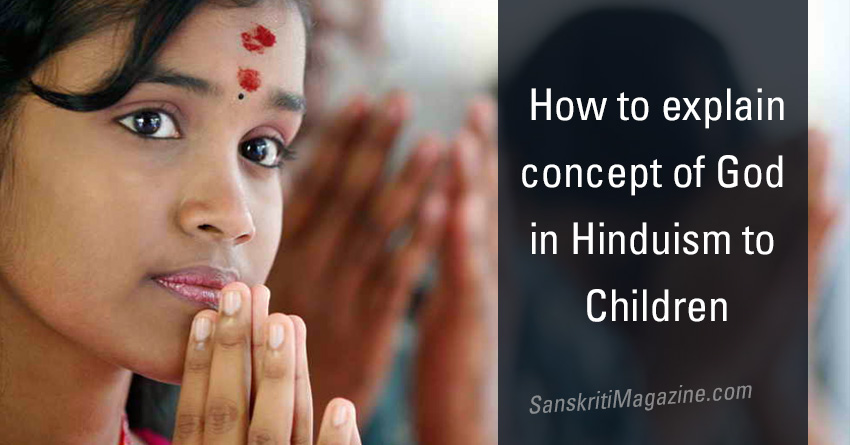
Where is God ? Who is God ? How is God ?
And more importantly being a Hindu, how many Gods is additional question that comes commonly to many minds including children.
Some of the Hindu parents instead of answering these questions in a simple and honest way, try to complicate or totally avoid these questions leaving their children to come up with their own definitions that may be far from completely wrong or far from truth. Answering these questions is much more important, especially in present technologically well-connected, terror trouble global world where young minds are exposed to diverse imposing and misleading cultures sometimes which are taking extreme approaches.
To explain the concept, please allow me to share my own experience of having this conversation with my child who is 10 years of age.
Daddy, is our god very weak ? Is a question that my child unhesitatingly asked me one day.
Out of curiosity I have asked him why he thinks so, for which he pointed at an idol and mentioned it can be destroyed by a hammer and hence he thought its weak. Similar to other parents trying to evade the topic, I could have given highly echoing no and he would have taken my word without second thought, but instead, I felt his question is much more deeper and he needed a clarity on the concept of god in Hinduism. With this in mind, asked my child, what he thinks is god, for which he mentioned, god is someone who stays above and beyond all of us.
During 80s as a growing up Hindu child, celebrating Vinaya Chaturthi, Sri Rama Navami, Deepavali, Dusshera and Shiva Rathri I have definitely learned epics behind such festivals. But the question of god being weak never occurred to my mind and am sure just like me, many might have just taken god as someone who establishes good by overcoming evil. As a grown up adult working and currently living out of India, this question was never posed to me by anyone as well. This question stemmed out from conversation my child had with his classmates on the reasons for terrorism.
In order to explain god to kids, I took an honest and simple to understand approach. First step is to define who is god. I have asked him and helped him in his thoughts to define god as someone who creates, nurtures and protects us.
After coming up with this definition, I have asked if a mother can fit into this definition. Even though he didn’t quite agree to what am asking, he started to think. Mother is someone who creates by giving birth, nurtures us by feeding and protects us by ensuring safety all the time. He genuinely agreed to his mother fitting into the definition of god. That’s when, I have explained in Hinduism, mother is considered as god and hence we chant Matrudevo Bhava (Divinity in motherhood).
I have then asked where did this earth that we all live come from ? since he read this in science, he immediately answered Sun. Will we all live without Sun for 1 month and what if Sun’s temperature goes beyond 100 degrees, for which he answer we wont be alive. Without asking any question, he unequivocally said, Sun is a creator, nurturer and protector of life on earth and hence Sun is god. Thats why your grandfather prays to Sun in early morning. I have asked him if this definition fits to his earth thats on which we were all born, nurtured by its water, wind etc and protected from asteroids and have also made him to think if his father, teacher etc fit into this definition. After careful thinking he mentioned they all fit into the definition and we could call them as gods.
After ensuring that he is sufficiently convinced, I have asked if he has any further questions to which he asked then why do we say there is only one god ? That is when, I have drawn him to an analogy of asking what are these books from his school bags for which he said, textbook, activity book and assessment book. I have then asked if these are made out of papers and if so, why are we calling them by different names instead of just calling as papers. That’s when I have introduced the term manifestation of one form taking several forms. Just as paper becoming different kinds of books, god as well takes multiple forms. Even though he was much clear with this example, he asked one more question that he felt god is someone sitting staying above and beyond all of us. That’s when I have introduced concept of one God from Hinduism.
Unlike Abrahmic religions such as Christianity and Islam, Hinduism mentions that Creator and Created are not separate and both of them are same, just as a paper manifests as different types of books, god manifests in all forms and we are all part of him rather than being separate. It is with this spirit of exploring this truth we all take yogic approach of of seeking god. God in Hinduism is everywhere and hence we call him omnipresent or being present in me, you and everyone.
To conclude, this honest and simple approach, not only helped my child in better understanding answers to questions like, who is god, where is god, how is god and more importantly how many gods but also helped me get good clarity on the concept of god in Hinduism that emphasizes universal spiritualism of seeing god in everyone and spiritual democracy of accepting all gods which is more important in this troubled terror times.
Finally, its always worthwhile to have a conversation with children with an open-mind, especially on God and for sure it will be quite educational both for kids and the parents.
I also felt this situation can be shared with other parents who might face similar situation.
Rao Yanamandra, Brought up in India, currently working as Software Professional in Australia and previously stayed in US and Singapore.