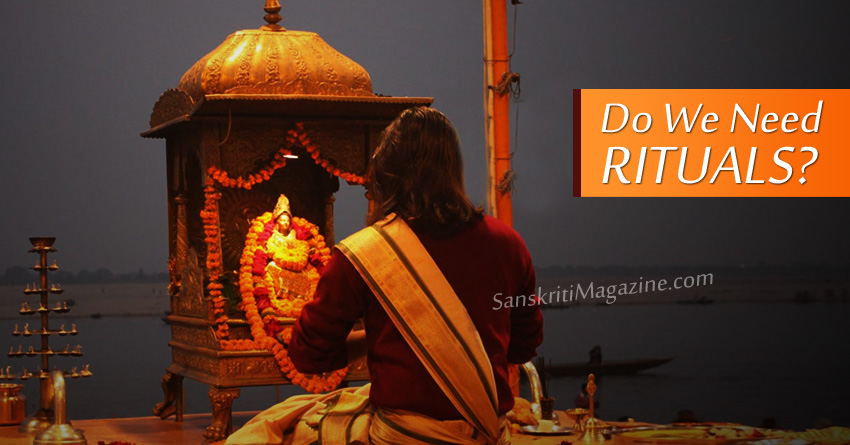
Some ask me whether religious functions, puja, etc, are not “mere” rituals. Atmic awareness is an inward experience. As for rituals they are outward actions. The question is how rituals will help in experiencing the Self.
Rituals are indeed not necessary for one who has realised the Self. But we must put the question to ourselves whether we have truly realised It, whether we are mature enough for realisation, whether we have become inwardly pure. Were we honest we would admit that we are far from having become mature for awareness of the Self.
By taking many births, by performing many works and by the vasana of previous lives, we have concealed the bliss of knowing the Self. By conducting good rites, and by associating ourselves with noble objects, we have to banish the evil habits sticking to us from our past lives. Then there will be an end to karma itself and we will embark on Atmic inquiry. Until then we have to perform what are called “mere” rituals.
The proper thing for ordinary people is to conduct all the rites mentioned in the sastras. The benefits obtained from them may be seen in practice. When a person takes care to go through the rites strictly in the manner prescribed in the canonical texts, he will gain one-pointedness of mind.
This should be of immense help to him in contemplating the Self later. And the desire to follow the sastras in all aspects of life will mean that he will be brought under a certain discipline. When we conduct rites according to the sastras our determination and will power will be strengthened. Since we subordinate our views to the injunctions of the scriptures, we will cultivate the qualities of humility and simplicity.
So what do we gain by performing “mere” rituals? We will acquire onepointedness of mind, discipline, non-attachment, will power, humility. On the whole it will help us to live a moral life. Without moral conduct there can never be Atmic inquiry and Atmic experience. Hindu Dharma The Buddha did not prescribe any Vedic rites. But he too laid stress on morality and discipline.
The Pancasila that Nehru often spoke about is of the utmost importance to the Buddhists. The Buddha points to the value of morality without the performance of Vedic rites. What about the Purvamimamsakas? They believe that Vedic rites are of the utmost importance and that is no need to worry about God. In our sanatana dharma, however, there is a weaving together of rites, the good conduct and discipline arising out of them, devotion to Isvara and finally knowledge of the Self.
Morality does not arise by itself. If you want milk you must keep a cow. If you keep a cow you will get not only milk but also cow dung. Then there will come up a haystack. When you keep the cow called karma you will not only derive not only morality and good conduct from it but also something that you feel is not wanted, that is cow dung. When you keep a cow must keep the place free from cow dung – that is a part of commonsense or wisdom.
It is in this manner that you must obtain the real benefits from religious rites. If rituals are not necessary for true Atmic knowledge, even the murti called Isvara is not necessary for the same. But we can dispense with rituals and Isvara only when we reach a high plane of knowledge. At first Isvara is very much necessary for our inward journey and there are so many reasons for it. I will tell you one.
We need an entity that exemplifies all that is good. Have we not for ages together thought of Isvara as such a one, one who represents all virtues and all auspicious qualities. When we mention the word “Isvara” we at once think of him as one without any evil. If anything or anyone combines beauty, compassion, power and enlightenment to the full it must be Isvara. It is a psychological principle that we become that which we keep thinking of.
By meditating on Isvara’s manifold auspicious qualities our own undesirable qualities will give place to good ones. There are many benefits that flow from rituals, puja, etc. One of them is that they help to make us good. They are also of value in taking us to the path of workless yoga and the inward quest.